
Search Knowledge Base by Keyword
Top 10 Winners of the altFINS API Challenge 2026: The Best Crypto Apps Built on altFINS API, MCP & CLI
Last updated: June, 2026
Every great trading tool starts with great data. That is the idea behind the altFINS API Challenge, an open call for developers, quants, and indie builders to create real, working products on top of the altFINS Analytics Data API, the altFINS MCP server, and the altFINS CLI.
The brief was simple: take altFINS’ live market data, technical indicators, candlestick and chart pattern signals, and fundamental scores, and turn them into something a real trader would actually use. We received submissions ranging from backtesting engines to AI-narrated dashboards, and the judging panel scored every entry on three criteria: technical execution, creativity of the use case, and practical value to traders.
Below are the ten winning projects, how each one was built, and why the altFINS team picked them. The order of the projects listed below is random and does not reflect the quality, ranking, or merit of any individual submission.
Quick summary: top 10 winning projects
| Project | Category | altFINS Tooling Used |
| Backtester.io | Strategy backtesting | API + CLI |
| BTC Live Signal Dashboard | Real-time price & signal feed | API + MCP |
| Candlestick Patterns Explorer | Education & pattern scanning | API + MCP |
| Crypto Signal Dashboard | Multi-coin screener UI | API + CLI |
| CryptoNarrative — Sector Rotation Dashboard | Macro / sector rotation analytics | API + MCP |
| AI Crypto Trading Workflow | AI Trading | MCP |
| 24/7 Pump Detector | Pump/Momentum finder | API |
| Discord Trade Alert Bot | Signals streaming | API |
| Browser Extension Market Overlay | Indicator extension | API |
| Scan for Assets Hitting RSI Extremes | RSI scanner | MCP |
1. Backtester.io — Strategy Backtesting Engine
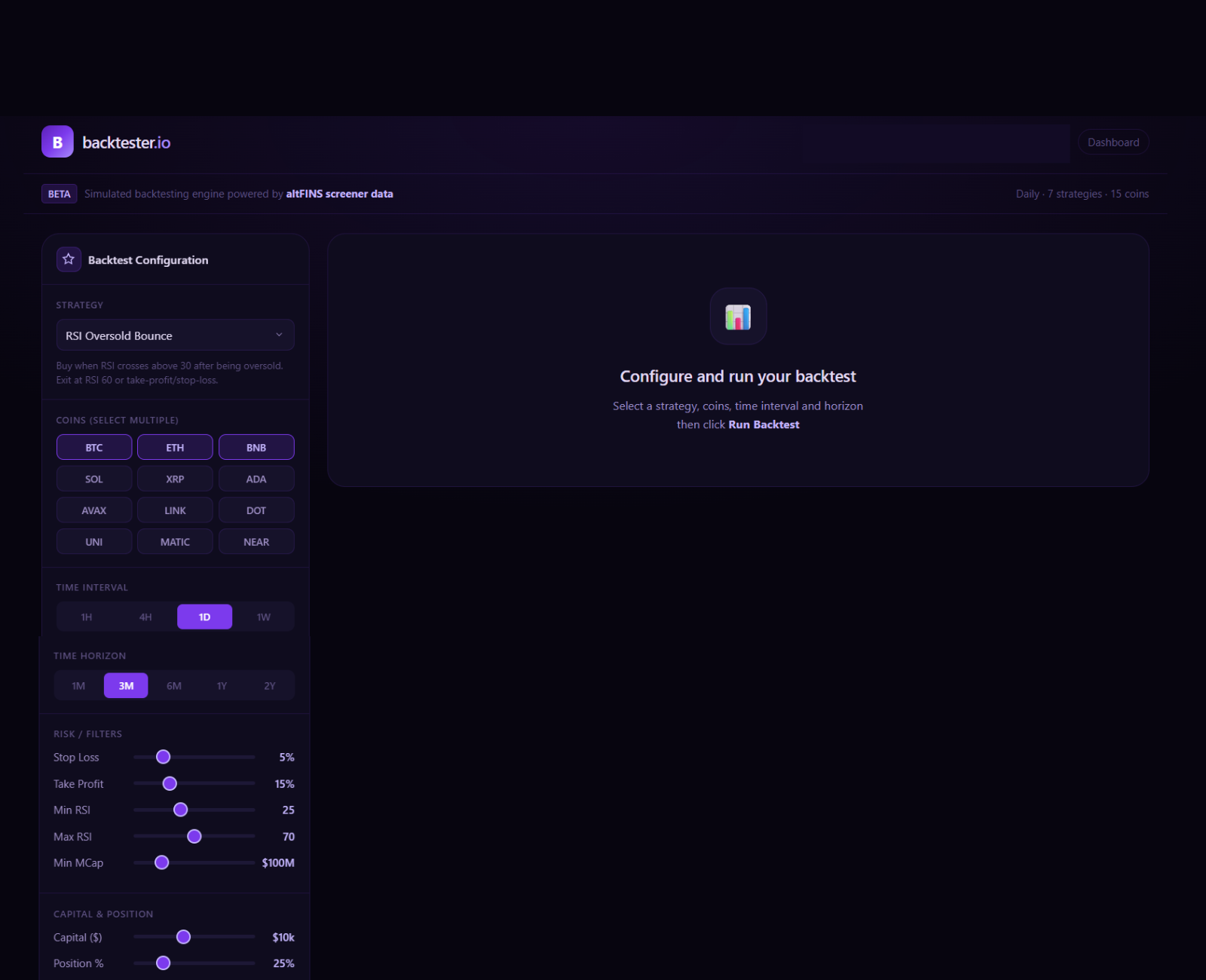
What it is: Backtester.io is a browser-based backtesting platform that lets a trader pick a coin, an interval, and a strategy template, such as RSI mean-reversion, MACD crossover, candlestick pattern entries, or Bollinger Band breakouts, then instantly see how that strategy would have performed historically. The output includes an equity curve, a monthly returns heatmap, win rate, max drawdown, and a full trade-by-trade log.
How they used the altFINS API, MCP & CLI: The team pulled historical OHLCV candles and pre-computed technical indicators (RSI, MACD, Bollinger Bands) directly from the altFINS Crypto Market & Analytical Data API, removing the need to calculate indicators client-side. The altFINS CLI was used during development to script bulk historical pulls across dozens of coins and intervals in a single command, which sped up testing considerably.
The goal: Give retail traders an institutional-style backtesting workflow without needing to write a single line of indicator math, and without paying for a dedicated quant platform.
Why we liked it: Backtesting is one of the most requested, least accessible features in retail crypto trading. Most traders either skip it entirely or rely on rough TradingView replay sessions. Backtester.io turned altFINS’ indicator data into a genuinely useful decision-support tool, and it is the kind of use case described in our own Real-World Use Cases of the altFINS API guide. It also proves out a strategy before it ever reaches live capital, which is exactly the discipline we want to see more of in the space.
2. BTC Live Signal Dashboard
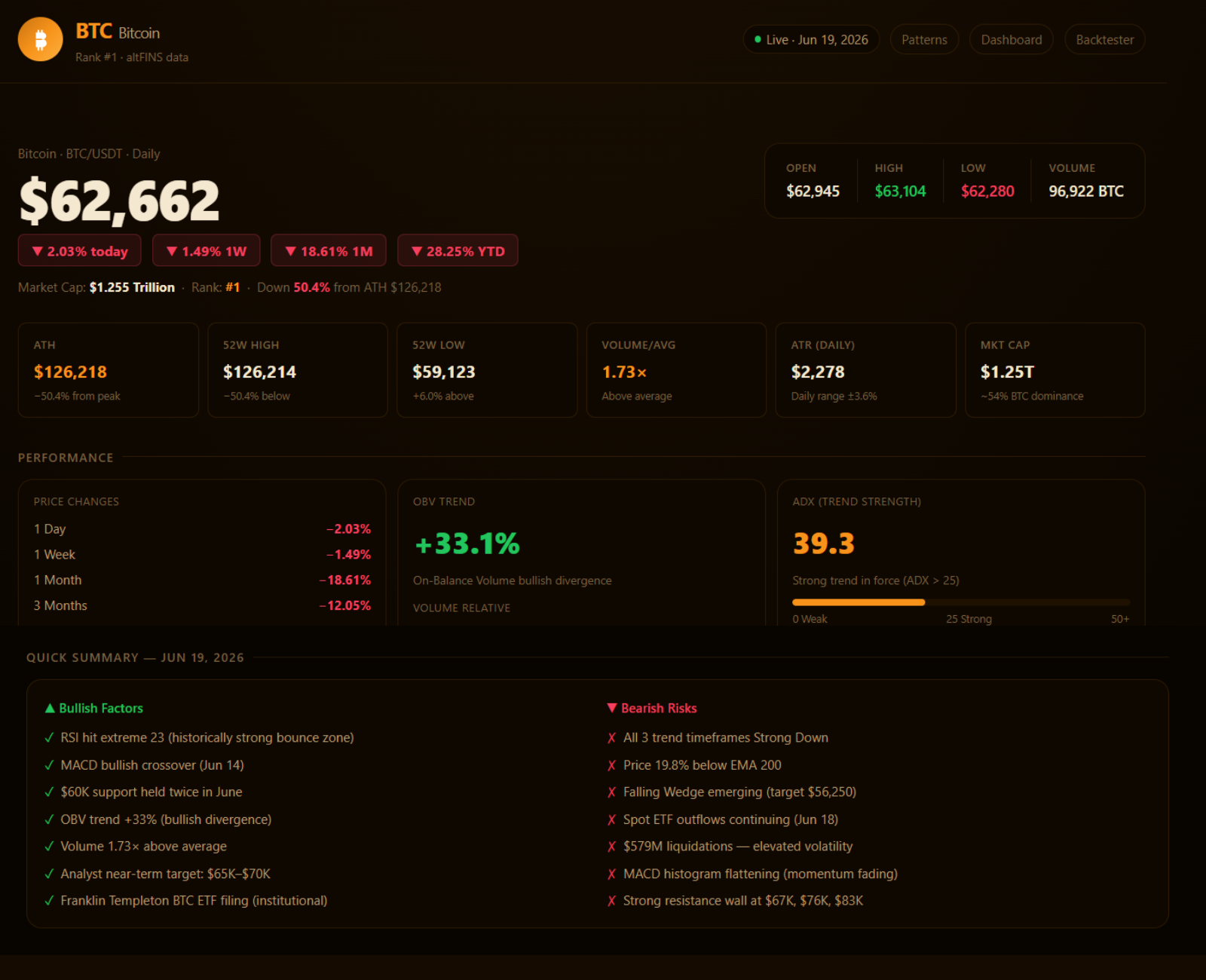
What it is: A single-page, always-on Bitcoin dashboard showing live price, RSI, MACD crossover status, support and resistance levels, an emerging chart pattern callout, and a short plain-English market read, all refreshed continuously rather than on a manual reload.
How they used the altFINS API, MCP & CLI: Live price and indicator values were pulled from the altFINS API on a polling interval. The standout part of the build was connecting the altFINS MCP server to an AI assistant to auto-generate the plain-language commentary block (“RSI oversold, MACD bullish cross, watch the $59K–$67K range”) every time the underlying data changed, instead of hardcoding static text.
The goal: Make a single glanceable screen that answers the question every trader asks first thing in the morning: “what is Bitcoin doing right now, and why?”
Why we liked it: This entry is a clean demonstration of pairing structured market data with an MCP-connected AI layer to translate numbers into narrative, the exact workflow we outline in 8 AI-Powered Trade Strategy Prompts Using altFINS MCP. It is lightweight, fast to load, and exactly the type of always-on situational awareness tool that turns raw data into a habit traders will check daily.
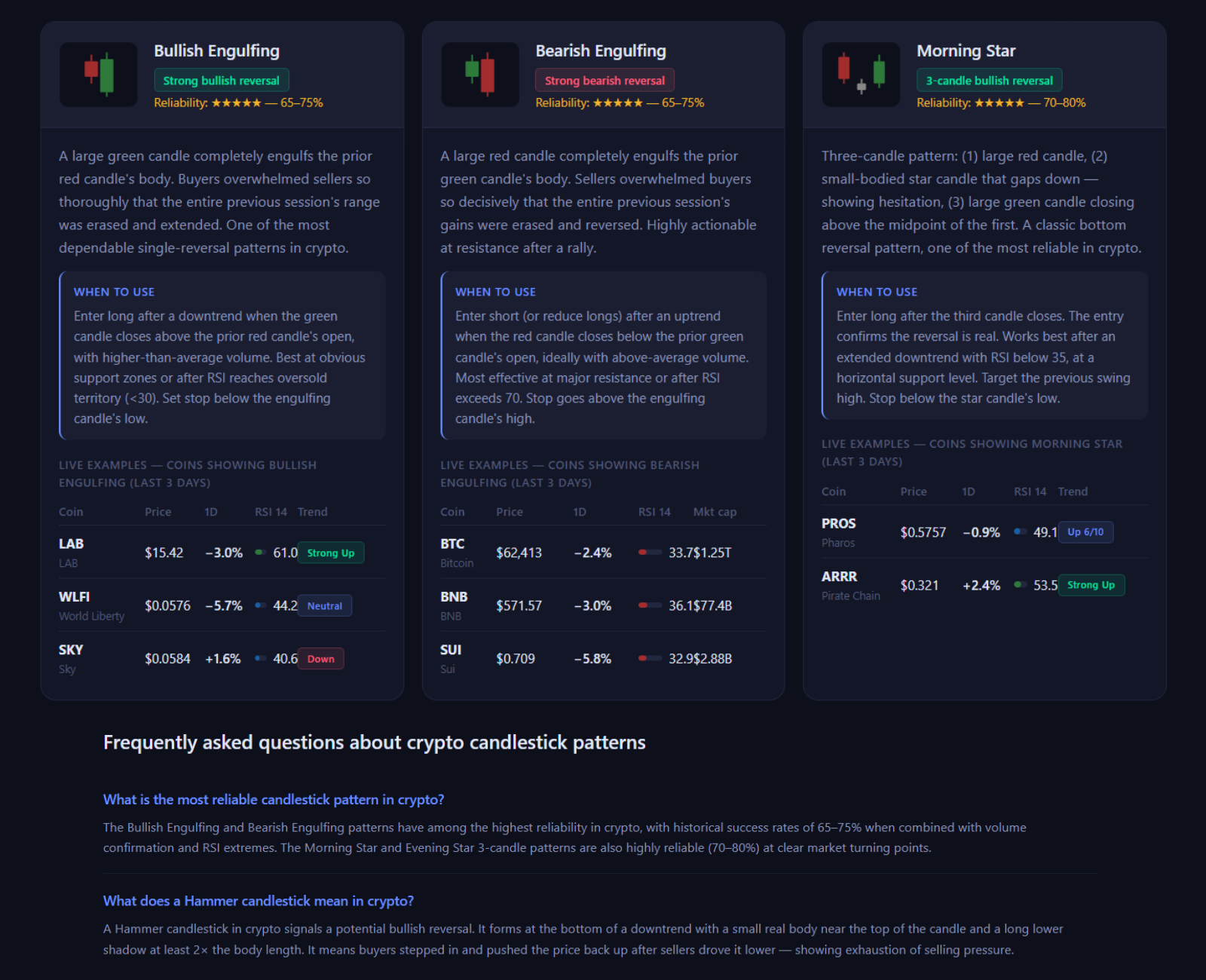
3. Candlestick Patterns Explorer
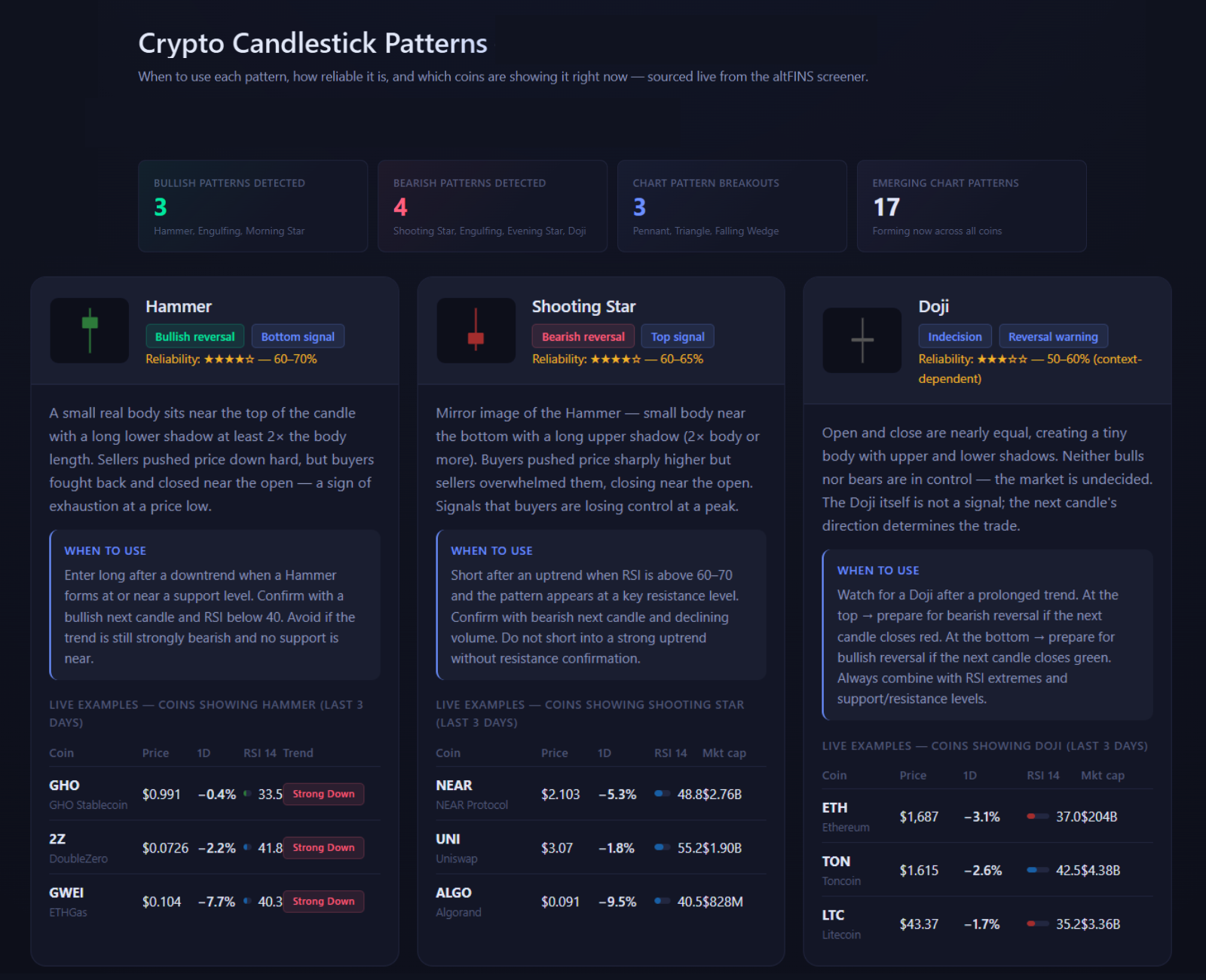
What it is: An educational reference site covering the major candlestick patterns (Hammer, Doji, Engulfing, Morning Star, Shooting Star, and more), where every pattern entry is illustrated with a real, currently-forming example pulled from the live market instead of a generic textbook diagram.
How they used the altFINS API: The build queries the altFINS API’s candlestick pattern detection fields across the full coin universe, then matches each detected pattern to its corresponding educational entry in real time, so the examples on the page are never stale or recycled.
The goal: Solve the “I memorized the shape but I’ve never seen it in the wild” problem that almost every new trader runs into when learning technical analysis.
Why we liked it: Education content normally goes stale within weeks. By wiring live pattern detection into the page, this project stays evergreen and current automatically, mirroring the live-example approach we use in our own candlestick pattern guides. It is a strong example of using the API for content and onboarding, not just for trade execution.
4. Crypto Signal Dashboard
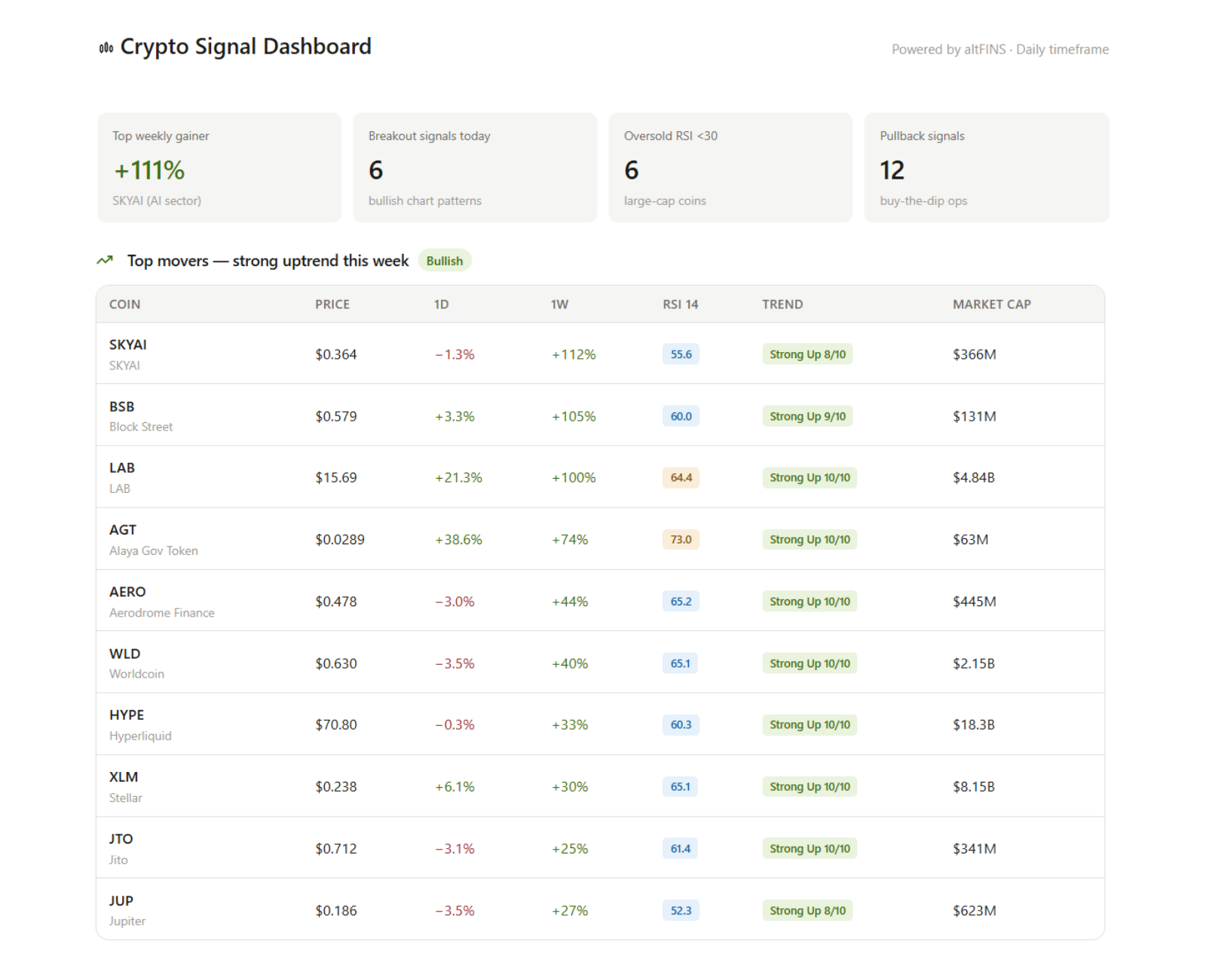
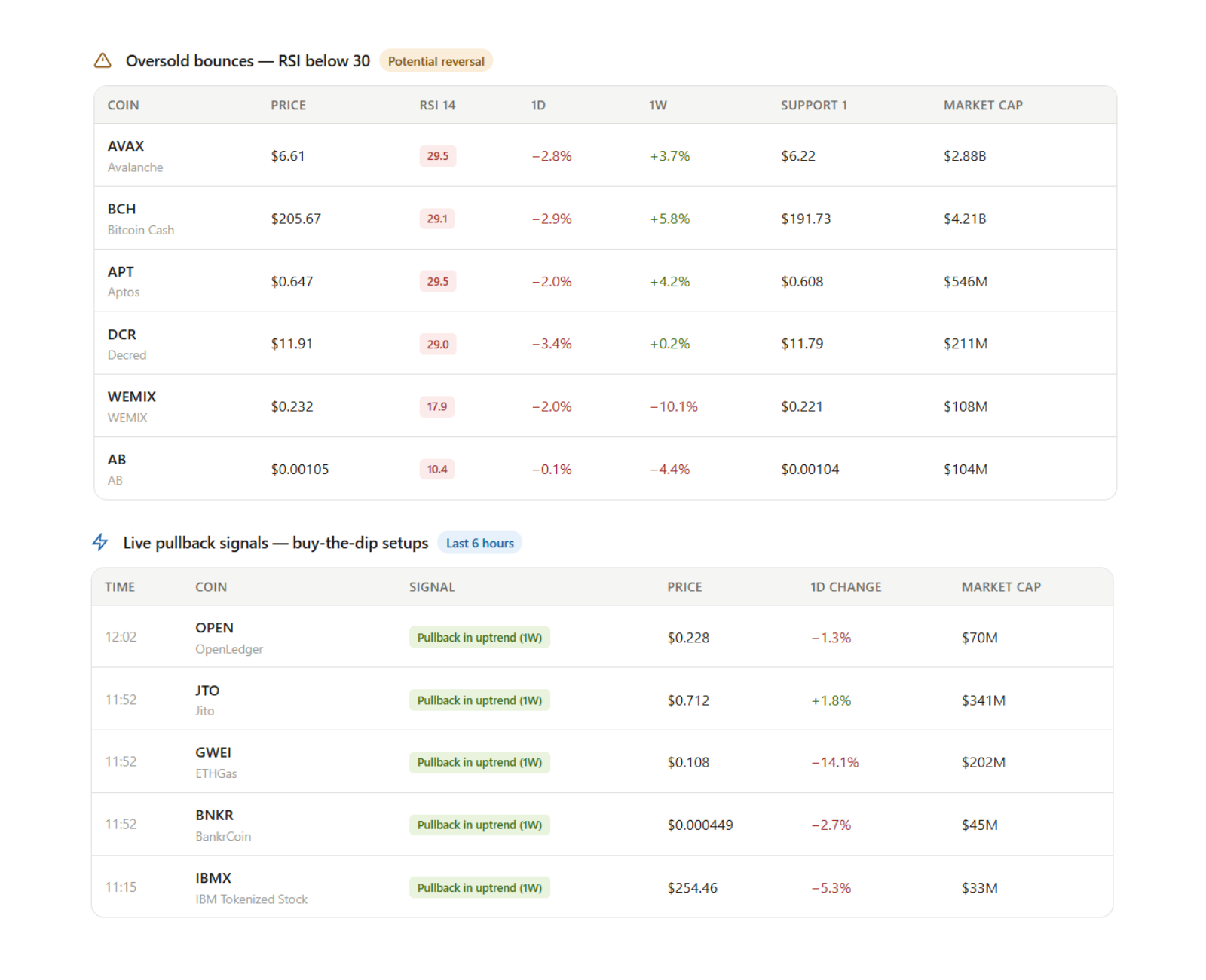
What it is: A clean, screener-style dashboard that surfaces coins matching specific technical signal combinations (oscillator extremes, trend strength, volume anomalies) with color-coded pills for trend direction, momentum, and signal type, built with both light and dark themes.
How they used the altFINS API & CLI: Signal and oscillator fields were pulled from the altFINS API’s screener endpoints, while the CLI was used to validate field names and test filter combinations locally before wiring them into the front end, cutting development time on the data layer significantly.
The goal: Build a faster, more visual alternative to scrolling a spreadsheet-style screener, designed for traders who want to scan the market in seconds, not minutes.
Why we liked it: Strong UI execution on top of raw signal data, and a genuinely useful daily-driver tool. It echoes the philosophy behind altFINS’ own Crypto Trading Signals system: surface the signal, not the noise, and let the trader act on it immediately.
5. CryptoNarrative — Sector Rotation Dashboard
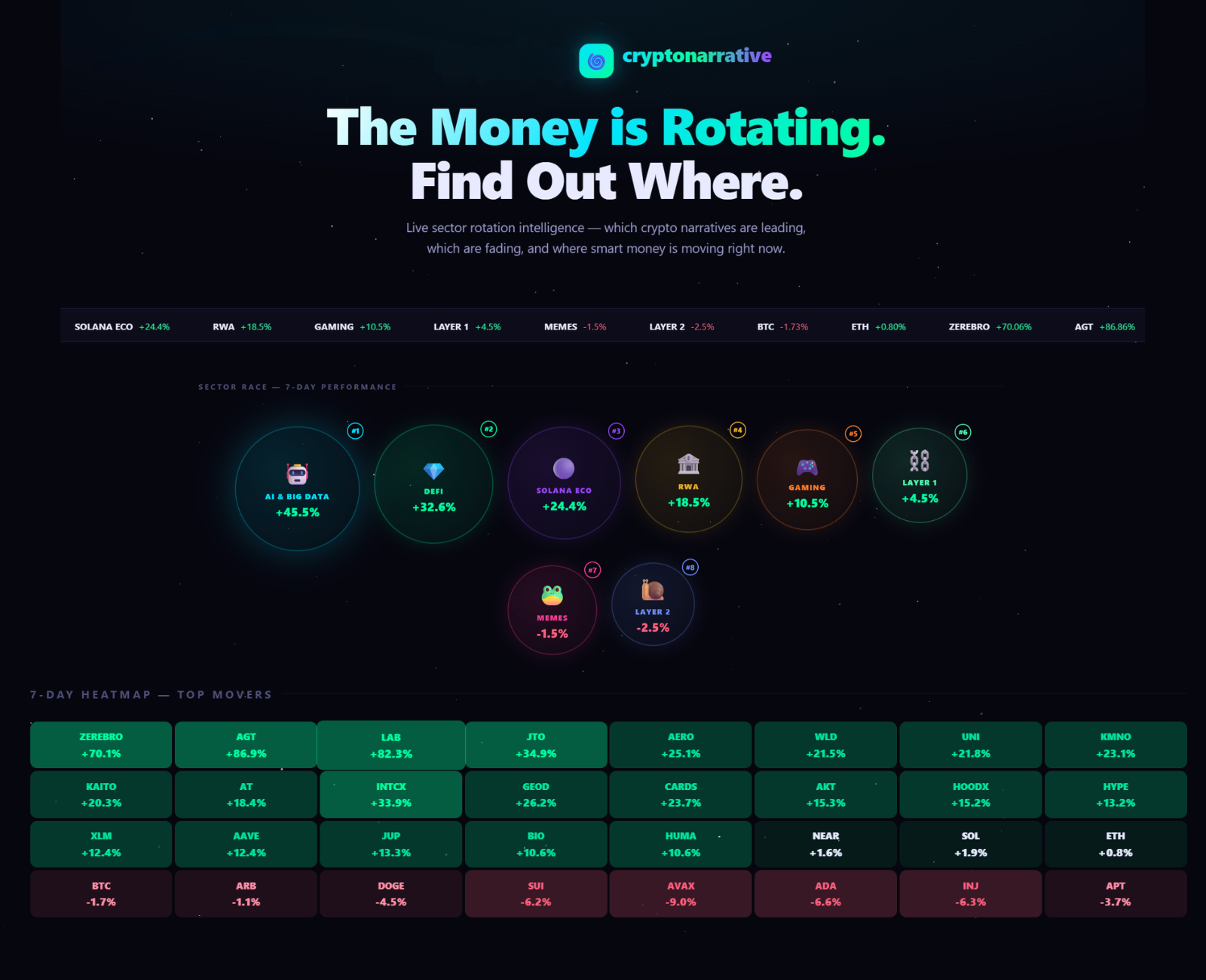
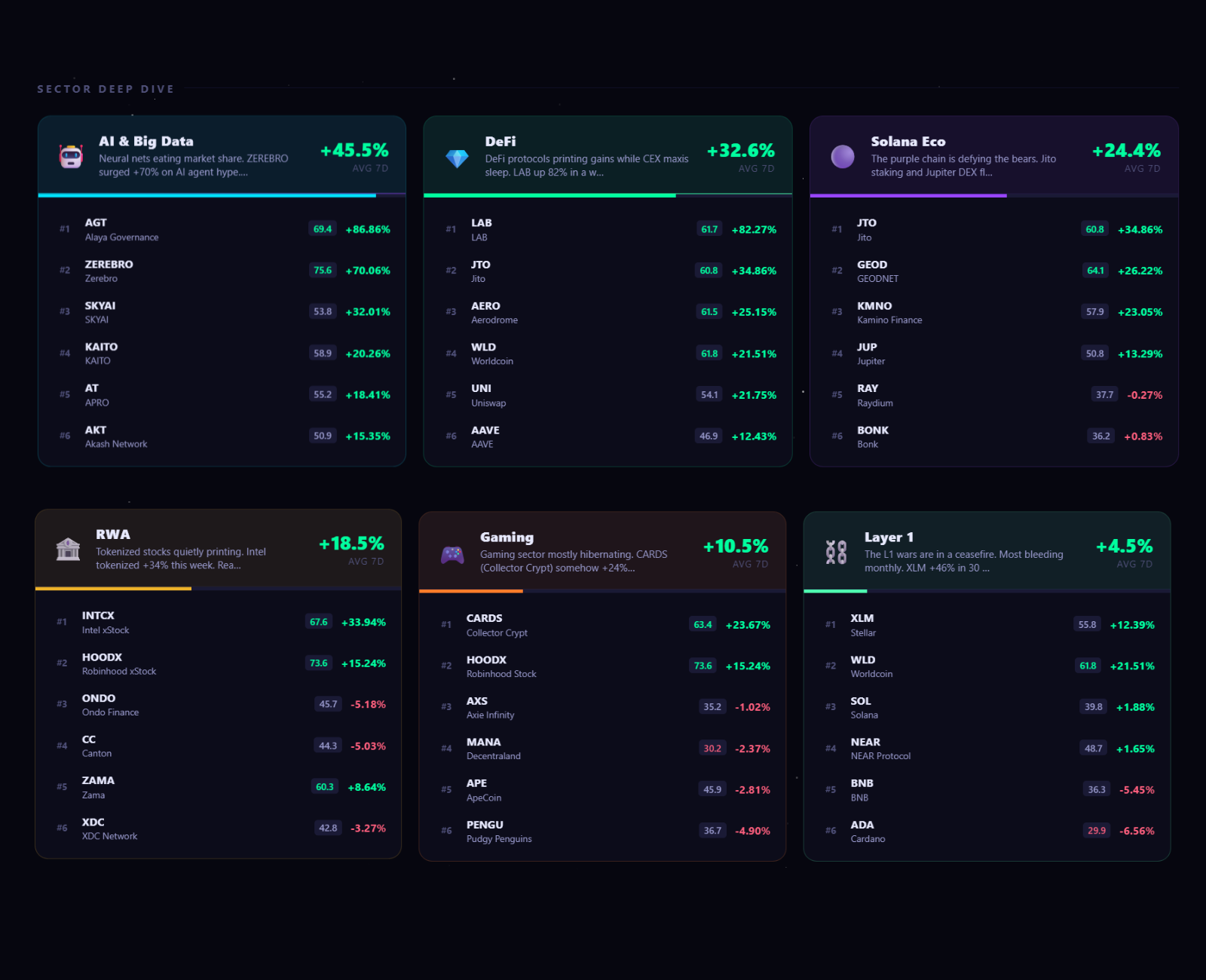
What it is: A macro-level dashboard that tracks how capital rotates between crypto sectors, AI tokens, DeFi, Solana ecosystem, memecoins, real-world assets (RWA), gaming, and Layer-1 / Layer-2 chains, visualizing which narrative is heating up and which is cooling off.
How they used the altFINS API & MCP: Category and fundamental classification data from the altFINS API powered the sector groupings and flow calculations, while the MCP server was used to generate the short narrative summaries (“AI tokens are outperforming the broader market by X% this week”) that accompany each sector module.
The goal: Give traders a top-down, sector-rotation view of the market instead of a coin-by-coin view, the same lens professional allocators use in equities, applied to crypto.
Why we liked it: Most retail tools stop at the individual coin. This project zoomed out to the sector level, a genuinely underserved use case, and combined it with AI-generated narrative through MCP. It is a strong real-world example of the workflows covered in our Complete Guide to altFINS MCP Crypto Trading Prompts.
6. AI Crypto Trading Workflow with Claude AI + altFINS + Binance MCP
What it is: A fully connected AI-powered trading workflow that chains three tools into a single, conversational pipeline. Claude AI acts as the intelligent “brain” that interprets natural language commands and coordinates actions across tools. altFINS provides the market data, screening results, and pre-computed trading signals. Binance MCP connects directly to Binance to execute market and limit orders, stop-losses, and take-profit levels — all triggered by a single prompt from the trader. Together, the three layers replace manual charting, screener-scrolling, and order-entry with one coherent workflow that runs from signal to execution without switching platforms.
How they used the altFINS MCP: The altFINS MCP server was the data and signals layer that Claude queried at each decision point — pulling screener results, RSI and MACD readings, pattern detections, and fundamental scores directly into the AI’s reasoning context. Rather than hardcoding any indicator logic, Claude interpreted live altFINS data and translated it into structured trade instructions that Binance MCP then executed on the exchange, creating a fully automated loop from signal to order with no manual step in between.
The goal: Replace the manual research-then-chart-then-click workflow with a single natural language instruction — such as “find oversold large-caps with a bullish MACD cross and open a position with a 2% stop” — that researches, analyses, and executes in seconds, with consistent risk management applied every single time.
Why we liked it: This is the most end-to-end submission in the challenge. It demonstrates exactly the multi-tool MCP chaining pattern we describe in How to Connect altFINS MCP to Claude Desktop and 8 AI-Powered Trade Strategy Prompts Using altFINS MCP, taken all the way through to live order execution. The key architectural insight is that altFINS handles the hardest part — clean, pre-computed signal data — so the AI agent never has to guess about indicator values or data quality. The result is faster decision-making, automated trade workflows, built-in risk management, and more consistent execution discipline.
7. 24/7 Pump Detector with altFINS API and n8n
What it is: A low-cost, always-on automated momentum and pump-detection system built without any paid AI subscription. The workflow uses altFINS as the signal provider, n8n as the workflow automation engine, Telegram as the real-time alert delivery channel, and Altrady as the optional trade execution layer. The system polls altFINS continuously for pre-calculated momentum and volume anomaly signals, filters them against configurable thresholds, and fires a Telegram notification the moment a qualifying coin is detected — 24 hours a day, seven days a week, with no manual monitoring required.
How they used the altFINS API: The altFINS API served as the signal provider throughout, delivering pre-calculated technical indicators — volume spikes, RSI momentum shifts, and trend acceleration readings — directly into the n8n workflow on a regular polling interval. Because altFINS computes all indicators server-side, the n8n automation only needed to filter and route the output rather than run any indicator math itself, keeping the workflow lightweight, fast, and reliable. No Claude Pro, no paid AI model, and no custom indicator code were required at any stage of the build.
The goal: Build a professional-grade, round-the-clock pump and momentum detector at near-zero ongoing cost — accessible to solo traders and small communities who want automated signal delivery without committing to expensive AI subscriptions or dedicated quant platforms.
Why we liked it: This entry proved that powerful automation does not require a large budget or a complex tech stack. The builder made a smart architectural decision: outsource the heavy computational work to altFINS, keep the automation layer (n8n) simple and cheap, and deliver the output where traders already live — Telegram. It is a textbook demonstration of the approach outlined in our Real-World Use Cases of the altFINS API guide, and a strong proof point that the altFINS data layer makes professional-grade signal infrastructure accessible to builders at every level, not just those with quant team budgets.
8. Discord Trade Alert Bot
What it is: A Discord-native companion bot designed for trading communities and server admins, streaming live altFINS breakout alerts, oversold signals, and volume-anomaly detections directly into designated server channels. The bot supports role-based access control, so community owners can gate premium signal tiers — high-conviction breakouts, multi-timeframe confluences, or pattern-based entries — behind subscriber or paid roles, while keeping a free tier of general alerts open to all members. Every alert arrives as a formatted Discord embed with coin name, signal type, timeframe, and a direct link to the relevant chart.
How they used the altFINS API: The bot subscribed to altFINS screener and signal endpoints on a continuous polling loop, parsing breakout, oscillator-extreme, and volume-anomaly fields and formatting them into Discord embeds in real time. The role-gating logic was built directly on top of the signal-tier data returned by the API, mapping signal confidence levels to Discord role permissions without any additional external data source or manual curation step.
The goal: Turn an existing Discord trading community into an active, signal-driven hub — giving members a reason to stay engaged and giving admins a clear path to a monetisable premium tier — without requiring anyone to leave Discord and check a separate platform.
Why we liked it: Community tooling is one of the highest-leverage applications of the altFINS API because it multiplies the reach of every signal. A single well-formatted alert in an active Discord server can prompt dozens of traders to act on the same setup at the same time. This build also demonstrates a clean monetisation path on top of the altFINS data layer, pairing tiered signal delivery with the signal quality described in our Crypto Trading Signals overview — and it is the kind of community infrastructure that keeps a server alive long after the initial hype fades.
9. Browser Extension Market Overlay
What it is: A lightweight browser extension that overlays live altFINS price, RSI, and trend data directly on top of any webpage the trader is currently reading — news articles, research threads, social media posts, or project documentation — without requiring a tab switch. A small persistent widget anchors to the corner of the screen and updates in real time whenever the trader searches or selects a coin ticker, delivering the current price, RSI reading, trend direction, and any active chart pattern signal as an ambient layer on top of whatever content is already open.
How they used the altFINS API: The extension called the altFINS Analytics Data API on demand each time the trader typed or selected a coin ticker, fetching the latest price, RSI value, trend direction, and any active pattern signal. The API’s clean, pre-computed JSON responses made it straightforward to parse and render the overlay widget in real time with minimal latency — and because altFINS handles all indicator computation server-side, the extension required no client-side calculation logic and stayed exceptionally lean.
The goal: Eliminate the constant tab-switching that breaks a trader’s reading flow — keep market awareness persistent and ambient rather than requiring a deliberate interruption to check a chart or screener.
Why we liked it: This is the most UX-forward submission in the challenge. The core insight — that market data should come to the trader rather than the trader going to it — is a genuinely different approach to how altFINS data gets consumed. It also proves how thin and fast an altFINS API integration can be when the data layer is already clean and pre-computed, echoing the accessibility principles behind our altFINS CLI tooling. As an idea, it is one of the most replicable in the challenge — any developer with browser extension experience could ship a working version in a weekend.
10. Scanner for RSI Extremes
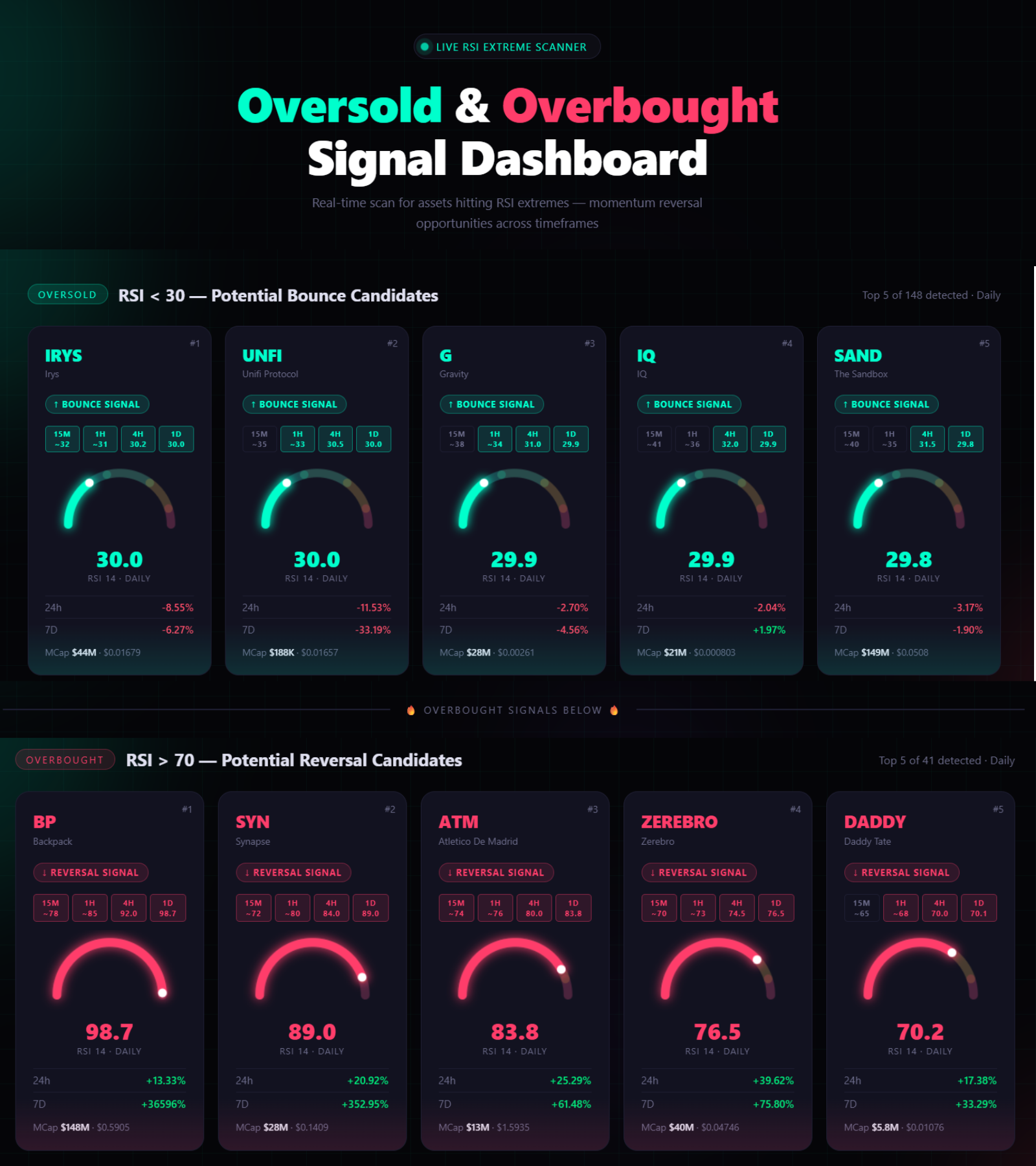
What it is: A live “Oversold & Overbought Signal Dashboard” that continuously scans the full altFINS coin universe and surfaces assets hitting RSI extremes across multiple timeframes. Coins below RSI 30 are grouped under Potential Bounce Candidates and coins above RSI 70 under Potential Reversal Candidates, each displayed as a colour-coded card showing the ticker, project name, an animated gauge dial, the RSI 14 value, multi-timeframe RSI readings across 15M, 1H, 4H, and 1D, plus 24h and 7D price performance and market cap — all on a clean, dark-themed dashboard with a live status indicator at the top.
How they used the altFINS MCP: The scanner was built entirely through the altFINS MCP server, using MCP tool calls to query RSI values across the coin universe and filter for extreme readings without writing a single line of direct API integration code. The MCP layer handled data fetching, field selection, and multi-timeframe RSI retrieval, making the build fast to prototype and easy to iterate — and the fully self-contained HTML front end confirms the entire project can be deployed with no additional back-end infrastructure.
The goal: Give contrarian and mean-reversion traders a dedicated, always-refreshed list of the most statistically stretched assets in the market — the coins most likely to snap back — without manually scrolling a screener or setting individual price alerts coin by coin.
Why we liked it: The execution speaks for itself. On June 19, 2026 the scanner detected 148 oversold coins and 41 overbought coins on the Daily RSI14 timeframe alone — a live, actionable shortlist delivered instantly. The multi-timeframe RSI breakdown per card (15M through 1D) is a particularly sharp UX decision: it lets the trader confirm whether the extreme reading is isolated to one timeframe or persistent across all of them before committing to a position. It also shows how much can be built through MCP alone, making it a compelling entry point for developers who want to prototype quickly before committing to a full altFINS API integration.
Why This Challenge Matters
The altFINS API Challenge was never just a contest. It is a live demonstration of what becomes possible once raw market data, technical signals, fundamental scores, and AI tooling are made accessible through a single API, MCP server, and CLI. Every project above started from the same base layer, the altFINS Data API, and shipped a completely different product on top of it: a backtester, a dashboard, an education tool, a screener, an automated agent, and a discord bot.
That range is the point. If you have an idea for a trading tool, a bot, or an AI agent, the data layer already exists. Start with How to Create an altFINS API Key, then explore the altFINS MCP Server documentation and the altFINS CLI documentation to see which integration path fits your project.
Ready to build your own use case?
Get your API key, connect the MCP server, or start scripting with the CLI today.
This roundup reflects submissions and entries received as part of the altFINS API Challenge. Project names and descriptions are based on the builds as submitted. altFINS does not provide financial advice; always do your own research before trading.