
Search Knowledge Base by Keyword
Prediction Markets Explained: The Complete 2026 Guide for Crypto Traders
What prediction markets are, how they work, why volumes exploded to $44+ billion per month, and how crypto traders can use them. Updated July 2026.
⚡ Quick Answer
A prediction market is an exchange where people trade contracts tied to the outcome of real world events, such as elections, sports results, Fed decisions, or the price of Bitcoin. Each contract pays $1 if the event happens and $0 if it does not, so the live price (for example $0.68) works as a real time probability estimate (68%). The two largest platforms, Polymarket and Kalshi, processed a combined $44.8 billion in trading volume in June 2026 alone.
Prediction Markets in Numbers (2026)
| $44.8B Monthly volume, June 2026 |
$150B+ Lifetime combined volume |
$22B Kalshi valuation (2026) |
840K Monthly active wallets |
Sources: The Block, TRM Labs, Pew Research Center, NYT. Data as of July 2026.
Three years ago, prediction markets were a niche corner of crypto. Today they are one of the fastest growing asset classes in finance. The New York Stock Exchange’s parent company invested up to $2 billion in Polymarket, Kalshi raised at a $22 billion valuation, Google Finance embeds live market odds, and mainstream media quote prediction market prices alongside traditional polls.
For crypto traders, this matters more than for anyone else. Prediction markets were built on crypto rails, they price crypto events directly (ETF approvals, price targets, regulation), and they offer a new way to trade conviction that does not depend on charts alone. This guide covers everything: how they work, why they became so popular, the best platforms compared, pros and cons, and how to combine them with the analytics you already use on altFINS.
📋 In this guide:
1. What is a prediction market?
2. How prediction markets work (step by step)
3. Why prediction markets are so popular in 2026
4. Prediction markets vs sports betting vs options
5. Best prediction market platforms compared
6. Polymarket vs Kalshi head to head
7. Pros and cons
8. How crypto traders use prediction markets
9. Risks and regulation
10. FAQ
What Is a Prediction Market?
A prediction market (also called an event contract exchange) is a peer to peer marketplace where traders buy and sell contracts on the outcome of future events. Every market asks a binary question: Will the Fed cut rates in September? Will Bitcoin close above $150,000 this year? Will Spain win the World Cup?
Each YES or NO contract settles at $1 if the outcome occurs and $0 if it does not. Prices float between $0.01 and $0.99 based on supply and demand, which means the price itself is a live, crowd sourced probability. If YES trades at $0.30, the market collectively believes there is roughly a 30% chance the event happens.
The concept is not new. University of Iowa researchers launched the Iowa Electronic Markets for election forecasting back in 1988, and platforms like Intrade drew attention in the 2000s before regulators shut them down. What changed is infrastructure and legality: Polymarket launched in 2020 on crypto rails (Polygon, settled in USDC), Kalshi became the first federally regulated US event exchange in 2021, and a landmark 2024 court ruling allowed regulated election contracts in the US. From there, growth went vertical.
How Prediction Markets Work: Step by Step
🔄 How a Prediction Market Works
| 1 | A question is listed. “Will Bitcoin trade above $150,000 on December 31, 2026?” The market has clear resolution rules and a trusted data source. |
| 2 | Traders buy YES or NO shares. Prices move between $0.01 and $0.99. You trade against other participants on an order book, not against the house. |
| 3 | Price = live probability. YES at $0.42 means the crowd prices a 42% chance. News, data and money flow move the odds in real time, 24/7. |
| 4 | Trade or hold to resolution. You can sell any time before the event to lock in profit or cut losses, exactly like exiting a spot position. |
| 5 | The market settles. Correct contracts pay $1.00 each, incorrect contracts expire at $0.00. Payouts are automatic. |
💡 Worked Example: A Bitcoin Market
The market “Will BTC close above $150K in 2026?” trades at YES = $0.35. You believe the real probability is closer to 55% based on your technical and on chain analysis, so YES looks undervalued.
| You buy | 1,000 YES shares × $0.35 = $350 |
| If BTC closes above $150K | Payout $1,000, profit +$650 (+186%) |
| If it does not | Contracts expire worthless, loss −$350 (capped) |
| Exit early option | If YES rallies to $0.60 mid year, you can sell for +71% without waiting for resolution |
Key feature: your maximum loss is always known upfront. There are no liquidations, no margin calls and no funding fees, unlike perpetual futures.
Why Are Prediction Markets So Popular in 2026?
The growth curve is remarkable even by crypto standards. Pew Research tracked combined monthly volume rising from under $5 billion in September 2025 to about $24 billion by April 2026, and The Block reported a new record of $44.8 billion in June 2026 as the FIFA World Cup drove a 75% monthly surge. Six main forces explain the boom:
1. Regulation flipped from enemy to tailwind. The October 2024 US court ruling on election contracts, CFTC approval of Kalshi as a Designated Contract Market, a CFTC no action letter for Polymarket in January 2026, and the launch of the regulated Polymarket US exchange in December 2025 turned a legal gray zone into a supervised industry.
2. Proven accuracy. Prediction markets priced the 2024 US election more accurately than most polls, and industry wide Brier scores (a standard forecast accuracy measure) sit near 0.09, which is excellent. Money concentrates where information is honest.
3. Institutional money arrived. ICE, the parent of the NYSE, invested up to $2 billion in Polymarket at an $8 billion valuation. Kalshi raised $1 billion led by Coatue at a $22 billion valuation, with institutional volume up roughly 800% in six months and annualized revenue above $1.5 billion.
4. A distribution flywheel. Robinhood integrated Kalshi markets for its 27+ million funded accounts, Google Finance embeds live odds, and news outlets quote market prices daily. Every citation sends new users back to the platforms.
5. Sports and the 2026 World Cup. Sports now dominate volume (around 80% of Kalshi’s flow historically), and the World Cup alone pushed Kalshi to $31.5 billion in June. Polymarket’s single World Cup Winner market has crossed $2 billion in lifetime volume.
6. Crypto rails made it global. USDC settlement, on chain transparency, 24/7 markets and near instant withdrawals let anyone with a wallet participate. Monthly unique wallets nearly tripled in six months to about 840,000 by February 2026, per TRM Labs.
Prediction Markets vs Sports Betting vs Options
The most common misconception is that prediction markets are just betting with extra steps. Structurally they are closer to an exchange traded derivative:
| Feature | Prediction Markets | Sportsbooks | Options |
| Who sets the price | Traders (peer to peer order book) | The house sets odds with a margin | Market makers and traders |
| Exit before the event | Yes, sell any time | Rarely (limited cash out) | Yes |
| Topics covered | Sports, politics, crypto, macro, culture, weather | Sports only | Financial assets only |
| Max loss | Capped at stake, no liquidations | Capped at stake | Capped for buyers, unlimited for sellers |
| US regulation | Federal (CFTC) | State by state gambling laws | Federal (SEC / CFTC) |
| Typical cost | 0% to ~1.8% taker fee | 4% to 8% built into odds (vig) | Spread + commissions |
Best Prediction Market Platforms in 2026 Compared
Two platforms control roughly 90% of the market, but the wider ecosystem is worth knowing:
| Platform | Type | Strengths | Fees (peak) | Best for |
| Polymarket | Crypto native (Polygon, USDC) | Largest global market, deep politics / geopolitics / crypto coverage, on chain transparency | 0% geopolitics, 0.75% sports, up to 1.8% crypto | Crypto traders, global users |
| Kalshi | CFTC regulated US exchange | Highest total volume, broadest category list, Robinhood integration, USD deposits | ~1.75¢ per contract at 50¢ | US traders wanting full regulation |
| Polymarket US | CFTC regulated (launched Dec 2025) | Polymarket experience with USD, debit card and ACH funding, maker rebates | 0.30% taker / 0.20% maker rebate | US users without crypto wallets |
| Limitless | On chain (Base) | Fast growing crypto price markets, short duration contracts | Varies | DeFi natives, short term crypto bets |
| PredictIt | Academic, US | Long track record in political markets | 10% on profits | Politics hobbyists |
| Metaculus / Manifold | Play money / forecasting | Practice forecasting with zero financial risk | Free | Beginners learning the mechanics |
Polymarket vs Kalshi: Head to Head
Volume and liquidity. Kalshi now leads on total volume ($31.5B vs $10.26B for Polymarket International in June 2026), driven mostly by sports. Polymarket leads on user count (roughly 8x more unique users in April 2026) and dominates politics, geopolitics and crypto markets, where its liquidity is far deeper.
Access. Kalshi is USD based with simple onboarding for US users, though several states currently restrict it. Polymarket’s global platform runs on USDC and a crypto wallet, which is exactly why crypto traders tend to feel at home there. Polymarket US bridges the gap with regulated USD access.
Fees. Both moved to probability weighted fees in 2026 that peak near 50/50 markets. Polymarket keeps geopolitics markets completely fee free, while Kalshi’s structure is easier to read at a glance. Neither charges deposit fees on standard rails.
Verdict. Crypto natives and global users: Polymarket. US traders who want a brokerage feel and the widest sports coverage: Kalshi. Many active traders use both and arbitrage price gaps between them.
Prediction Markets: Pros and Cons
|
✅ Pros • Defined risk: max loss known upfront, no liquidations |
❌ Cons • Binary outcomes: wrong means losing 100% of the stake |
How Crypto Traders Can Use Prediction Markets
1. Trade crypto events directly. Markets on Bitcoin price levels, ETF approvals, protocol upgrades and regulation let you express a thesis with capped risk instead of leveraged perps. Crypto markets alone did over $2 billion on Kalshi in May 2026.
2. Use odds as a sentiment indicator. A market pricing “BTC above $150K” at 35% is a cleaner read of positioning than social media. When your own analysis disagrees strongly with the crowd, that gap is the trade.
3. Hedge event risk. Holding a large altcoin bag into an FOMC decision or an ETF ruling? Buying NO on the bullish outcome partially insures your portfolio for a known, fixed cost.
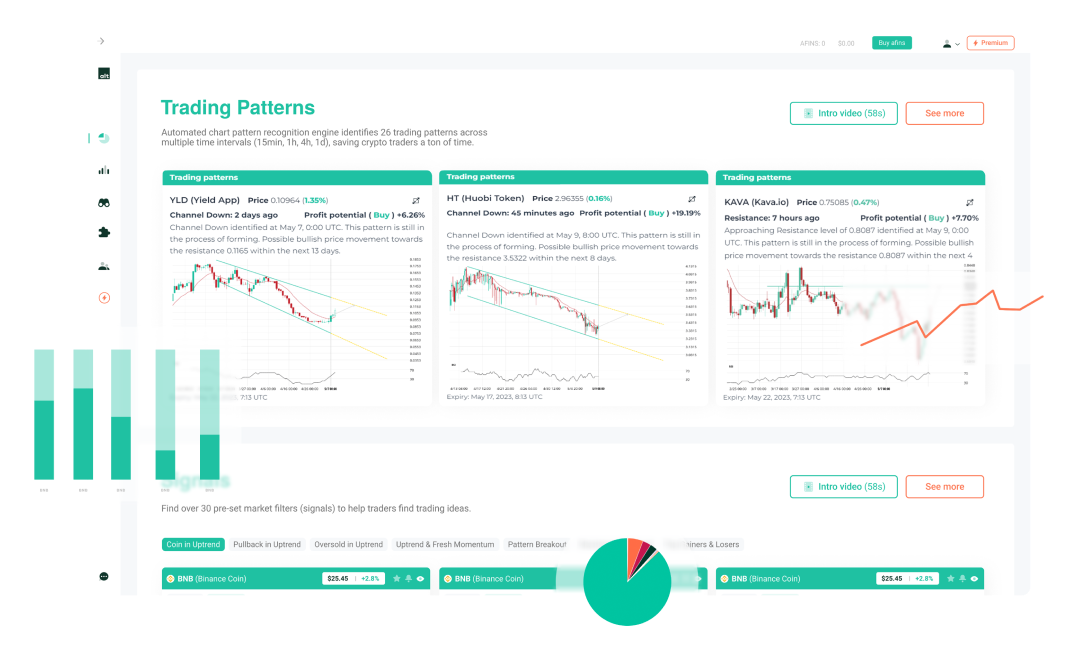
4. Combine odds with technical analysis. Prediction markets tell you what the crowd expects. Technical analysis tells you what price is actually doing. The edge lives in the overlap. Use the altFINS Crypto Screener to scan 2,000+ coins for momentum and trend, verify setups with AI detected chart patterns, and set price alerts at the levels that would flip a prediction market’s odds. If you are new to TA, start with the altFINS technical analysis learning guide.
5. Size positions like a trader, not a gambler. Treat each contract as a probability trade: only buy when your estimated probability meaningfully exceeds the market price, risk 1 to 2% of capital per idea, and diversify across uncorrelated events. Read our trading risk management guide before placing your first trade.
Risks and Regulation in 2026
Regulation is moving fast in both directions. In the US, the CFTC designated event contracts as falling under its exclusive federal jurisdiction, while more than a dozen state authorities have filed actions against Kalshi and Polymarket over sports contracts, and the SEC has delayed the first prediction market ETFs. Platforms responded with stronger consumer protection: identity checks, deposit limit tools and insider trading restrictions announced in March 2026.
In Europe, crypto based platforms intersect with the MiCA framework, which fully applies to EU crypto firms from mid 2026 (see our MiCA 2026 guide). Practical takeaway: check availability in your jurisdiction, use only official apps and domains, start small, and never treat any single market as a sure thing. Ambiguously worded questions are the most common source of painful surprises, so always read resolution criteria before trading.
FAQ: Prediction Markets
What is a prediction market in simple terms?
It is a marketplace where you buy YES or NO contracts on future events. Correct contracts pay $1, wrong ones pay $0, and the live price shows the probability the crowd assigns to the outcome.
Are prediction markets legal?
In the US, Kalshi and Polymarket US operate as CFTC regulated exchanges, though some states restrict access and legal challenges continue. Elsewhere, availability depends on local law, and Polymarket’s global platform serves most non US jurisdictions. Always verify the rules where you live.
Are prediction markets accurate?
Historically, yes. Because participants risk real money, prices aggregate information efficiently. Industry Brier scores near 0.09 indicate strong forecast quality, and accuracy improves further in high volume markets. They are not infallible: low probability surprises still happen.
Is prediction market trading gambling?
Structurally it is exchange trading: peer to peer order books, exit before settlement, federal regulation in the US. In practice the outcome depends on the user. Research driven, risk managed trading is investing behavior. Impulse betting on coin flips is gambling regardless of the venue.
Polymarket or Kalshi, which is better for crypto traders?
Polymarket, in most cases. It is crypto native (USDC on Polygon), has deeper crypto and geopolitical markets, and offers fee free trading on world events. Kalshi is better if you are a US resident who prefers USD banking rails and the widest sports coverage.
How much money do I need to start?
Minimums are as low as $1 to $10 on major platforms. Start small, learn how resolution works, and scale only once you consistently beat the market’s implied probabilities.
🏁 Final Verdict
Prediction markets have graduated from crypto curiosity to a $44+ billion per month industry backed by the NYSE’s parent company and regulated by the CFTC. For crypto traders they offer three real advantages: defined risk exposure to events, an honest sentiment signal, and a hedging tool that perps cannot replicate. The edge does not come from guessing. It comes from knowing something the market has not fully priced, and that is exactly what disciplined analysis provides.
Build Your Edge Before You Trade the Odds
Scan 2,000+ coins, detect chart patterns with AI, and set smart alerts. Then take your conviction to the markets.
Disclaimer: This article is for educational purposes only and is not financial, legal or tax advice. Prediction market trading involves substantial risk, including the loss of your entire stake, and availability varies by jurisdiction. Data cited from The Block, Pew Research Center, TRM Labs and other public sources as of July 2026 and may change. Always do your own research and read each platform’s terms before trading.