
Search Knowledge Base by Keyword
-
Overview
-
- altFINS Platform Features - Your All-in-One Crypto Trading Tool
- Why use altFINS?
- Registered user benefits
- What kind of trader are you?
- How to trade cryptocurrencies?
- How to Trend Trade Crypto
- Trading Risk Management
- What Makes altFINS One of the Best Crypto Screeners in 2025?
- What Kind Of Crypto Trading Signals Are on altFINS?
-
-
Crypto Analytics
-
- Why use it?
- Overview > Charts > Scorecards > Performance > Trend > Oscillators
- Add table columns
- Detail view
- Charts
- Create a Trading Signal or Filter
- Find SMA crossover signals
- Crypto Time Intervals
- Crypto Alerts on altFINS: The Complete 2026 Guide to Price, Filter, and Pattern Alerts
- Extreme Overbought coins Due for a Pullback
- Early momentum detection
- Crypto Trend Changes
- Why And How Use altFINS Crypto Screener
- Mastering Candlestick Patterns for Successful Crypto Trading
- Fibonacci Retracement Levels: The Complete Crypto Trading Guide (2026)
- Essential Candlestick Patterns for Crypto Traders
- Using Local High to Spot Breakouts
- Oversold in Uptrend
- Strong Uptrend
- The Hammer Candlestick Pattern
- The Inverted Hammer Candlestick Pattern
- The Hanging Man Candlestick Pattern
- The Spinning Top Candlestick Pattern
- The Dragonfly Doji Candlestick Pattern: Complete Trading Guide (2026)
- What is "My Data" Option on altFINS?
- The Relative Volume (RVOL) Indicator
- New Local High
- New Local Low
- Buying Coins at an All-Time-High (ATH)
- Bullish Engulfing Candlestick Pattern: A Comprehensive Guide
- The Gravestone and Perfect Gravestone Doji Candlestick Patterns
- Support and Resistance Crypto: The Complete 2026 Guide for Traders
- What Makes altFINS One of the Best Crypto Screeners in 2025?
- Crypto Volume Tracker: Spot Unusual Volume and Momentum with altFINS
- Crypto Fundamental Data On altFINS: Identifying Projects with Real Traction
- What is ATR Indicator and How to Find It on altFINS?
- Combining fundamentals with TA
- Trading RSI and RSI Divergence
- What Is the 200-Day Simple Moving Average and How to Find It on altFINS
- 11 Best Crypto Screeners in 2026: Comparison, Pricing & Features
- The Complete Guide to altFINS Preset Screener Filters
- altFINS AI Trade Setup: Analyze 2,000 Coins in Seconds
- Crypto Charts on altFINS: The Complete Guide to the Defined Chart (2026)
- Top 100 Crypto in 2026: How to Find the Best Coins in the Top 100 (Live altFINS Data)
- Tokenized Stocks and RWA in 2026: Track and Scan 200+ Tokenized Equities on altFINS
- Best Tokenized Stocks Screener in 2026: Scan 200+ Tokenized Equities With altFINS
- Trading Tokenized Stocks: How to Find, Analyze, and Trade Them (Full Tutorial)
- The Shooting Star Candlestick Pattern: A Crypto Trader's Guide
- Show all articles ( 33 ) Collapse Articles
-
- Overview
- Emerging v. Complete
- Mastering Key Levels in Crypto Trading: The Ultimate Guide
- Consecutive Candles
- Big Movement in Trading: Understanding and Trading the Volatility
- Fibonacci Patterns
- 10 steps for how to trade crypto using Crypto Chart Patterns
- How to trade Channel Down? | Crypto Chart Pattern
- Tutorial: Using Custom Chart Pattern Filters
- How To Set Up Chart Patterns Alerts?
- How To Trade Channel Up Pattern? | Crypto Chart Pattern
- How To Trade Ascending Triangles? | Crypto Chart Pattern
- How To Trade Bullish Flag Pattern? | Crypto Chart Pattern
- How To Trade Sideways Channel pattern? | Crypto Chart Pattern
- How To Trade Rising Wedge pattern? | Crypto Chart Pattern
- How To Trade Falling Wedge pattern? | Crypto Chart Pattern
- How To Trade Descending Triangle pattern? | Crypto Chart Pattern
- How To Trade Inverse Head and Shoulders pattern? | Crypto Chart Pattern
- What is "My Data" Option on altFINS?
- How To Trade Symmetrical Triangle Pattern? | Crypto Chart Pattern
- Crypto Chart Patterns Cheat Sheet
- How Does AI Help with Crypto Trading?
- Crypto Chart Patterns: The Complete 2026 Guide to 26 AI-Detected Patterns
- Best Automated Crypto Chart Pattern Recognition Platforms in 2026: The Ultimate Comparison
- Trading Patterns Explained: The Complete 2026 Guide to Reading Price Charts
- Show all articles ( 10 ) Collapse Articles
-
- Technical Analysis in Crypto: Trade Setups, Hot Setups, and How They Differ From AI Trade Setups
- Fibonacci Retracement Levels: The Complete Crypto Trading Guide (2026)
- How To Trade Sideways Channel pattern? | Crypto Chart Pattern
- Technical Analysis Alerts
- Support and Resistance Crypto: The Complete 2026 Guide for Traders
- 8 AI-Powered Trade Strategy Prompts Using altFINS MCP
- Crypto Charts on altFINS: The Complete Guide to the Defined Chart (2026)
-
- Signals Summary Overview
- How To Find And Trade Crypto Pullbacks In Uptrend (Buying Dips)?
- Momentum & Up / Down Trend
- Range in Up/Down Trend
- Momentum
- How to trade EMA 12 / 50 crossovers?
- Moving Average Ribbons
- Strong Up / Down Trend
- Strong Up / Down Trend (Short Term)
- Strong Up / Down Trend (Medium Term)
- Strong Up / Down Trend (Long Term)
- Price / SMA Crossovers In Crypto
- What are Price / EMA Crossovers in crypto?
- SMA Crossovers
- EMA Crossovers
- Crypto Unusual Volume Gainers / Decliners
- New Up/Down trend (ADX)
- Bollinger Band - Price Broke Upper / Lower Band
- Strong Up / Down Trend and Oversold / Overbought
- Strong Up / Down Trend and Strong / Weak Ultimate Oscillator
- MACD (12,27,9) Signal Line cross
- MACD (12,27,9) Center Line cross
- Commodity Channel Index cross
- Overall Score of Oscillators (Oversold / Overbought)
- Relative Strength Index (9)
- Relative Strength Index (14)
- Relative Strength Index (25)
- Stochastic RSI (3, 3, 14, 14)
- Williams Percent Range (14)
- Bull Power
- MACD line
- Relative Strength Index (RSI) Divergence: Explained
- How to Trend Trade Crypto
- Early momentum detection
- Short-Medium-Long-Term Trend
- Relative Strength Index
- Uptrend and Fresh Bullish Momentum Inflection
- Using Local High to Spot Breakouts
- Oversold in Uptrend
- Strong Uptrend
- The Hammer Candlestick Pattern
- The Inverted Hammer Candlestick Pattern
- The Hanging Man Candlestick Pattern
- The Spinning Top Candlestick Pattern
- The Dragonfly Doji Candlestick Pattern: Complete Trading Guide (2026)
- What is "My Data" Option on altFINS?
- The Relative Volume (RVOL) Indicator
- New Local High
- New Local Low
- Bullish Engulfing Candlestick Pattern: A Comprehensive Guide
- The Gravestone and Perfect Gravestone Doji Candlestick Patterns
- Three White Soldiers Candlestick Pattern: A Comprehensive Guide
- How Does AI Help with Crypto Trading?
- What Kind Of Crypto Trading Signals Are on altFINS?
- Trading RSI and RSI Divergence
- The Complete Guide to altFINS Preset Screener Filters
- The Shooting Star Candlestick Pattern: A Crypto Trader's Guide
- Show all articles ( 42 ) Collapse Articles
-
- Volume
- OBV Divergence Indicator
- SMA vs. EMA
- Trading RSI and RSI Divergence
- Stochastic (14, 3, 3) (STOCH)
- What is CCI 20? (Commodity Channel Index 20)
- ADX
- MACD Indicator Explained: MACD Line, Signal Line & Histogram (Complete 2026 Guide)
- Williams %R
- Stochastic RSI Fast
- Bull / Bear Power
- What is the UO: Ultimate Oscillator (7, 14, 28)
- Short Term Trend
- Medium Term Trend
- Long Term Trend
- Oscillator Rating
- Trading Multiple Time Frames
- Support and Resistance Crypto: The Complete 2026 Guide for Traders
- Polarity principle
- Early momentum detection
- Crypto Trend Changes
- MACD Histogram (H1, H2)
- Fibonacci Retracement Levels: The Complete Crypto Trading Guide (2026)
- Using Local High to Spot Breakouts
- Oversold in Uptrend
- Strong Uptrend
- The Relative Volume (RVOL) Indicator
- New Local High
- Buying Coins at an All-Time-High (ATH)
- Crypto Volume Tracker: Spot Unusual Volume and Momentum with altFINS
- What is ATR Indicator and How to Find It on altFINS?
- Combining fundamentals with TA
- What Is the 200-Day Simple Moving Average and How to Find It on altFINS
- The Complete Guide to altFINS Preset Screener Filters
- Show all articles ( 19 ) Collapse Articles
-
- Crypto Alerts on altFINS: The Complete 2026 Guide to Price, Filter, and Pattern Alerts
- Extreme Overbought coins Due for a Pullback
- Simple price alerts
- How To Set Up Chart Patterns Alerts?
- Push Alerts Notifications on Mobile App
- Watchlist and Portfolio Alerts
- Technical Analysis Alerts
- Crypto Alerts on altFINS: A Comprehensive Guide
- Crypto Portfolio Tracker
- How To Trade Symmetrical Triangle Pattern? | Crypto Chart Pattern
- New Local High
- New Local Low
- Three White Soldiers Candlestick Pattern: A Comprehensive Guide
- Crypto Volume Tracker: Spot Unusual Volume and Momentum with altFINS
- What is ATR Indicator and How to Find It on altFINS?
- What Is the 200-Day Simple Moving Average and How to Find It on altFINS
- Crypto Breakouts Explained: How to Spot Winning Trades with altFINS
- Getting Started with altFINS! Your Complete Step-by-Step Guide to Crypto Trading Success
- 11 Best Crypto Screeners in 2026: Comparison, Pricing & Features
-
-
Trade Crypto
-
- Initiating a trade
- Market vs. Limit order
- Refreshing tables
- Are derivatives such as futures, options and perpetual swaps supported?
- Does altFINS charge trading fees?
- Balances
- Open Orders
- Transaction History
- Orderbook in Crypto: How to Read It, Spot Liquidity, and Trade Smarter (2026 Guide)
- Connecting to Exchanges on altFINS Terminal
- How to trade cryptocurrencies?
- Trading Risk Management
- Crypto Portfolio Tracker
- Connect To Bitget
- Connect to Coinbase
-
-
Research Hub
-
Crypto Education
-
- Where To Buy And Sell Cryptocurrency?
- When Is The Best Time To Buy And Sell Cryptocurrency?
- Crypto Profits: Full Guide How to Take Profits In Cryptocurrency
- What Is Crypto Copy Trading?
- What Is Leverage Trading Cryptocurrency?
- Crypto Arbitrage Trading: Meaning, Signals And Opportunities
- Crypto Hot Wallet vs. Cold Wallet: What is the Difference
- Crypto Trading Strategies
- Difference Between Crypto Fundamental and Technical Analysis
- Best Decentralized Exchanges in 2026: Complete Ranking by Volume, Fees & Features
- What is a Crypto Prop Trading? A Complete Guide to Crypto Proprietary Trading Firms
- The Best Crypto Prop Trading Firms
- Altrady Review: How To Achieve Optimal Trade Execution
- Crypto AI Agents Explained: Top 10 AI Agent Cryptos by Market Cap to Watch in 2025
- The Ultimate Guide to Smart Money Whales in Crypto
- The Ultimate Guide to Cryptocurrency ETFs in 2025
- How to Control Your Emotions While Trading Crypto (and How altFINS Can Help)
- HyroTrader Review: A Comprehensive Analysis
- Best Crypto Trading Bots in 2025: Coinrule vs Cryptohopper vs 3Commas
- How to Automate Your Crypto Trading with Coinrule
- OneFunded Review: Pros & Cons Revealed
- The Market's X-Ray: Liquidation Heatmaps
- Can Quantum Computers Break Bitcoin? | 2026 Google Research
- CoinEx Exchange Review 2026: Features, Fees, Security & What You Should Know Before Trading
- Hyperliquid ($HYPE) Price: The On-Chain Derivatives Powerhouse Eyeing $50
- Crypto Exchange Comparison 2026: CoinEx vs MEXC vs BYDFi vs Phemex vs Margex
- Best Crypto Prop Trading Firms in 2026: The Ultimate Comparison Guide
- Best Crypto Portfolio Trackers 2026: altFINS, CoinStats & 3 More Compared
- RebelsFunding Review 2026: The No-Time-Limit Prop Firm Built for Patient Traders
- LBank Review 2026: The Complete Guide to Fees, Security, Features & Trust
- Crypto Signals on Telegram in 2026 – Complete Guide With altFINS Examples
- MiCA 2026: The July 1 Deadline Every EU Crypto Firm Must Prepare For
- 10 Best Crypto Telegram Signals Groups in 2026: Ranked and Compared
- Best Crypto Discord Servers for Trading Signals in 2026 (Ranked & Reviewed)
- Best Crypto Trading Courses for Learning Technical Analysis in 2026 (Ranked & Reviewed)
- Prediction Markets Explained: The Complete 2026 Guide for Crypto Traders
- Best Crypto Hardware Wallets 2026
- Best Crypto Liquidity Providers in 2026: Comparison, Coverage & Pricing
- Best Self-Custody Solutions in 2026: One Pick Per Job
- Best Crypto Communities to Join in 2026: Ranked for Signals, Analysis and Learning
- 5 Best RPC Providers for Production Web3 Apps in 2026
- Trading Tokenized Stocks: How to Find, Analyze, and Trade Them (Full Tutorial)
- CoinMarketCap API Review (2026): Features, Pricing, Setup Guide, and Honest Pros & Cons
- Best Crypto APIs in 2026: An In-Depth Comparison of 6 Leading Data Providers
- Fair Value Gap (FVG) Explained: How to Spot and Trade Imbalances in Crypto
- Show all articles ( 30 ) Collapse Articles
-
-
About
-
AI Features
- 🚀 Meet altFINS AI Copilot: Your Smart Crypto Trading Assistant
- Getting Started with altFINS! Your Complete Step-by-Step Guide to Crypto Trading Success
- altFINS AI Trade Setup: Analyze 2,000 Coins in Seconds
- Using AI to Sharpen Your Trading Edge
- Best AI Trading Tools in 2026: The Complete Ranked Guide
-
altFINS API
- What Is the altFINS Analytics Data API?
- Who Is the altFINS Data API For?
- Real-World Use Cases of the altFINS API
- altFINS Crypto Market & Analytical Data API
- How to Create an altFINS API Key (Step-by-Step Guide)
- The Ultimate Guide to Cryptocurrency MCP Servers in 2026: Complete Comparison for Traders, Developers & Trading Platforms
- 11 Best Crypto APIs for 2026: Comparison, Pricing & Features
- How to Connect altFINS MCP to Claude Desktop
- 8 AI-Powered Trade Strategy Prompts Using altFINS MCP
- altFINS CLI: The Complete Guide To Crypto CLI
- Find Trade Ideas | Prompts Using altFINS MCP And AI
- How to Use altFINS AI Skills with OpenAI Codex
- The Complete Guide to altFINS MCP Crypto Trading Prompts
- The Trinity Moment: When a Local AI Model, altFINS CLI, and an M1 Max Started Working Like One Tool
- altFINS Preset Filters + MCP: Find Crypto Trade Opportunities in Plain English
- What Is a Crypto API & How to Use One: 2026 Tutorial
- How to Connect altFINS MCP to Perplexity PRO
- Top 10 Winners of the altFINS API Challenge 2026: The Best Crypto Apps Built on altFINS API, MCP & CLI
- Best Free Crypto API in 2026: 9 No-Cost Options Compared
- How to Build a Live Multi-Timeframe RSI Crypto Screener with Claude Code and the altFINS API (2026 Guide)
- How to Build a Crypto Trading App with Gemini Canvas and the altFINS API (2026 Guide)
- 5 altFINS Trading MCP Prompts to Find Setups With Claude (2026)
- Show all articles ( 7 ) Collapse Articles
What Is the altFINS Analytics Data API?
From Raw Data to Actionable Intelligence
Traditional crypto APIs provide fragmented datasets—prices, trades, or order books—leaving teams to build complex analytics pipelines from scratch.
altFINS eliminates that burden.
Instead of raw inputs, the API delivers a complete analytics layer, pre-computed, standardized, and ready to use across:
- Trading systems
- AI agents (LLMs + decision engines)
- Market intelligence platforms
- Fintech dashboards
This allows teams to move directly from data ingestion to decision-making.
A Complete Analytics Engine, Delivered via API
The altFINS Crypto API aggregates and processes data form 30+ exchanges, and calculate
- 150+ technical indicators
- 130+ trading signals types
- on 7 years history
- across 2,200+ coins
What you get:
1. Institutional-Grade Market Data
- Real-time and historical OHLCV data
- Volume, liquidity, and volatility metrics
- Exchange-level insights
2. 150+ Pre-Computed Technical Indicators
No need to build or maintain indicator logic.
Access ready-to-use calculations such as:
- RSI, MACD, Bollinger Bands
- Trends
- Moving averages (SMA, EMA)
- Candlestick Patterns
- Momentum, trend, and volatility indicators
All optimized for scale, consistency, and accuracy.
3. Trading Signals & AI Signals
The same signal engine used by thousands of traders is exposed via API and MCP.
Use it to:
- Automate trade execution
- Trigger alerts
- Feed AI agents with decision-ready inputs
- Creating trading dashboards
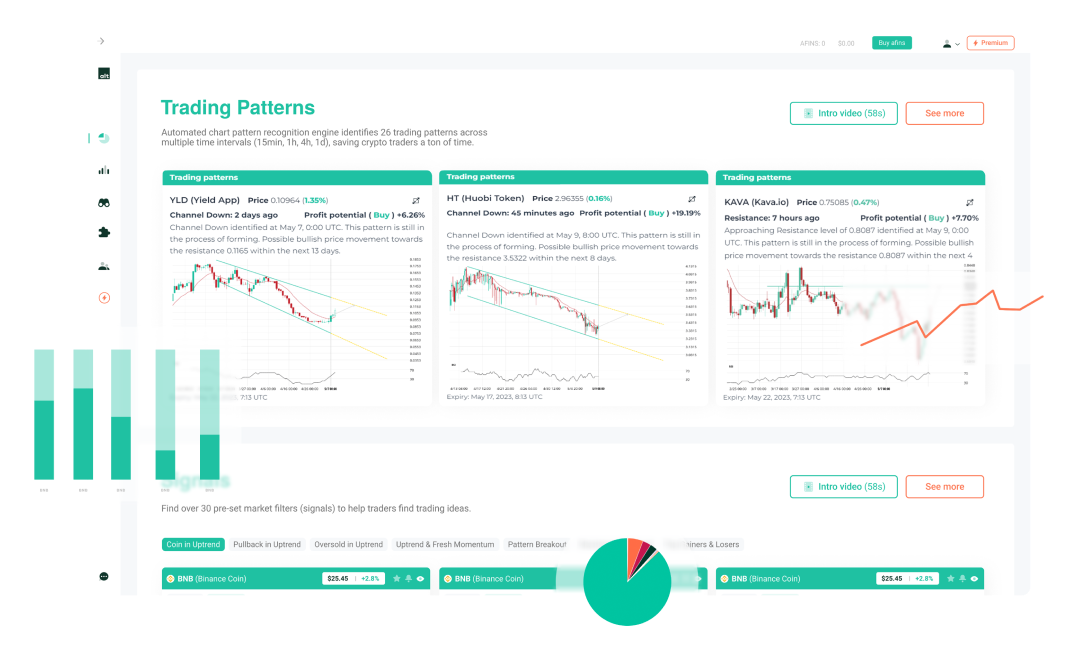
4. Screener & Pattern Recognition Data
Go beyond indicators with higher-level analytics:
- Support & resistance levels
- Trend classification
- Breakout detection
- Candlestick patterns
This enables strategy-level logic without building it yourself.
5. AI-Ready Data (MCP Layer)
The API is designed with AI-native applications in mind.
All data is:
- Clean and normalized
- Consistently structured
- Context-rich
This makes it ideal for:
- LLM-powered agents
- Autonomous trading systems
- Predictive models
- Quant research pipelines
Think of altFINS as a Model Context Provider (MCP) for crypto markets—delivering structured intelligence that AI systems can directly reason over.
Connect altFINS MCP + Claude
Try these 8 trading prompts
6. CLI Access: Terminal-Native Intelligence for Developers and AI Agents
For teams that prefer speed, automation, and terminal-based workflows, the altFINS ecosystem also includes a powerful command-line interface (CLI). The altFINS CLI (af) acts as a direct, terminal-native interface to the Analytics Data API, allowing users to access market data, trading signals, technical indicators, and news with simple commands—without writing any integration code.
Installed as a lightweight single binary, the CLI bridges the gap between raw API access and real-world workflows. It enables developers, quant analysts, and AI engineers to query, stream, and export structured data (JSON, CSV, JSONL) directly into pipelines, scripts, or agent frameworks.
From an MCP perspective, the CLI functions as an agent-ready execution layer—supporting machine-readable outputs, self-discoverable commands, and seamless integration into LLM-powered systems. This makes it ideal for building AI trading agents, automated research tools, and real-time analytics pipelines, all without the overhead of managing API clients or infrastructure.
Built for Scale, Speed, and Reliability
The altFINS infrastructure is designed for production-grade workloads:
- Low-latency responses
- High-frequency request handling
- Scalable to millions of API calls
- Global CDN delivery
Proven at scale:
- 5M+ signals generated
- Millions of data points processed per hour
- Thousands of active API users
Powering the Next Generation of AI Finance
The shift toward AI-driven finance is already underway.
The altFINS API enables teams to build:
AI Trading Agents
Autonomous systems that analyze signals and execute trades in real time.
Institutional Dashboards
Advanced analytics platforms for traders, funds, and exchanges.
Smart Alerts & Research Tools
Automated insights without manual analysis.
Quant Strategies
Data-driven strategies powered by proven signals and indicators.
From Data Engineering to Product Innovation
Without altFINS:
- Months spent building data pipelines
- Ongoing maintenance of indicators and models
- Complex normalization across exchanges
With altFINS:
- Instant access to structured analytics
- Reduced engineering overhead
- Faster time-to-market
The Bottom Line
The altFINS Analytics Data API transforms how crypto products are built.
It replaces fragmented data workflows with a unified intelligence layer, enabling companies to:
- Build faster
- Scale easier
- Innovate with AI
If you’re building in crypto, especially with AI, the question is no longer “Where do we get data and analytics?”
It’s “How fast can we turn data into decisions?”
altFINS API is the answer.
— Read API Documentation — Read MCP Documentation — Read CLI Documentation