
Search Knowledge Base by Keyword
5 Best RPC Providers for Production Web3 Apps in 2026
Public RPC endpoints are convenient for prototyping, but production applications need stronger controls. A private RPC service gives a team an authenticated endpoint, account-level limits, usage analytics, and protection from anonymous public traffic. Some providers go further and offer single-tenant nodes, private networking, or multi-provider routing for additional isolation and resilience.
Those options are not interchangeable. A private URL does not necessarily mean the underlying node is dedicated to one customer. An RPC router can improve failover without operating the nodes itself. A dedicated node provides stronger infrastructure isolation, but it can require more capacity planning and cost more than a shared endpoint.
This altFINS guide ranks five private RPC providers and routing platforms for production Web3 workloads. The ranking considers access control, infrastructure isolation, network coverage, reliability features, observability, pricing, and independent benchmark evidence where comparable data is available.
Key takeaways
- Chainstack ranks first for its combination of authenticated Global Nodes, fully isolated Dedicated Nodes, and Chainstack Self-Hosted for customer-controlled infrastructure.
- OnFinality takes second place with private API endpoints, detailed usage analytics, endpoint allowlists, and a clear upgrade path to managed Dedicated Nodes.
- RouteMesh is best treated as a multi-provider routing layer. It offers one API key, automated failover, and access to more than 1,000 chains, but it is not a single-tenant node provider.
- Uniblock combines RPC routing across more than 55 providers with higher-level blockchain APIs. Dedicated nodes are available as a custom enterprise option.
- Quicknode offers mature shared RPC infrastructure and private Dedicated Clusters, but its dedicated infrastructure is enterprise-priced and it placed behind Chainstack in the specific Robinhood Chain benchmark used in this article.
Private RPC Providers at a Glance
| Rank | Provider | Private access model | Dedicated infrastructure | Best for | Main tradeoff |
|---|---|---|---|---|---|
| 1 | Chainstack | Authenticated Global Node endpoints with access controls | Dedicated Nodes or Chainstack Self-Hosted on customer infrastructure | Teams that want managed RPC, isolated nodes, or self-hosted deployments | Each model has different operational and infrastructure responsibilities |
| 2 | OnFinality | Private API endpoints with application-level limits and analytics | Yes, managed Dedicated Nodes and clusters | Multi-chain applications that value endpoint analytics and a managed upgrade path | Response-unit pricing requires workload modeling |
| 3 | RouteMesh | One API key routed across multiple upstream providers | No single-tenant nodes offered directly | Applications prioritizing provider diversity, failover, and broad chain access | Performance and availability still depend on upstream providers |
| 4 | Uniblock | Unified API key with automated provider selection and fallback | Available on custom enterprise plans | Teams combining RPC access with token, NFT, transaction, and webhook APIs | Compute-unit billing and routing behavior add an abstraction layer |
| 5 | Quicknode | Authenticated shared Core RPC endpoints | Yes, private single-tenant Dedicated Clusters | Enterprises that want broad chain coverage and custom cluster architecture | Dedicated infrastructure requires a custom enterprise engagement |
What Does Private RPC Actually Mean?
The phrase private RPC is used for several different infrastructure models.
- Authenticated shared endpoint: The customer receives a unique URL or API key, separate rate limits, and usage analytics. The gateway and backend nodes may still be shared with other customers.
- Routed private endpoint: The customer sends requests through an authenticated gateway that selects among several upstream RPC providers. This can improve failover and reduce dependence on one vendor, but it does not guarantee single-tenant compute.
- Dedicated RPC infrastructure: A node, group of nodes, or cluster is reserved for one customer. This offers stronger workload isolation, predictable capacity, and more control over client, region, data mode, and configuration.
Private RPC also should not be confused with private transaction delivery. An authenticated endpoint does not automatically hide transactions from the public mempool or protect a user from maximal extractable value. Those use cases require a private transaction relay, protected mempool, or chain-specific transaction service.
How We Ranked the Providers
This list evaluates the factors that matter after a project moves beyond a public endpoint:
- Isolation: Whether the provider offers only an API-key endpoint or also supports single-tenant nodes and clusters.
- Latency and consistency: Median latency matters, but tail latency, regional performance, and behavior under sustained traffic matter too.
- Reliability: Useful features include load balancing, automatic retries, multi-provider failover, and a clear response to stale or unhealthy nodes.
- Security controls: IP allowlists, origin restrictions, private credentials, role-based access, and private network paths reduce endpoint exposure.
- Observability: Teams should be able to inspect requests, methods, regions, errors, rate limits, and node health.
- Coverage: Chain, method, archive, trace, debug, WebSocket, and gRPC support should match the application rather than a generic checklist.
- Commercial fit: Pricing should be understandable enough to estimate the cost of the actual method mix and traffic profile.
1. Chainstack
Chainstack ranks first because it offers a practical path from a private managed endpoint to fully isolated blockchain infrastructure without forcing teams to change platforms.
Global Nodes provide authenticated, geo-balanced RPC endpoints for development and production applications. Teams that need stronger isolation can deploy a Dedicated Nodes with reserved compute, storage, and bandwidth. Dedicated deployments support region, client, configuration, and data-mode choices, including archive, trace, and debug use cases where available on the selected network.
Teams that need to keep infrastructure and data in their own environment can use Chainstack Self-Hosted. It is a Kubernetes-native control plane for deploying, operating, and monitoring blockchain nodes on customer-controlled cloud virtual machines, bare-metal servers, or local infrastructure. It standardizes node configurations and adds automated deployment, monitoring, updates, recovery, and configurable failover while the customer retains control of the underlying infrastructure, data, access, and configuration.
Chainstack Self-Hosted is not simply another managed private RPC endpoint. It is a separate deployment path for teams with data-residency, infrastructure-ownership, customization, or operational-control requirements. This gives Chainstack coverage across managed shared RPC, managed dedicated nodes, and self-hosted node operations.
Chainstack also supports endpoint security controls such as IP allowlists, allowed origins, and private credentials. For supported Dedicated Node deployments, private networking can keep traffic between an application and its node inside the same AWS region instead of sending it over the public internet.
OpenChainBench Result: 5 ms p50 From US-East
In the OpenChainBench keyed Robinhood Chain benchmark, Chainstack recorded 5 ms p50 latency over the trailing 24 hours from US-East, compared with 6 ms for Alchemy and 71 ms for Quicknode in the supplied snapshot.
The benchmark sends eth_getBlockByNumber to authenticated endpoints every 60 seconds with a rotating JSON-RPC ID. Only successful responses contribute to the latency distribution.
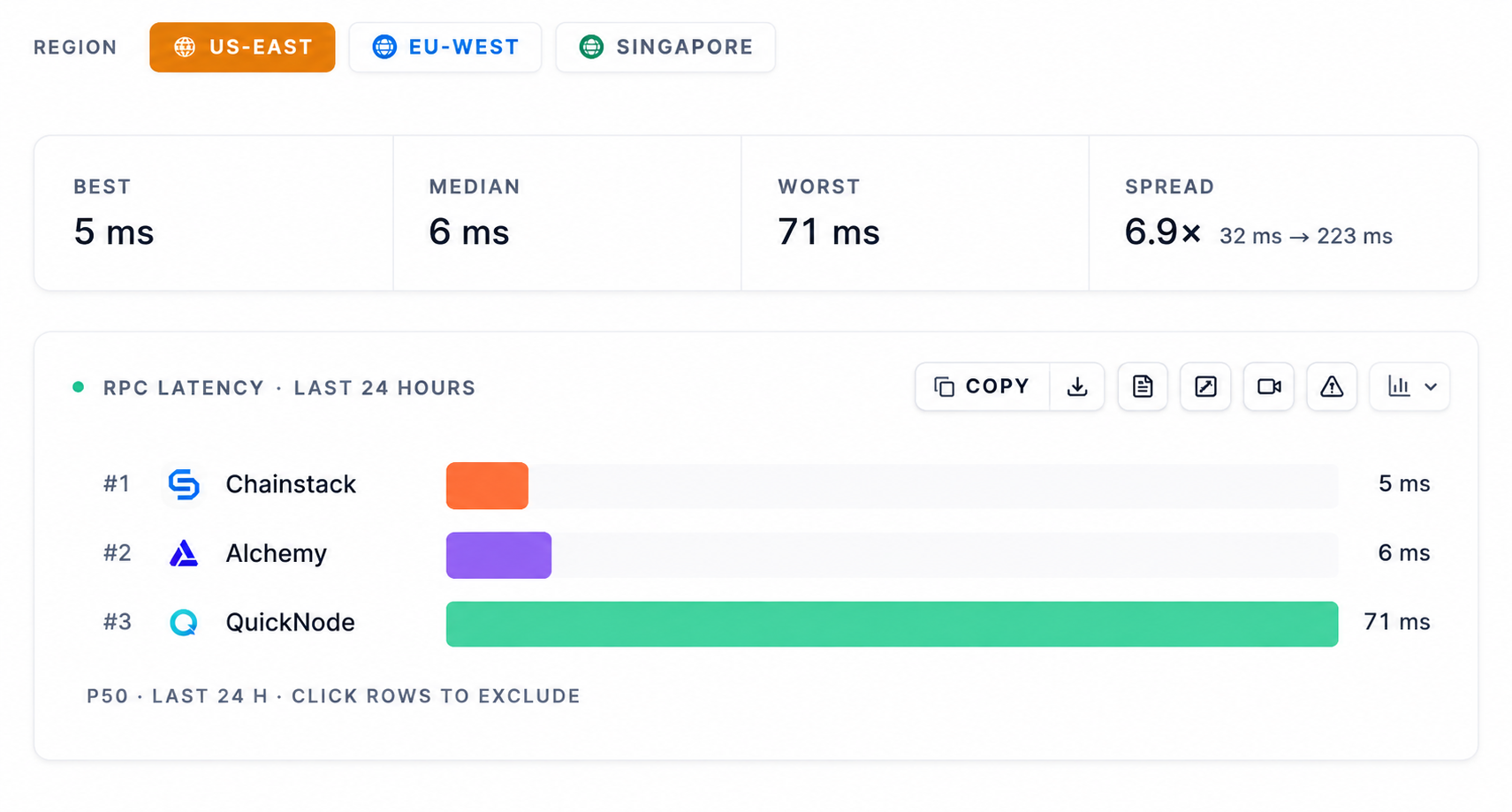
OpenChainBench snapshot for Robinhood Chain keyed RPC latency. US-East selected, p50 over the last 24 hours. Chainstack: 5 ms; Alchemy: 6 ms; Quicknode: 71 ms.
Key Features
- Authenticated Global Node RPC and WebSocket endpoints.
- Fully isolated Dedicated Nodes with selectable regions and configurations.
- Chainstack Self-Hosted for running nodes on customer-controlled Kubernetes infrastructure.
- Load balancing across dedicated nodes for resilient deployments.
- IP allowlists, origin restrictions, and private endpoint credentials.
- Private networking for eligible AWS deployments in the same region.
- Archive, trace, debug, and custom configuration options on supported networks.
- Deployment options across major cloud providers and Chainstack infrastructure.
Pricing
Chainstack Pricing starts with a free Developer plan that includes 3 million request units per month and 25 requests per second. The Growth plan starts at $49 per month. Dedicated Node compute starts at $0.50 per hour, with storage and configuration affecting the total price. Chainstack Self-Hosted has a free Community edition, but customers still provide and pay for the infrastructure on which it runs.
Best For
Chainstack is the strongest all-around option for DApps, wallets, trading infrastructure, protocols, and enterprise teams that want managed RPC access today with a clear route to dedicated, privately connected, or self-hosted infrastructure later.
Limitations
Coverage and available node configurations vary by chain. A Global Node is a private authenticated endpoint, but it is not the same as a single-tenant Dedicated Node.
2. OnFinality
OnFinality combines private API endpoints with managed Dedicated Nodes. Its private endpoints use unique application credentials, independent limits, and detailed dashboards, while the dedicated service provides a separate infrastructure path for teams that need reserved resources or custom node configurations.
OnFinality is particularly transparent about the distinction between a private Private RPC Endpoints and a dedicated node. The private endpoint provides authenticated access and isolates account-level limits, but the underlying infrastructure may still be shared. That explanation helps buyers choose the right tier instead of assuming an API key guarantees physical isolation.
Application dashboards provide request analytics by method, country, latency percentile, and error. Teams can also restrict access by origin or IP address. For higher-control deployments, OnFinality Dedicated Pricing can include clusters, HTTP and WebSocket access, P2P connectivity, Prometheus metrics, and fallback to the managed RPC network.
Key Features
- Private HTTPS and WebSocket endpoints with separate application credentials.
- Allowed-origin and IP-address restrictions.
- Per-method p50, p95, average latency, geographic, and error analytics.
- More than 130 supported mainnet and testnet networks.
- Managed Dedicated Nodes and optional clustered deployments.
- RPC fallback options for dedicated infrastructure.
- Particularly deep documentation and operational support for Substrate and Polkadot ecosystems.
Pricing
OnFinality RPC pricing includes a free Developer plan with 400,000 response units per day and up to 40 response units per second. Growth starts at $49 per month with 20 million response units and up to 200 per second. Dedicated Node pricing is customized by chain, client, region, storage, and architecture.
Best For
OnFinality is a strong choice for multi-chain DApps and protocol teams that want a well-instrumented private endpoint first and a managed dedicated deployment later. It is especially attractive for teams building across Polkadot and other Substrate-based networks.
Limitations
Response units are more complex than counting raw requests because expensive methods may consume more units. Teams should model their actual method mix before comparing plans.
3. RouteMesh
RouteMesh is an RPC aggregation and routing layer rather than a conventional node provider. Applications use one API key while RouteMesh selects among more than 15 upstream providers across more than 1,000 chains.
Its routing system considers provider support, method availability, region, cost, and node health. If an upstream returns an error, the platform can retry through another route. RouteMesh also runs asynchronous data quality checks that replay a sample of requests against multiple nodes, compare responses, check chain-head lag, and move unreliable nodes out of production routing.
This architecture can reduce the operational burden of maintaining several direct provider integrations. It also gives teams a way to diversify upstream dependencies without changing endpoint logic every time a provider or chain is added.
Key Features
- One API key for more than 15 providers and more than 1,000 chains.
- Region-aware selection across upstream providers and cloud locations.
- Automatic retries and failover after upstream errors.
- Chain- and method-aware routing.
- Asynchronous consensus and chain-head freshness checks.
- Normalized error handling across providers.
- Usage-based route pricing without a broad platform commitment.
Pricing
RouteMesh uses per-route usage pricing, with a route defined by chain and method. Prices are calculated from upstream costs and can be updated monthly. Committed-use discounts are available for larger workloads.
Best For
RouteMesh is best for wallets, multi-chain applications, and backend platforms that value provider diversity, broad long-tail chain access, and automated failover more than direct control of a specific node deployment.
Limitations
RouteMesh does not directly provide single-tenant nodes. Its performance, chain coverage, and data availability depend on its upstream providers. The documentation also distinguishes full routes backed by multiple scalable providers from lighter routes that may rely on one provider, so buyers should verify the support level for every required chain and method.
4. Uniblock
Uniblock provides a unified RPC and blockchain API layer across more than 55 infrastructure providers. One API key can access JSON-RPC endpoints and higher-level services for token, market, NFT, transaction, webhook, and blockchain data use cases.
For RPC traffic, Uniblock can evaluate latency, reliability, and cost when selecting a route. Its Uniblock Auto Routing supports retries and fallback when an upstream provider fails. Teams can also use direct provider APIs when they need a provider-specific method, although direct routing does not receive the same multi-provider fallback benefit.
Uniblock is useful when a product needs more than RPC. A team can centralize provider keys, routing, and billing while also using normalized data APIs. Enterprise plans add priority routing paths, custom throughput, and dedicated node options.
Key Features
- One API key across more than 55 infrastructure providers.
- Unified JSON-RPC access across hundreds of chains.
- Latency-, reliability-, and cost-aware routing.
- Automatic retries, fallback, and provider selection.
- Direct access to provider-specific APIs when required.
- Token, NFT, transaction, market, scan, and webhook APIs.
- Enterprise priority routing and dedicated node options.
Pricing
Uniblock pricing starts with a free Startup plan that includes 40 million compute units and basic routing. Growth starts at $49 per month, or $40 per month when billed annually, with 500 million compute units and optimized routing. Dedicated nodes and priority routing are custom enterprise features.
Best For
Uniblock fits startups and multi-chain product teams that want to consolidate RPC providers and blockchain data APIs behind one integration and one bill.
Limitations
Uniblock is an orchestration layer, so a private Uniblock API key does not by itself mean that the underlying node is single-tenant. Compute-unit pricing also requires teams to understand how their method mix is weighted. Applications that use direct provider APIs bypass the platform automatic fallback path for those requests.
5. Quicknode
Quicknode offers two relevant infrastructure models. Core RPC provides authenticated access to shared, multi-tenant infrastructure, while Dedicated Clusters reserve single-tenant infrastructure for one customer.
Dedicated Clusters are designed for enterprises that need custom architecture, capacity, and regional deployment. The provider supports RPC and WebSocket access, along with products such as streams, webhooks, indexed data, and chain-specific gRPC services. Its custom RPC options can include private hardware, complete infrastructure isolation, and custom geographic or performance requirements.
Quicknode has broad chain coverage and a mature developer platform. It ranks fifth here because the most isolated infrastructure requires a custom enterprise engagement, while its shared endpoint was the slowest of the three providers in the supplied OpenChainBench Robinhood Chain US-East snapshot. That result is narrowly scoped and should not override testing on other chains, methods, regions, or plans.
Key Features
- Authenticated shared Core RPC endpoints.
- Private, single-tenant Dedicated Clusters.
- Support for more than 79 chains and 135 networks.
- RPC, WebSocket, streams, webhooks, indexed data, and selected gRPC services.
- Custom regions, performance targets, and cluster architecture.
- Enterprise security controls and contractual service options.
Pricing
Quicknode pricing includes a one-month free trial with 10 million API credits and 15 requests per second. The Build plan starts at $49 per month, or $34 per month with the displayed annual discount. Dedicated infrastructure is custom-priced for enterprise workloads.
Best For
Quicknode is best for enterprises that want a broad developer platform and are prepared to design a custom single-tenant deployment with the provider.
Limitations
Core RPC is authenticated but shared. Dedicated Clusters require an enterprise conversation and are not included in the standard self-service plans shown on the pricing page. Quicknode also recorded 71 ms p50 in the cited US-East Robinhood Chain snapshot, but that result should be treated as one measured endpoint rather than a platform-wide conclusion.
How to Choose a Private RPC Provider
Start with the isolation level your application actually needs.
- Choose an authenticated shared endpoint when the main goals are stable credentials, higher limits, analytics, and protection from anonymous public traffic.
- Choose an RPC routing platform when provider diversity, automatic failover, and long-tail chain access are more important than controlling the underlying nodes.
- Choose a Dedicated Node or cluster when noisy-neighbor isolation, predictable capacity, client configuration, private networking, or compliance requirements justify the added cost.
- Choose a self-hosted control plane when the organization must keep nodes and data on infrastructure it owns or controls and is prepared to operate the underlying compute, storage, networking, and Kubernetes environment.
Then run a production-shaped test. Measure the exact methods, payloads, batch sizes, WebSocket subscriptions, and transaction flows the application uses. Test from the same cloud regions as the application. Track p50, p95, p99, success rate, stale responses, rate limits, and recovery during provider or node failure.
The fastest provider in a short read-latency test may not be the best provider for archive calls, traces, transaction submission, subscriptions, or burst traffic.
Frequently Asked Questions
Is a private RPC endpoint the same as a dedicated node?
No. A private endpoint usually means the URL is authenticated and its limits and analytics belong to one account. The gateway or backend nodes may still be shared. A dedicated node or cluster reserves infrastructure for one customer.
Does private RPC protect transactions from MEV?
Not automatically. Standard private RPC credentials control access to the endpoint, but transactions may still enter the public mempool. MEV protection requires a private transaction relay, protected mempool, or chain-specific transaction-delivery service.
Which private RPC provider is fastest?
There is no permanent, universal winner. Performance changes by chain, region, method, plan, and time window. In OpenChainBench keyed Robinhood Chain testing, Chainstack led the supplied US-East 24-hour snapshot at 5 ms p50. That result does not predict performance for every workload or geography.
Should an application use more than one RPC provider?
Critical applications should avoid a single untested dependency. A team can integrate two providers directly, use a routing platform such as RouteMesh or Uniblock, or build a dedicated cluster with a managed fallback. The right design depends on the failure modes the application can tolerate.
What should teams test before choosing a provider?
Test latency percentiles, success rate, chain-head freshness, correctness, rate-limit behavior, WebSocket stability, archive and trace methods, transaction submission, and recovery from failure. Run tests from the application real deployment regions and at realistic concurrency.
Final Verdict
Chainstack is the best overall private RPC provider in this ranking. It combines accessible private endpoints, fully isolated Dedicated Nodes, Chainstack Self-Hosted for customer-controlled infrastructure, security controls, flexible deployment options, and the strongest result in the available OpenChainBench US-East Robinhood Chain test.
OnFinality is the best alternative for teams that prioritize private endpoint analytics and managed dedicated infrastructure. RouteMesh and Uniblock are better choices when the goal is multi-provider routing rather than direct node ownership. Quicknode remains a capable enterprise option for custom single-tenant clusters, although buyers should test the exact chain and region before committing.
Private RPC selection should end with a benchmark, not a feature checklist. Shortlist the infrastructure model that fits the application, test it under the expected production workload, and keep measuring after deployment.
Building on-chain? Pair your RPC stack with altFINS data.
Once your endpoint is production-ready, plug in the altFINS Analytics Data API and MCP to add screening, signals, and market data to your Web3 app.
Disclaimer: This altFINS guide is based on publicly available provider documentation, pricing pages, and the supplied OpenChainBench snapshot as of 2026. Benchmark figures reflect a single narrowly scoped measurement and are not a platform-wide guarantee. Always run your own production-shaped tests before committing to any provider.