
Search Knowledge Base by Keyword
Trading RSI and RSI Divergence
The Relative Strength Index (RSI) is one of the most popular indicators in crypto trading. It helps traders identify when a cryptocurrency may be overbought or oversold, spot momentum shifts, and anticipate potential price reversals before they show up on the candles themselves.
This guide covers how RSI works and five practical ways traders use it, from basic overbought/oversold signals to trend-based setups and RSI divergence, the single most misunderstood RSI signal in crypto:
- Classic RSI mean reversion (simple, most common)
- RSI + Support/Resistance (higher probability)
- RSI + Trend Filter (more advanced version)
- RSI Momentum Breakout
- RSI Divergence
Quick answer: RSI divergence happens when price makes a new high or low that RSI does not confirm. Bullish divergence: price makes a lower low while RSI makes a higher low, warning that downside momentum is fading. Bearish divergence: price makes a higher high while RSI makes a lower high, warning that upside momentum is fading. Neither is a trade signal on its own; treat it as an early warning and confirm it with support/resistance, a trend filter, or a candlestick reversal pattern before acting.
Crypto Relative Strength Index (RSI) Explained
RSI is a momentum indicator that measures the magnitude of recent price changes to identify overbought or oversold conditions. Values range from 0 to 100. It is calculated as: RSI = 100 − 100 / (1 + RS), where RS is the average gain of up periods divided by the average loss of down periods over the specified timeframe, typically 14 candles.
A coin is generally considered overbought (due for a pullback) when RSI is above 70, and oversold (due for a rebound) when it is below 30. Some traders use more extreme levels, 75/25 or even 80/20, to filter out false readings on volatile crypto pairs.
Takeaway: RSI measures momentum, not price direction, which is exactly why it can disagree with price and flag a divergence.
Bullish vs Bearish RSI Divergence
| Feature | Bullish Divergence | Bearish Divergence |
|---|---|---|
| Price action | Makes a lower low | Makes a higher high |
| RSI action | Makes a higher low | Makes a lower high |
| Reads as | Buy signal, downside momentum fading | Sell signal, upside momentum fading |
| Best found at | Established support, after an extended downtrend | Established resistance, after an extended uptrend |
| Best confirmed by | Bullish candlestick pattern, rising volume on the bounce | Bearish candlestick pattern, falling volume on the push higher |
(1) Classic RSI Mean Reversion: Overbought vs Oversold
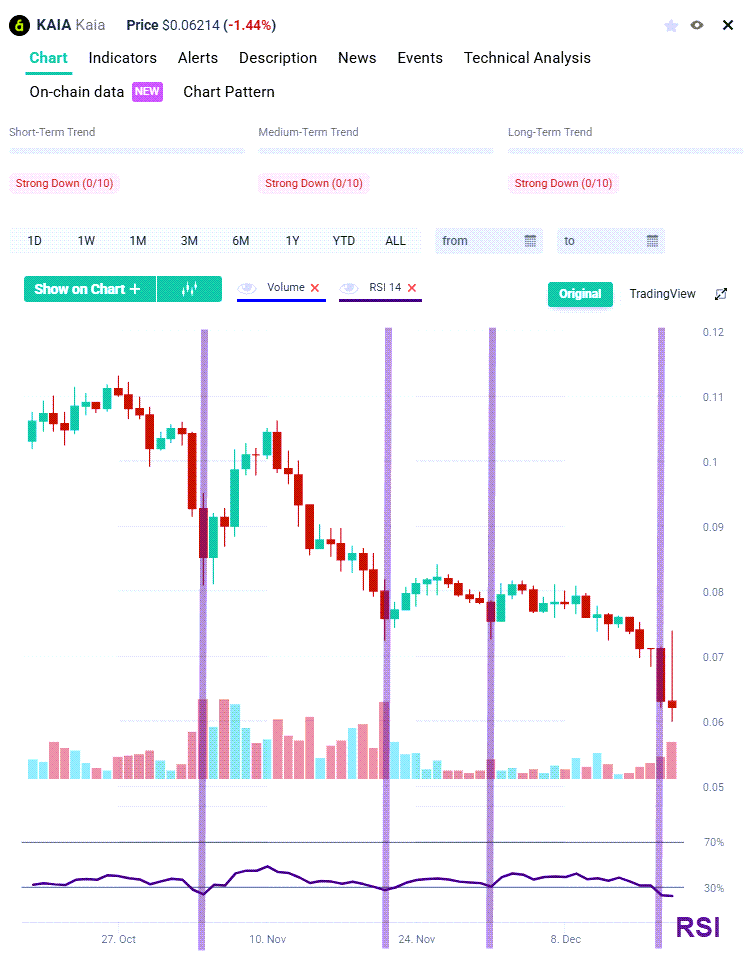
Rules: buy when RSI is below 30 (oversold); sell when RSI is above 70 (overbought). Works best: ranging markets, lower timeframes. Fails: strong trends, where RSI can stay pinned at an extreme for weeks.
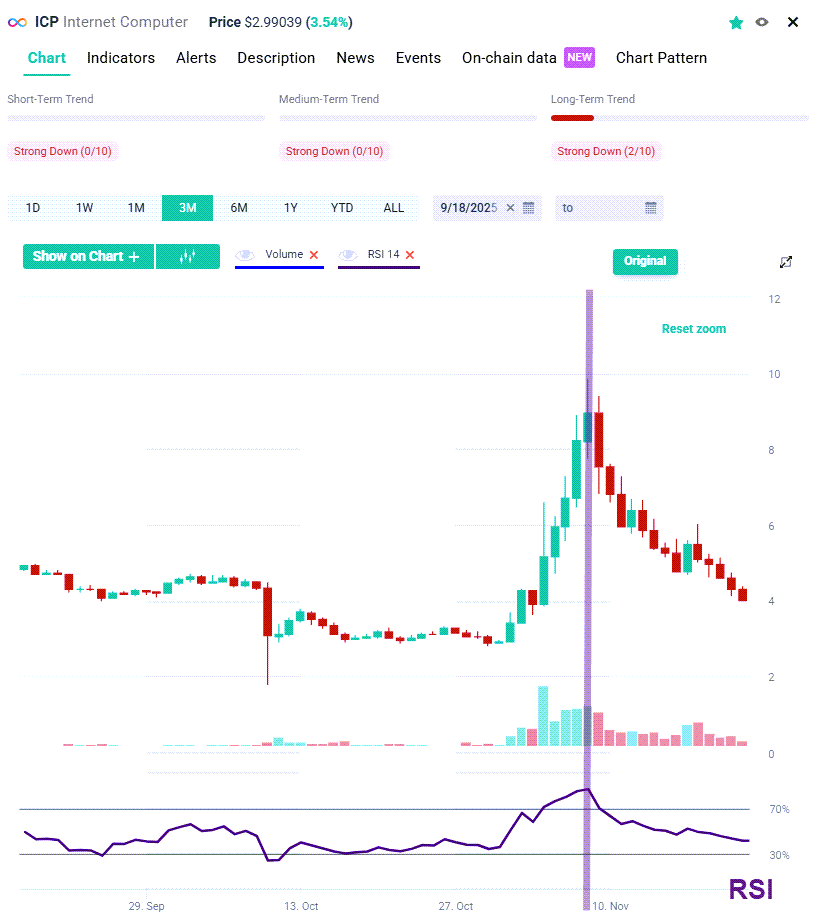
A real example: ICP (Internet Computer Protocol) shot up sharply in November 2025 but got extremely overbought, RSI above 85, and reversed afterward as traders took profits. When a coin’s RSI stretches that far past 70, many traders tighten stops or use a trailing take-profit instead of holding through the pullback. altFINS’s extreme overbought screener flags coins in this state automatically.
Warning: in a strong uptrend, RSI will often reach 70 and beyond for sustained periods, and during downtrends price can stay at 30 or below for a long time. General overbought/oversold levels can still be accurate, but on their own they will not give you the most timely entries in a trending market.
Oversold (RSI <30) example:
Overbought (RSI > 70) example:
The following example, ICP (Internet Computer Protocol), shot up in November 2025 but got way overbought (RSI > 85!!) and reversed afterwards as traders took profits.
When coin prices get so extremely overbought, traders need to take profits or use trailing take profit orders to lock in their profits.
(2) RSI + Support/Resistance (Higher-Probability Strategy)
Rules: only take RSI signals at key horizontal levels, VWAP, or trendlines. Effect: dramatically reduces false signals compared to trading RSI extremes in open space.
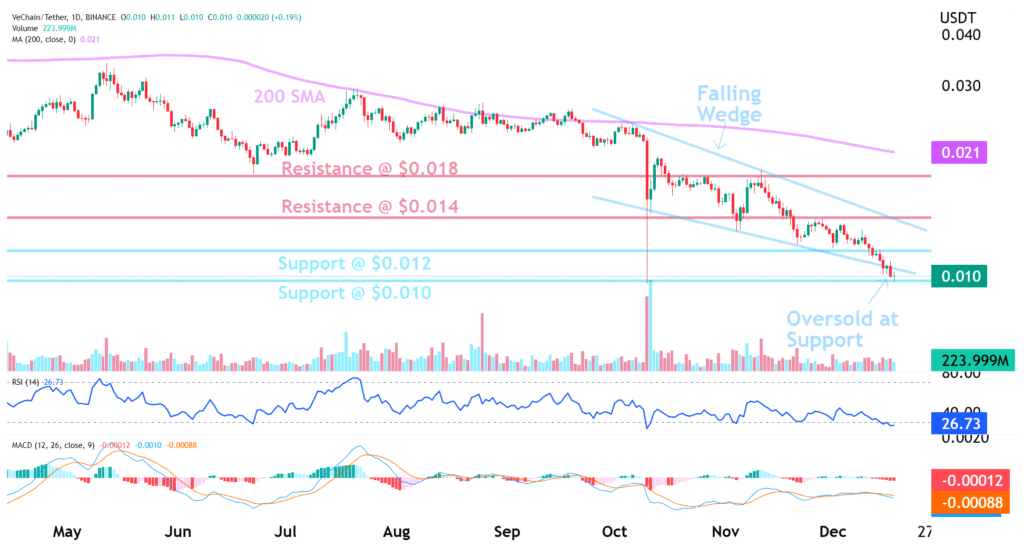
When a coin is oversold (RSI under 30) AND sitting near a known support level, the odds of a bounce improve meaningfully. Real example: VET (VeChain) traded with RSI at 26.7 right as price tested its $0.010 support level, a materially stronger setup than an oversold reading with no structure underneath it.
(3) RSI + Trend Filter
Rules: identify the trend first, then only buy RSI dips to 30 to 40 in an uptrend, and only sell RSI rallies to 60 to 70 in a downtrend. Why it works: it avoids fading strong trends, historically one of the fastest ways to lose on RSI signals alone.
altFINS constantly calculates and refreshes trend ratings for over 2,000 cryptocurrencies, which makes it easy to check whether a coin is in an uptrend or downtrend before you act on an RSI reading.
(4) RSI Momentum Breakout
Rules: RSI breaking above 50 signals bullish momentum; RSI breaking below 50 signals bearish momentum. Use case: trend continuation and earlier confirmation than waiting for the 30/70 extremes. This works best combined with trend: a buy signal is RSI breaking above 50 while price is already in an uptrend; a sell signal is RSI breaking below 50 while price is in a downtrend.
(5) RSI Divergence Crypto Trading Strategy
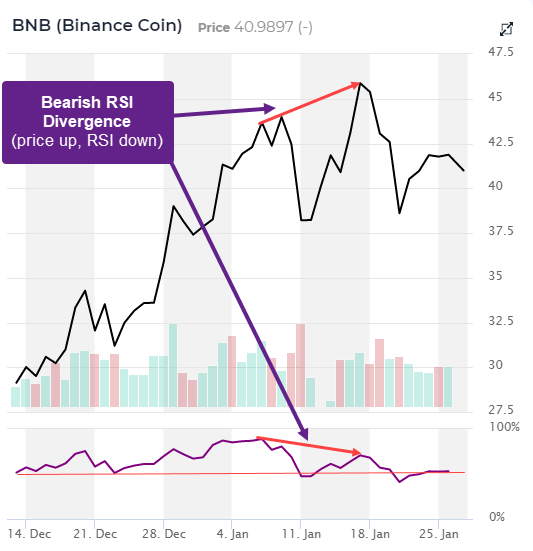
Bullish divergence: price makes a lower low, RSI makes a higher low, read as a buy signal. Bearish divergence: price makes a higher high, RSI makes a lower high, read as a sell signal. Best: near support/resistance, on higher timeframes.
RSI divergence is interpreted as a warning that the RSI value does not confirm the new price extreme, showing weakening momentum. Divergence signals tend to be more accurate on longer timeframes (a minimum of 1-hour charts and above); the higher the timeframe, the fewer false signals you will get.
Benefits and Drawbacks of RSI Divergence
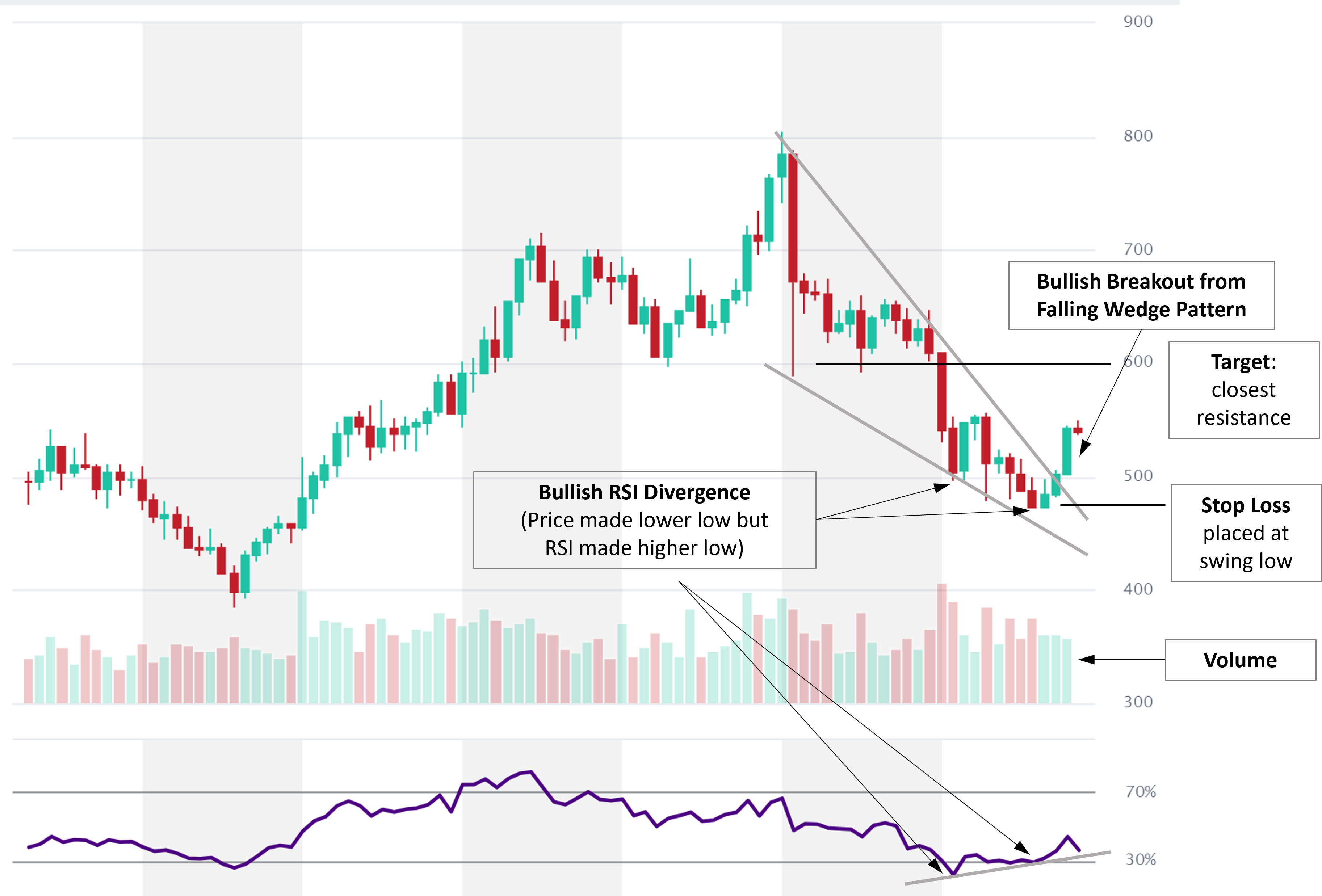
RSI divergence is a strong indication, although it is not always accurate. Divergences can occasionally show up too soon, and price may keep moving in the original direction before it finally turns. For this reason, most traders mix RSI divergence with other signals: candlestick patterns, support/resistance levels, or chart patterns such as a falling wedge. Combining multiple signals meaningfully boosts the odds of a successful entry and exit.
Do: use divergence as an early warning, confirm it with a candlestick pattern, volume, or a second indicator, and favor higher timeframes for fewer false signals.
Don’t: enter the instant you spot a divergence, use it alone on low-cap coins with thin volume, or treat every divergence as a guaranteed reversal; plenty resolve as a pause within the existing trend instead.
Using RSI Divergence to Confirm a Breakout
RSI divergence is not just a reversal tool, it can also confirm a breakout that is already in progress. A common combination is bullish RSI divergence forming right before a breakout from a falling wedge pattern. Together, fading momentum on the way down plus a bullish chart-pattern breakout make a materially stronger case than either signal alone.
What Candlestick Patterns and Indicators Strengthen a Divergence Signal?
Combining RSI divergence with other confirmation signals is a smart way to reduce false entries and increase confidence. Here are the candlestick patterns and indicators that work well alongside it.
Top candlestick patterns for confirmation
| Pattern | Signal type | Why it helps |
|---|---|---|
| Bullish engulfing | Bullish | Strong reversal after a downtrend, confirms bullish divergence |
| Bearish engulfing | Bearish | Strong reversal after an uptrend, confirms bearish divergence |
| Hammer / Inverted Hammer | Bullish | Shows buyer rejection at lows, good near bullish divergence |
| Shooting Star / Hanging Man | Bearish | Shows seller rejection at highs, useful for bearish divergence |
| Doji | Indecision | Can mark a turning point, especially alongside a volume shift |
Indicators that strengthen the signal
| Indicator | Usage | How it helps |
|---|---|---|
| MACD | Trend/momentum | Confirm divergence if MACD shows a cross or histogram shift too |
| Volume | Strength of move | Look for a volume increase as the divergence resolves |
| Moving Averages (50/200 EMA) | Trend filter | Only trade the divergence in the direction of the major trend |
| Stochastic RSI | Extra momentum filter | If both RSI divergence and Stoch RSI show reversal, the case is stronger |
| Bollinger Bands | Overextension | Divergence forming near the band extremes adds conviction |
| Support/Resistance zones | Context | Divergence near a key level is more likely to actually reverse |
| Chart patterns (wedge, triangle) | Structure | Breakout + divergence is a powerful combo, e.g. falling wedge + bullish divergence |
Example combo, real use
A high-confidence bullish setup stacks several of these signals at once: price makes a lower low; RSI makes a higher low (bullish divergence); the divergence sits at a horizontal support level; a hammer candle appears; and volume increases on the breakout. When most or all of these line up, the setup goes from “worth watching” to “worth sizing.”
A real-world version of this: ICP rallied sharply in November 2025, pulled back to test a prior resistance-turned-support zone, and printed a higher RSI low while price briefly dipped below its prior swing low, a textbook bullish divergence. The reversal candle closed as a bullish engulfing bar on rising volume, the same two-signal confirmation described above.
Summary
- Use altFINS tools to find divergence across the market instead of scanning charts by hand.
- Confirm the signal visually on the chart before treating it as valid.
- Combine it with other technical signals, a candlestick pattern, volume, MACD, or a trend filter.
- Apply strong risk management: define a stop-loss and size the position for the possibility the divergence fails.
How To Find Trading RSI and RSI Divergence on altFINS
You can ask altFINS AI Copilot
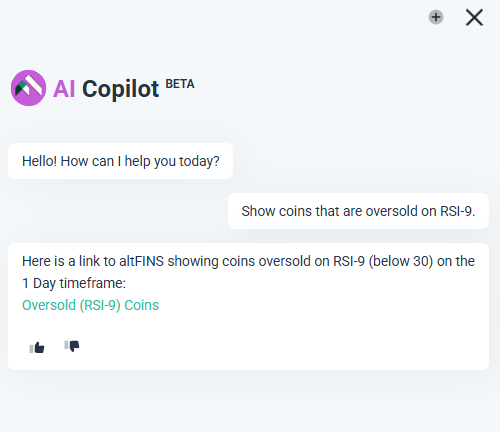
Ask AI Copilot to have fresh data
Quickly Scan For RSI RSI Divergence and Trading RSI on altFINS Crypto Screener
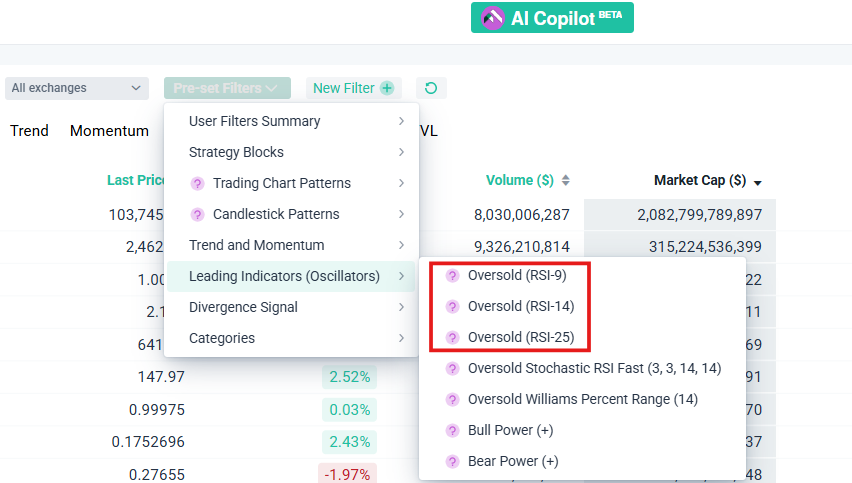
Bullish RSI Divergence in Pre-set Filters`
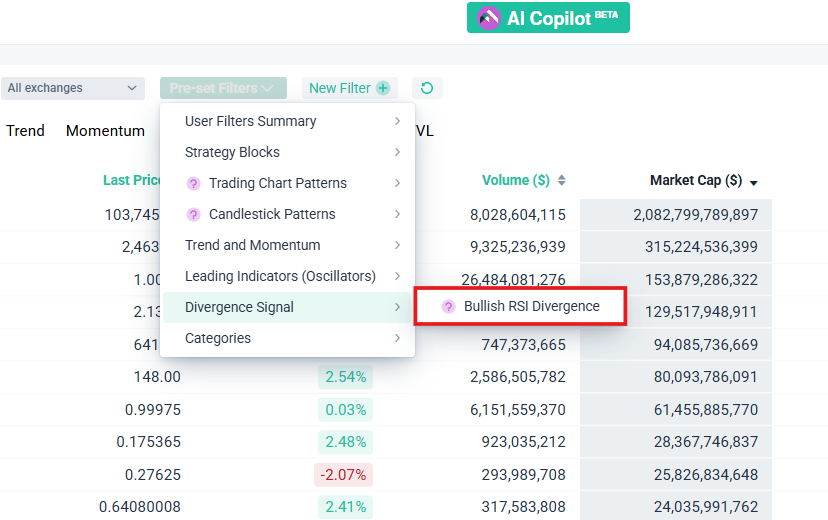
Trading RSI in Pre-set Filters
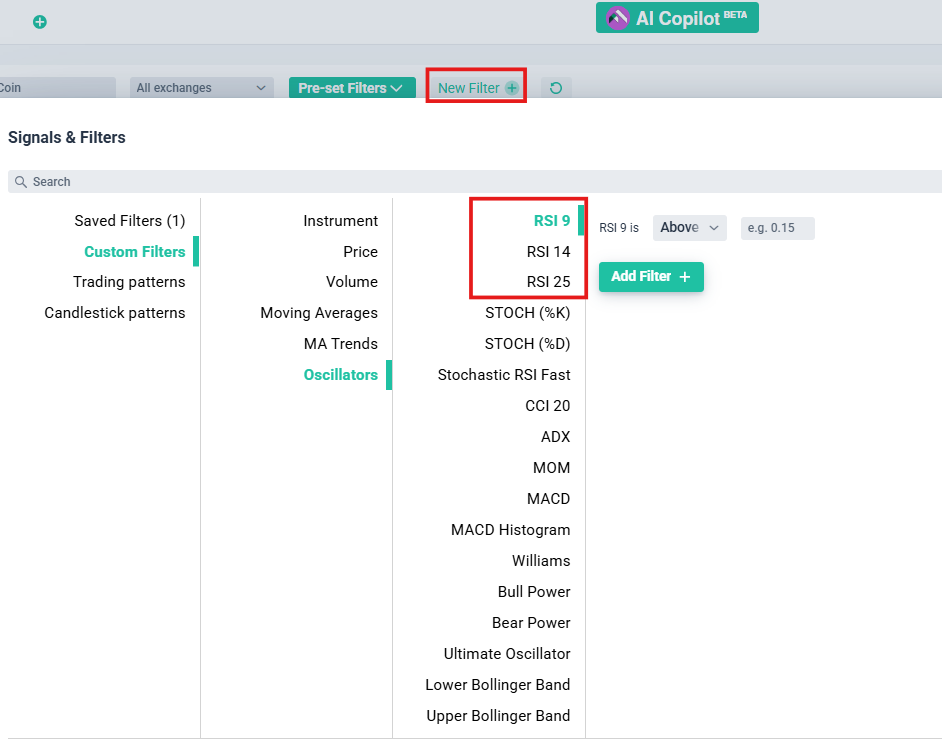
Create a Custom filter on Crypto Screener
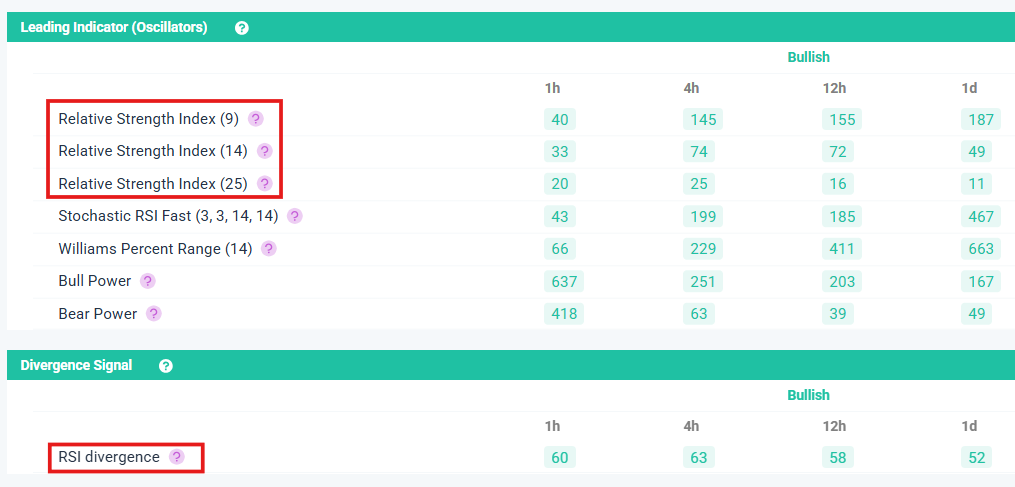
Go to Signals Summary and Find Bullish and Bearish Coins with RSI Divergence or Trading RSI
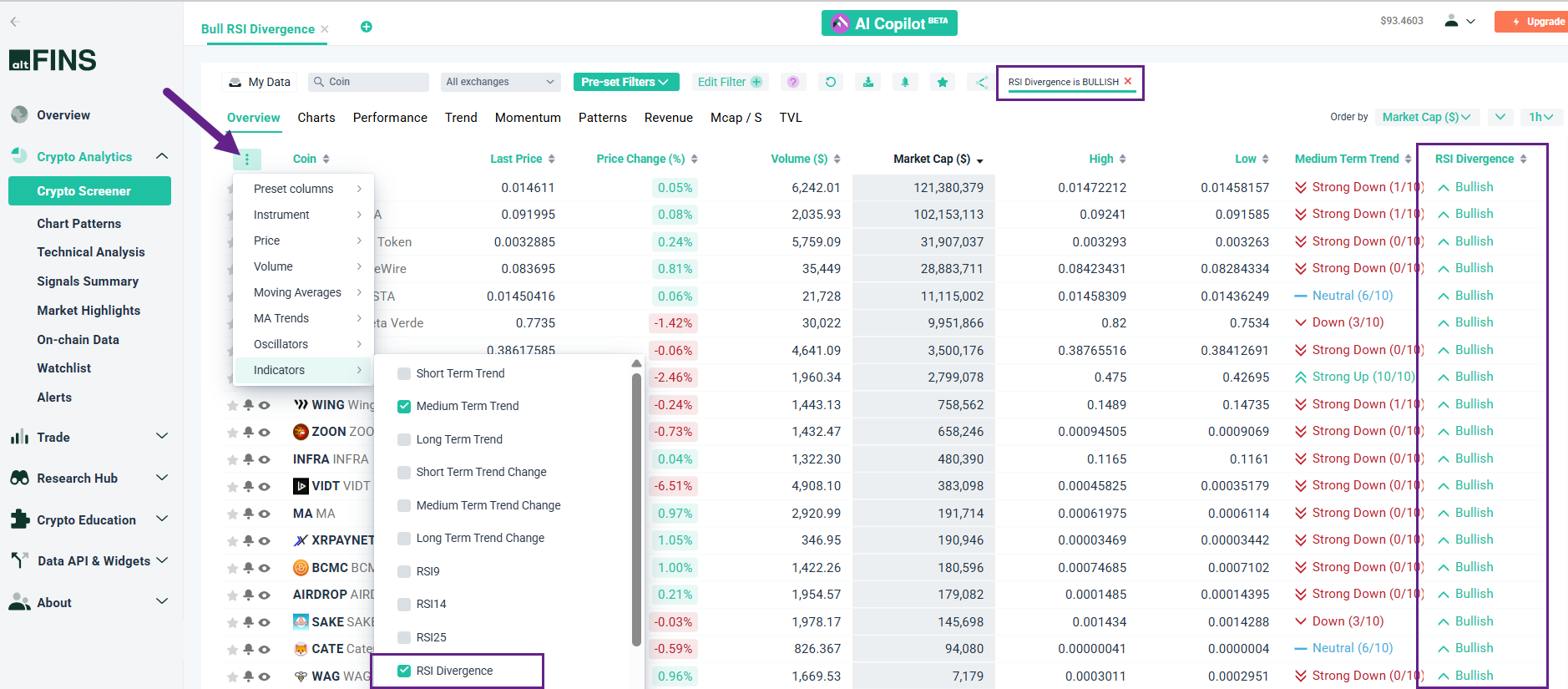
And after running the Pre-set Filter, you can add the RSI Divergence indicators to the Screener.
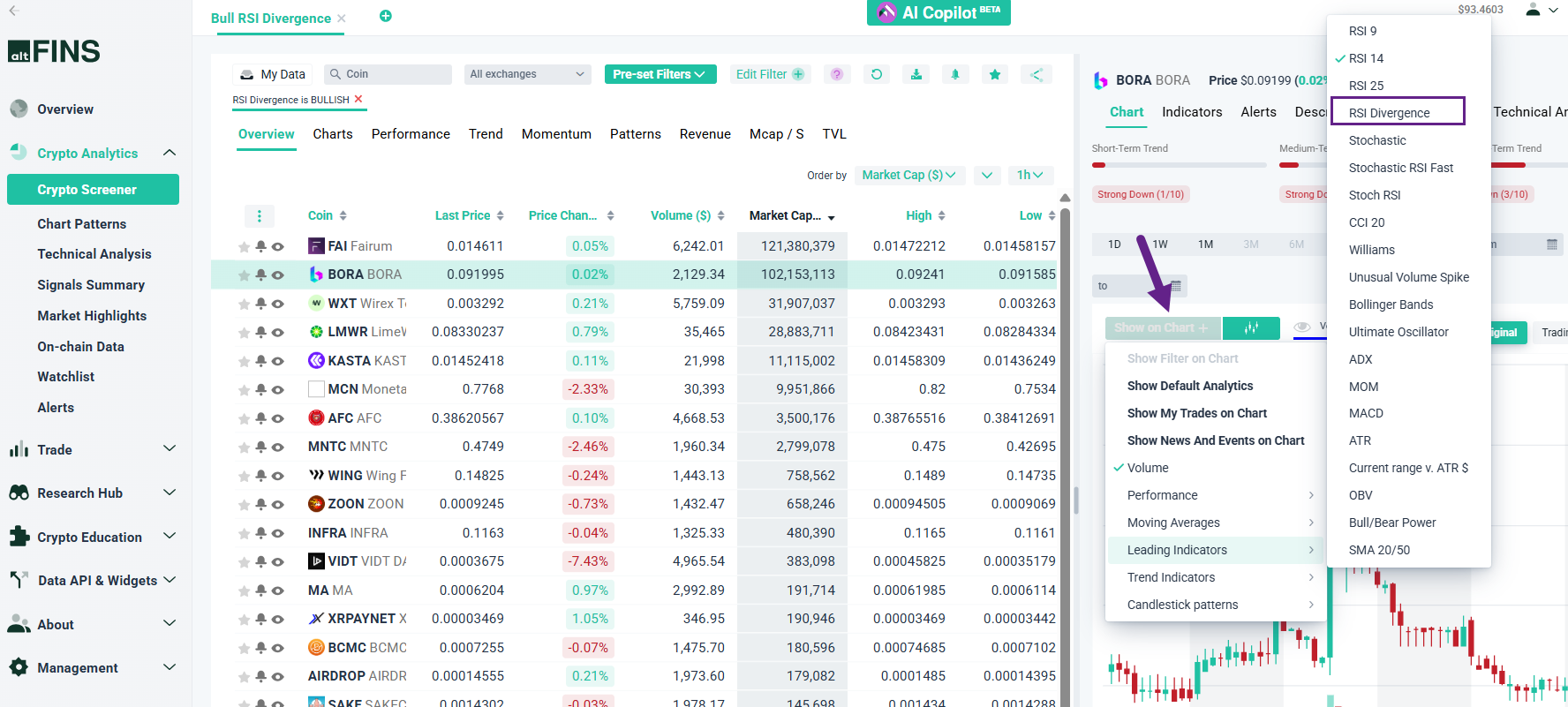
Aldo add RSI Divergence to the charts. Open Detail View for a selected coin. Add RSI (14-period). Draw trendlines on price and RSI to confirm divergence visually.
Frequently asked questions
What does RSI divergence in cryptocurrency trading mean?
RSI divergence means price and the RSI indicator are moving in opposite directions. If price makes a new low that RSI does not confirm with its own new low, that is bullish divergence. If price makes a new high that RSI does not confirm, that is bearish divergence. Both flag fading momentum before price necessarily reverses.
What is the ideal period of time for RSI divergence?
The default 14-period RSI works well on most timeframes and is what most charting platforms, including altFINS, use by default. Divergence signals tend to be more accurate on 1-hour charts and above; shorter periods or lower timeframes react faster but produce more false signals.
Is it possible for me to automatically check for RSI divergence?
Yes. The altFINS crypto screener scans over 3,000 cryptocurrencies and flags RSI-based signals, including overbought/oversold and divergence conditions, in real time through Signal Summary, pre-set filters, and Trade Setups. You can also set a custom alert instead of manually checking each coin’s chart.
Is RSI divergence sufficient for trading?
No. Divergence is an early warning of fading momentum, not a complete trade signal. Pair it with a known support or resistance level, a confirming candlestick pattern, a volume increase, or a second momentum indicator like MACD before entering, and always define a stop-loss in case the divergence fails to resolve into a reversal.
What is the difference between regular and hidden RSI divergence?
Regular divergence (covered in this guide) signals a potential trend reversal. Hidden divergence is the opposite setup: price makes a higher low while RSI makes a lower low during an uptrend, or a lower high while RSI makes a higher high during a downtrend, and it signals trend continuation rather than reversal.
Why does RSI stay overbought or oversold for so long in crypto?
In a strong trend, momentum can stay stretched far longer than the textbook 70/30 levels suggest, as the ICP example above shows. Crypto trends particularly hard during bull and bear phases, so treat overbought and oversold readings as a caution flag during a strong trend, not an automatic reversal signal, and rely on divergence or a trend filter instead.
Ready to stop scanning charts by hand? Open the altFINS crypto screener to filter live RSI signals and divergence setups across the market, or see how RSI pairs with chart patterns like the double top and double bottom to confirm a reversal.
This article is for educational purposes only and is not financial advice. RSI, RSI divergence, and every other technical indicator describe historical price behavior and do not guarantee future results. Cryptocurrency trading involves substantial risk of loss; always use a stop-loss and never risk more than you can afford to lose.