
Search Knowledge Base by Keyword
Connecting to Exchanges on altFINS Terminal
Use API connections to become a more efficient trader.
Traders can use altFINS’ many features even without connecting to supported exchanges, including running screeners, alerts, watchlists, and Twitter news.
However, connecting your exchange accounts to altFINS unlocks the following benefits:
- Filter Screener results for just coins in your portfolio
- Filter Signals Summary for just coins in your portfolio
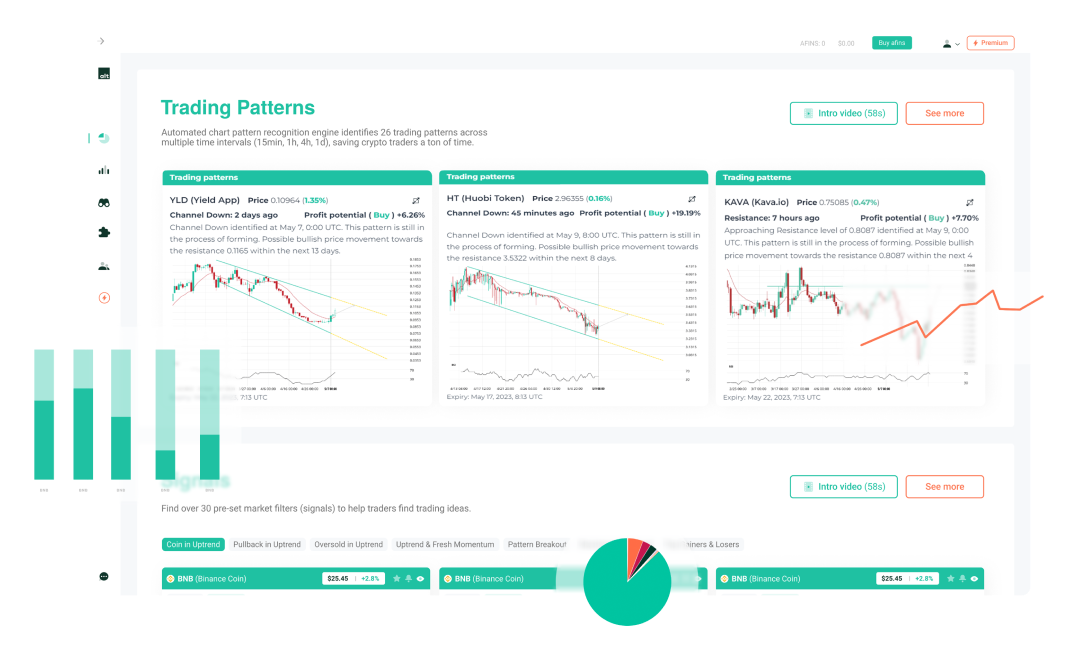
- Filter automated Chart Patterns for just coins in your portfolio
- Monitor coins in your portfolio across multiple exchanges
- Trade coins in your portfolio across multiple exchanges
You can easily connect your altFINS account to your exchange accounts via API connections. All exchanges allow users to create an API connection so they can use third-party tools to trade and monitor positions.
Supported Exchanges & Tutorials
Currently, altFINS supports API connectivity with the following exchanges:
- Binance — see how to connect
- Bitfinex — see how to connect
- Kraken — see how to connect
- Gate.io — see how to connect
- Bybit — see how to connect
- KuCoin — see how to connect
- Coinbase — see how to connect
- Bitget — see how to connect
- OKX — video coming soon
- HTX — video coming soon
- Crypto.com — video coming soon
- CoinEx — see how to connect *NEW
To request integration with another exchange, please email us at [email protected].
About the Supported Exchanges
Below is a short overview of each exchange altFINS supports, so you can decide which ones best match your trading style.
Binance
The world’s largest crypto exchange by trading volume. Binance offers one of the broadest selections of spot pairs, futures, and altcoins. A strong fit for traders who want deep liquidity, low fees, and access to nearly every major token.
Bitfinex
One of the longest-running exchanges, popular with professional and high-volume traders. Bitfinex offers advanced order types, margin trading, and lending markets — ideal for users who need sophisticated tools beyond basic spot trading.
Kraken
Known for its strong security track record, regulatory compliance, and reliable fiat on/off-ramps. A solid choice for traders who prioritize trust, transparency, and a curated selection of established assets.
Gate.io
Offers an extremely wide range of altcoins and early-stage tokens, often listing projects before larger exchanges. A good fit for traders looking to access smaller-cap or newly launched assets.
Bybit
Built its reputation around derivatives and perpetual futures, with a fast matching engine and a clean trading interface. Spot markets have grown rapidly, making it appealing to both active traders and newer users.
KuCoin
Often called the “people’s exchange” thanks to its huge altcoin selection, trading bots, and earn products. Popular with retail traders looking for variety and built-in passive income tools.
Coinbase
One of the most established and regulated exchanges, particularly in the U.S. Beginner-friendly, deeply integrated with traditional banking rails, and ideal for users who value compliance and ease of use.
Bitget
Focuses on copy trading and derivatives, allowing users to mirror the strategies of experienced traders. A strong option for newer traders who want to learn by following others, alongside standard spot and futures markets.
OKX
Offers a comprehensive suite covering spot, futures, options, and DeFi access through its built-in Web3 wallet. Versatile for traders who want both centralized trading and on-chain exposure in one place.
HTX
Formerly Huobi — one of the older exchanges in the space, with a strong presence in Asian markets. Offers a broad mix of spot and derivative products and a wide range of supported assets.
Crypto.com
Combines exchange trading with a popular consumer app, debit card, and earn products. Well-suited to users who want a single platform for trading, spending, and holding crypto.
CoinEx
A global exchange offering spot, margin, and futures trading across hundreds of pairs, including many smaller-cap altcoins. Known for a simple interface, low fees, and accessibility for traders in regions where other exchanges have limited support.
Crypto Exchange Comparison 2026: Binance, Coinbase, Kraken, Bybit, OKX & More
A side-by-side breakdown of the 12 exchanges supported by altFINS API connectivity — covering features, fees, liquidity, regulation, security, pros, cons, and best fit for each trader profile. Fee data verified March 2026; rates and jurisdictions can change, so always confirm on the exchange’s official page before trading.
1. Binance
Overview: The world’s largest crypto exchange by trading volume, serving 270M+ users globally with the deepest liquidity and broadest product suite in the industry.
Key features: Spot, margin, futures (up to 125x), options, copy trading, Earn/staking, BNB Chain Web3 wallet, Launchpad, NFT marketplace, Binance Pay.
Fees: Spot 0.10% / 0.10% (or 0.075% with BNB discount). Futures 0.02% maker / 0.05% taker. Up to 25% extra discount paying fees in BNB.
Liquidity & assets: 600+ coins, 1,500+ trading pairs, deepest order books in the industry on majors and most altcoins.
Regulation: Licensed in multiple EU/MENA jurisdictions. Restricted: US (Binance.US is a separate, more limited entity), UK derivatives, Canada, Netherlands.
Security: SAFU insurance fund (~$1B+), publishes proof-of-reserves, no major successful hack since the 2019 $40M incident (fully reimbursed).
Pros: Deepest liquidity globally • Lowest fees among major exchanges • Most complete product ecosystem.
Cons: Geographic restrictions in many Western markets • Interface overwhelming for beginners • Past regulatory settlements raise compliance concerns.
Best suited for: Active traders, altcoin hunters, derivatives traders, anyone outside the U.S. wanting one-stop coverage.
2. Bitfinex
Overview: A veteran exchange founded in 2012, popular with professional and high-volume traders. Closely affiliated with Tether (USDT).
Key features: Spot, margin (up to 10x), perpetual futures, P2P funding/lending market, OTC desk, advanced order types (Iceberg, TWAP, Trailing Stop), staking, Bitfinex Pay.
Fees: Spot 0.10% maker / 0.20% taker. Derivatives 0.02% / 0.065%. Discounts via LEO token holdings and 30-day volume.
Liquidity & assets: ~170 coins, 400+ pairs. Strong liquidity on BTC, ETH, USDT pairs; thinner on small-caps.
Regulation: Headquartered in BVI. Restricted from U.S. retail users.
Security: Notable 2016 hack ($72M, all funds eventually repaid in BTC/equity tokens). Today operates with cold storage and insurance reserves; track record stable since.
Pros: Industry-leading order types and margin lending • Strong API for algo traders • Deep BTC/USD liquidity.
Cons: Steep learning curve • Banking/withdrawal friction historically • Closed to U.S. retail.
Best suited for: Professional traders, margin lenders, algorithmic/quant traders.
3. Kraken
Overview: Founded in 2011 — one of the oldest exchanges still operating. Known for security, compliance, and a clean U.S./EU regulatory record.
Key features: Spot, Kraken Pro (advanced UI), margin (up to 5x), futures, staking, OTC desk, NFT marketplace, fiat on/off-ramps in USD/EUR/GBP/CAD/AUD.
Fees: Spot 0.25% / 0.40% (Kraken Instant Buy); Kraken Pro: 0.16% / 0.26% at base tier. Futures 0.02% / 0.05%. Pro fees scale to 0% maker at high volume.
Liquidity & assets: 500+ coins, 700+ pairs. Strong fiat liquidity, 99.9% uptime, sub-2ms latency on Pro.
Regulation: Registered with FinCEN (US), FCA (UK e-money), and multiple state-level licenses. Available: 190+ countries including most U.S. states.
Security: No major exchange-level hack in 14+ years of operation. Publishes proof-of-reserves with cryptographic verification.
Pros: Best security track record in the industry • Strong fiat support and compliance • Reliable customer service.
Cons: Higher base fees than Asian exchanges • Fewer altcoins than Binance/Gate.io • Simple interface lacks features of Pro.
Best suited for: Long-term investors, U.S. and EU users, security-focused traders, institutions.
4. Gate.io
Overview: Founded in 2013, Gate.io is famous for listing emerging tokens earlier than competitors and supporting one of the widest altcoin selections in the market.
Key features: Spot, margin, futures (up to 100x), options, copy trading, Startup IEO platform, dual-currency products, HODL & Earn, NFT, Web3 wallet.
Fees: Spot 0.20% / 0.20% base (zero fees on selected BTC pairs). Futures 0.02% / 0.05%. GT token holders get up to 55% off.
Liquidity & assets: 1,700+ coins, 2,800+ pairs — one of the largest catalogs in crypto. Liquidity strong on majors, thin on micro-caps.
Regulation: Registered in multiple jurisdictions including Lithuania (VASP), Italy, and Hong Kong. Restricted: U.S., U.K., Canada, mainland China.
Security: Publishes proof-of-reserves; no major hack in 12+ years. Operates a $1B safety reserve.
Pros: Largest altcoin selection of any major CEX • Early access to new listings • Solid security history.
Cons: Higher base spot fees than top tier • Some listed tokens are highly speculative • Excluded from major Western markets.
Best suited for: Altcoin hunters, early-listing traders, traders outside the U.S./U.K.
5. Bybit
Overview: Launched in 2018 as a derivatives-first exchange, now the second-largest crypto exchange by overall trading volume.
Key features: Spot, perpetual & inverse futures (up to 100x), options, copy trading, Bybit Earn, Web3 wallet, NFT marketplace, demo trading account.
Fees: Spot 0.10% / 0.10%. Futures 0.02% maker / 0.055% taker — among the lowest in derivatives. Watch out: “Instant Buy” charges up to 5%.
Liquidity & assets: 650+ trading pairs, 100+ coins. Excellent perpetual futures depth on majors.
Regulation: Operates in ~160 countries. Restricted: U.S., Canada, U.K., France, Singapore (resident retail).
Security: Suffered a major hack in February 2025 (~$1.4B in ETH stolen) — funds were fully reimbursed via reserves and loans, but the incident is the largest in crypto history. Now publishes proof-of-reserves and has rebuilt cold-storage architecture.
Pros: Best-in-class derivatives engine and UX • Very low futures fees • Strong copy trading.
Cons: Recent record-setting hack damages trust • No U.S. access • Regulatory pressure rising in EU.
Best suited for: Derivatives traders, copy traders, scalpers, perpetual futures specialists.
6. KuCoin
Overview: Known as “the People’s Exchange” for its huge altcoin selection and strong retail focus.
Key features: Spot, margin, futures (up to 100x), trading bots (grid, DCA, smart rebalance), KuCoin Earn, Win-Win pools, P2P fiat, NFT marketplace.
Fees: Spot 0.10% / 0.10% (20% off paying with KCS token). Futures 0.02% / 0.06%.
Liquidity & assets: 700–1,100+ coins (one of the broadest), 1,300+ pairs. Decent liquidity on top altcoins.
Regulation: Pleaded guilty in 2024 to U.S. AML violations and paid ~$300M in penalties; permanently exited the U.S. market. Available in most other regions.
Security: Suffered a 2020 hack (~$280M, fully recovered/reimbursed). Now uses Merkle Tree proof-of-reserves and a Safeguard Insurance Fund.
Pros: Massive altcoin catalog • Built-in trading bots • Generous earn products.
Cons: No U.S. access post-settlement • Mixed regulatory record • Variable token quality.
Best suited for: Retail altcoin traders, bot users, passive-income seekers.
7. Coinbase
Overview: The largest U.S. exchange, publicly listed on Nasdaq (COIN), and the gold standard for regulatory compliance in North America.
Key features: Spot, Coinbase Advanced Trade (Pro), futures (regulated CFTC), staking, Coinbase Wallet (self-custody), Base L2 chain, Coinbase One subscription, debit card.
Fees: Simple interface up to 3.99%; Coinbase Advanced: 0.40% maker / 0.60% taker at base tier (drops with volume). Coinbase One ($20/mo) waives fees up to certain limits.
Liquidity & assets: ~310 coins, 400+ pairs. Excellent USD liquidity.
Regulation: Most heavily regulated major crypto exchange — operates in 100+ countries with state-by-state U.S. licensing, MiCA-registered in EU.
Security: No major hack in its history. SOC-2 audited; insurance on hot-wallet holdings; 98%+ of assets in cold storage.
Pros: Strongest regulatory standing • Beginner-friendly • Excellent fiat banking integration.
Cons: Highest fees among major exchanges • Smaller altcoin selection • No high-leverage products.
Best suited for: Beginners, U.S. users, long-term HODLers, compliance-focused institutions.
8. Bitget
Overview: Founded in 2018, Bitget pioneered one-click copy trading and has become a top-5 derivatives exchange globally.
Key features: Spot, futures (up to 125x), copy trading (largest in crypto), trading bots, Bitget Wallet (Web3), Launchpad, Earn, Telegram trading apps.
Fees: Spot 0.10% / 0.10% (as low as 0.01%/0.01% with BGB token + VIP). Futures 0.02% / 0.06%.
Liquidity & assets: 1,300+ coins, deep futures liquidity, 100M+ users.
Regulation: Registered in Lithuania, Poland, Italy, Australia (AUSTRAC). Restricted: U.S., Canada, U.K., Singapore.
Security: $500M+ Protection Fund (publicly verifiable). Monthly proof-of-reserves. No major hack.
Pros: Industry-leading copy trading • Large protection fund • Growing global compliance footprint.
Cons: No U.S. access • Younger track record than Binance/Kraken • Some listed tokens highly speculative.
Best suited for: Copy traders, beginner derivatives traders, mobile-first users.
9. OKX
Overview: A top-3 exchange globally, with one of the most comprehensive product suites bridging CEX, DeFi, and Web3.
Key features: Spot, margin, futures (up to 100x), options, OKX Wallet (multi-chain Web3), DEX aggregator, NFT marketplace, Jumpstart launchpad, structured products.
Fees: Spot 0.08% maker / 0.10% taker (regular tier). Futures 0.02% / 0.05%. OKB token holders get up to 40% off; zero-fee on select stablecoin pairs.
Liquidity & assets: 350+ coins, 680+ pairs. Strong derivatives depth.
Regulation: Settled with U.S. DOJ in 2025 (~$500M for AML violations); now licensed in select U.S. states (launched April 2025), Dubai (VARA), Singapore (in-principle), Bahamas, Malta.
Security: Publishes monthly proof-of-reserves. No major exchange hack. Cold-storage majority.
Pros: Excellent built-in Web3/DeFi tools • Competitive fees with token discounts • Expanding compliance footprint.
Cons: Complex interface • Past AML settlement raises trust questions • Limited U.S. product set so far.
Best suited for: Hybrid CeFi/DeFi traders, derivatives users, on-chain explorers.
10. HTX (formerly Huobi)
Overview: Founded in 2013 as Huobi; rebranded HTX in 2023 after acquisition by Justin Sun (Tron). Strong presence in Asian markets.
Key features: Spot, margin, futures, options, copy trading, Earn, Prime launchpad, OTC, Web3 wallet.
Fees: Spot 0.20% / 0.20% base (HTX Pro: 0.10% / 0.10%). Futures 0.02% / 0.04%. Discounts via HTX Token (HT) holdings.
Liquidity & assets: 700+ coins. Strong on Asian-focused tokens, derivatives volume in top 10 globally.
Regulation: HQ in Seychelles. Restricted: U.S., U.K., mainland China.
Security: Suffered a $258M hack in late 2023 (mostly recovered/reimbursed). Currently publishes proof-of-reserves, but transparency is rated mid-tier.
Pros: Long operating history • Wide derivatives offering • Strong APAC liquidity.
Cons: Mixed regulatory and security history • Heavy ownership ties to Tron ecosystem • Limited Western reach.
Best suited for: Asia-based traders, Tron-ecosystem users, derivatives traders comfortable with the platform’s history.
11. Crypto.com
Overview: A consumer-focused crypto super-app combining exchange, debit card, earn products, and an NFT marketplace. Heavy global marketing presence.
Key features: App (simple buy/sell), Crypto.com Exchange (Pro trading), futures, derivatives, Visa debit card, Crypto Earn, DeFi Wallet, Cronos chain, NFT marketplace.
Fees: App: variable spread (often 0.5–2.99%). Exchange: 0.25% / 0.50% base, drops to 0.04% / 0.10% with CRO staking and volume. Futures 0.02% / 0.04%.
Liquidity & assets: 350+ coins on the exchange, 250+ on the app.
Regulation: Licensed in U.S. (multiple states + MSB), U.K., Singapore (in-principle MAS), Italy, France, Australia, Dubai.
Security: A January 2022 hack of $35M (fully reimbursed). Publishes proof-of-reserves. SOC-2 Type II certified.
Pros: All-in-one app + card + trading • Strong global compliance • Generous CRO staking rewards.
Cons: App fees can be high without CRO staking • Card rewards reduced significantly since 2022 • Customer support widely criticized.
Best suited for: Casual users, card-spenders, all-in-one consumer crypto experience.
12. CoinEx
Overview: Founded in 2017 by ViaBTC’s team, CoinEx targets retail traders with a clean interface, broad altcoin coverage, and accessible KYC requirements in many regions.
Key features: Spot, margin, perpetual futures (up to 200x on select pairs), AMM pools, CoinEx Earn (financial account), copy trading.
Fees: Spot 0.16% / 0.20% standard (discounts via CET token + 30-day volume). Futures 0.03% / 0.05%.
Liquidity & assets: 600+ coins, 1,300+ trading pairs. Liquidity on majors is solid; small-caps thin.
Regulation: Operates under multi-jurisdictional registrations. Restricted: U.S., U.K., several other regulated markets. Withdrawals up to ~$50,000/day available without full KYC in many regions.
Security: Suffered a 2023 hack (~$70M, all user funds reimbursed). Publishes monthly proof-of-reserves; maintains a “Shield Fund” insurance reserve.
Pros: Simple, beginner-friendly UI • Accessible in regions where bigger exchanges restrict • High leverage available.
Cons: Higher base fees than top tier • Smaller liquidity than Binance/Bybit • Past hack and limited Western regulatory standing.
Best suited for: Retail altcoin traders, users in regions with limited exchange access, traders preferring simpler UIs.
📊 Summary Ranking Table (1–10 each)
Scores reflect a blend of public data, fee schedules, security history, regulatory filings, and user reports as of early 2026. They are guides, not absolutes.
| Exchange | Ease of Use | Fees | Asset Variety | Derivatives | Regulation | Trust Score |
|---|---|---|---|---|---|---|
| Binance | 7 | 9 | 9 | 10 | 6 | 8 |
| Bitfinex | 5 | 7 | 6 | 7 | 5 | 6.5 |
| Kraken | 8 | 6 | 7 | 7 | 10 | 9.5 |
| Gate.io | 6 | 7 | 10 | 8 | 5 | 7 |
| Bybit | 8 | 9 | 7 | 10 | 5 | 6.5 |
| KuCoin | 7 | 8 | 9 | 7 | 4 | 6.5 |
| Coinbase | 10 | 4 | 6 | 5 | 10 | 9.5 |
| Bitget | 8 | 9 | 9 | 9 | 6 | 7.5 |
| OKX | 7 | 8 | 8 | 9 | 6 | 7.5 |
| HTX | 6 | 7 | 8 | 8 | 4 | 5.5 |
| Crypto.com | 9 | 5 | 7 | 6 | 9 | 8 |
| CoinEx | 7 | 6 | 7 | 7 | 4 | 6.5 |
🏆 Top Picks by Category
🥇 Best for U.S. users: Coinbase & Kraken
🥇 Best for derivatives: Bybit & Binance
🥇 Best for altcoin hunters: Gate.io & KuCoin
🥇 Best for copy trading: Bitget & Bybit
🥇 Best for compliance & security: Kraken & Coinbase
🥇 Best for one-stop ecosystem: Binance & OKX
🥇 Best all-in-one consumer app: Crypto.com
⚠️ Important Caveats & Things That May Have Changed
- Bybit Feb-2025 hack: The largest exchange hack in crypto history. Bybit reimbursed users in full but trust is still recovering.
- OKX entered the U.S. market in April 2025 after a $500M DOJ settlement — its product set there is still expanding.
- KuCoin exited the U.S. market in 2024–2025 following its AML settlement; if you’re a U.S. user, look elsewhere.
- Regional restrictions shift constantly due to MiCA (EU), FCA (UK), and individual U.S. states. Always verify access from your jurisdiction.
- Fees change with promotions and VIP tiers — most exchanges post quarterly fee updates and run zero-fee campaigns periodically.
- “Trust scores” are inherently subjective. Treat them as a starting point; do your own due diligence before depositing significant capital.
Final Thoughts
There’s no single “best” crypto exchange — the right choice depends on where you live, what you trade, and how active you are. Many serious traders use 2–3 exchanges in parallel: a regulated one (Coinbase/Kraken) for fiat on/off-ramps, a high-volume one (Binance/OKX) for active trading, and a specialty one (Bybit for derivatives, Gate.io for early altcoins) for niche needs.
Whichever combination you choose, connect them all to altFINS via API to monitor your full portfolio in one place, run signals on the coins you actually own, and execute trades from a unified interface.
Ready to unify your exchanges?
Connect your accounts to altFINS and trade smarter across all 12 supported exchanges.