
Search Knowledge Base by Keyword
Best Decentralized Exchanges in 2026: Complete Ranking by Volume, Fees & Features
Last updated: April 2026 | The decentralized exchange (DEX) market has evolved dramatically into 2026. With perpetual DEX volumes surging over 650% year-on-year, Solana DEXs now moving more money than Ethereum DEXs, and Hyperliquid controlling 60–70% of on-chain derivatives, choosing the best DEX in 2026 requires fresh data — not last year’s playbook.
This guide ranks the top decentralized exchanges in 2026 by trading volume, TVL, supported chains, fee structures, and unique features — so you can match the right DEX to your trading strategy, whether you’re a retail swapper, a yield farmer, a stablecoin whale, or a perps trader chasing leverage.
Quick Answer: What Is the Best DEX in 2026?
There is no single “best” DEX in 2026 — but here are the clear category leaders based on April 2026 data:
- Best overall & deepest liquidity: Uniswap
- Best for BNB Chain & multi-chain retail: PancakeSwap
- Best perpetual DEX: Hyperliquid
- Fastest-growing perp challenger: Aster
- Best for Base ecosystem: Aerodrome
- Best for Solana trading: Raydium, Orca & Jupiter
- Best for stablecoin swaps: Curve Finance
- Best cross-chain native swaps: THORChain
Explore altFINS DEX Aggregator
DEX Market in 2026: Key Statistics
Before diving into individual platforms, here is the state of the DEX market in 2026:
- DEXs processed approximately $4.9 trillion in spot volume during 2025, with perpetual DEXs adding another $8 trillion.
- DEX share of global spot trading volume climbed from 6.9% in January 2024 to 13.6% in January 2026.
- DEX share in perpetuals expanded fivefold — from 2.0% to 10.2% over the same period.
- Total DEX TVL stands above $155 billion, up 40% year-on-year.
- Monthly active wallets interacting with DEXs exceed 12 million, a new record.
- In a major 2026 shift, Solana DEXs now move more volume than Ethereum DEXs ($117B vs $52B in January 2026).
Sources: DefiLlama, CoinGecko 2026 Trading Activity Report.
Top Decentralized Exchanges in 2026 — Full Ranking
1. Uniswap — Best Overall DEX in 2026
Website: app.uniswap.org
- Chains supported: ~40 (Ethereum, Arbitrum, Optimism, Polygon, Base, BNB Chain, and more)
- TVL: ~$4.98 billion
- Daily volume: ~$1.44 billion (across V2, V3, V4)
- Monthly volume: ~$37.5 billion
- Fees: 0.05% on major pairs, 0.3%–1% on long-tail pools
Uniswap remains the most influential spot DEX in 2026. The V4 upgrade introduced “hooks” — pluggable code modules enabling on-chain limit orders, dynamic fees that adjust to volatility, and custom LP strategies. Uniswap captures roughly 70% of Ethereum’s DEX volume and reclaimed the #1 overall spot position in late 2025 with a 35.9% market share.
Pros: Deepest liquidity, widest chain coverage, battle-tested security, V4 hooks unlock institutional strategies.
Cons: Fees higher than stablecoin-optimized DEXs, Ethereum L1 gas can be brutal during congestion.
2. PancakeSwap — Best Multi-Chain DEX for Retail
Website: pancakeswap.finance
- Chains supported: 9 (BNB Chain, Ethereum, Base, Arbitrum, zkSync, Linea, Polygon zkEVM, Aptos, opBNB)
- TVL: ~$2.47 billion (85%+ on BNB Chain)
- Monthly volume: ~$27.3 billion
- Peak monthly volume (June 2025): $325 billion
- Fees: ~0.25% per trade
PancakeSwap had its breakout year in 2025, growing +539% QoQ from Q1 to Q2 and briefly becoming the largest DEX by quarterly volume with 45% share. It now dominates BNB Chain with over 85% market share and has entered the global top 10 spot exchanges — centralized or decentralized. PancakeSwap Infinity CLMM (concentrated liquidity) and V4 contribute heavily to this flow.
Pros: Low fees, fast execution on BNB Chain, intuitive UI, robust yield farming and gamified features.
Cons: Lower liquidity outside BNB Chain, some pools carry impermanent loss risk.
3. Hyperliquid — Best Perpetual DEX in 2026
Website: app.hyperliquid.xyz
- Chain: Custom Hyperliquid L1 (with HyperEVM)
- TVL: ~$4.06 billion
- 30-day perp volume: ~$208 billion+
- Daily volume: Regularly exceeds $8 billion
- Open interest: ~$5.15 billion average
- Fees: Maker ~0.01% / Taker ~0.035%, zero gas
- Leverage: Up to 50x
Hyperliquid is the defining DEX story of 2026. Running a fully on-chain order book on its own purpose-built L1, it delivers sub-second execution with zero gas fees. It controls more than 70% of open interest in decentralized perpetual markets as of March 2026 and became the first perpetuals-focused DEX to enter the global top 10 crypto exchanges. The HYPE token benefits from a fee buyback mechanism in which roughly 99% of fees fuel HYPE buybacks and burns.
Pros: CEX-level speed, zero gas, full on-chain order book, deepest perp liquidity, S&P 500 stock perps now available.
Cons: Single-chain ecosystem, steep learning curve for DeFi newcomers.
4. Aster — Fastest-Growing Perp DEX Challenger
Website: asterdex.com
- Chains supported: 4 (BNB Chain, Ethereum, Solana, Arbitrum)
- TVL: ~$1.05 billion
- 24h volume: ~$11.5 billion
- Open interest: ~$899 million
- Leverage: Up to 1001x (Simple Mode)
- Fees: Competitive maker/taker; yield-bearing collateral supported
Aster is the breakout perp DEX of late 2025 — born from the merger of Astherus and APX Finance and backed by YZi Labs. Its ASTER token launched on September 17, 2025 and surged over 1,500% in its first week. Aster offers unique features like hidden orders (dark pool–style privacy), 24/7 stock perpetuals, and yield-bearing collateral that continues earning while positions remain open.
Pros: Multi-chain access, extreme leverage options, MEV-resistant hidden orders, stock perps.
Cons: Newer than Hyperliquid, token volatility, questions around sustainability of incentive-driven volume.
5. Aerodrome — Best DEX on Base
Website: aerodrome.finance
- Chain: Base (Coinbase L2)
- TVL: ~$1+ billion
- Monthly volume (Aug 2025): $22.9 billion
- Market share of Base DEX volume: 50–63%
- Fees: ~0.2% per trade
Aerodrome runs a ve(3,3) tokenomics model where AERO holders vote on where liquidity incentives flow. The result: it dominates Base, with over half of every trade on the chain passing through Aerodrome. In 2026, Aerodrome is the third-largest DEX globally by market share (~7.4% as of August 2025) — impressive for a single-chain platform.
Pros: Deep Base-native liquidity, low slippage, strong incentive flywheel.
Cons: Single-chain exposure, complex ve(3,3) mechanics for newcomers.
6. Raydium — Best Solana AMM for Memecoins
Website: raydium.io
- Chain: Solana
- TVL: ~$1.7 billion
- Market share of Solana DEX volume: ~20–25%
- Fees: ~0.22% per trade
Raydium combines AMM and order-book liquidity for fast, low-cost Solana trades. After ceding significant memecoin market share to PumpSwap in 2025, Raydium built LaunchLab and fought back. It remains a core venue for SOL-based pairs and memecoin launches.
Pros: Ultra-fast execution, deep Solana ecosystem integration, cheap transactions.
Cons: Solana-only exposure, occasional network congestion.
7. Orca — Best Solana DEX for Concentrated Liquidity
Website: orca.so
- Chains supported: Solana, Eclipse
- TVL: ~$345 million
- Market share on Solana: ~15%
- Fees: ~0.3% standard pool
Orca quietly holds around 15% of Solana DEX volume with the best concentrated liquidity for SOL/USDC pairs. Its clean UI remains one of the most beginner-friendly in DeFi.
Pros: Clean UX, strong concentrated liquidity, fast and cheap swaps.
Cons: Lower volume than competitors, limited long-tail token selection.
8. Jupiter — Best Solana DEX Aggregator
Website: jup.ag
Jupiter is the leading DEX aggregator on Solana, automatically routing trades across Raydium, Orca, Meteora, PumpSwap, and dozens more to guarantee best execution. In 2026, Jupiter has expanded beyond aggregation into perps, LFG token launches, and cross-chain routing.
Pros: Best-in-class Solana routing, broad DEX coverage, sleek UI, added perps product.
Cons: Solana-focused, adds a small routing layer to each trade.
9. Curve Finance — Best DEX for Stablecoin Swaps
Website: curve.fi
- Chains supported: 27
- TVL: ~$2.1–2.7 billion
- Fees: ~0.04% per trade (lowest in the industry)
Curve remains unmatched for stablecoin and correlated-asset swaps. Its bonding curve algorithm delivers near-zero slippage on USDC/USDT/DAI routes, and it serves as foundational infrastructure for countless yield and aggregation protocols.
Pros: Industry-best stablecoin execution, deep DeFi composability, 27-chain coverage.
Cons: Not ideal for volatile asset swaps, interface feels dated compared to newer DEXs.
10. dYdX — Professional-Grade Order-Book DEX
Website: dydx.trade
dYdX operates on its own Cosmos-based Layer 1 and brings a full on-chain order book with advanced charting, sophisticated order types, and up to 20x+ leverage on perpetual contracts. Its 2026 roadmap includes designated proposers for high-frequency trading firms and spot market expansion.
Pros: Pro-grade order types, decentralized governance, permissionless market listings.
Cons: Smaller perp market share than Hyperliquid/Aster, Cosmos ecosystem learning curve.
11. THORChain — Best Native Cross-Chain Swaps
Website: thorchain.org
THORChain enables native cross-chain swaps — including Bitcoin — without wrapped assets or centralized bridge custody. It’s the go-to venue in 2026 for users who want to swap BTC, ETH, BNB, ATOM, and other L1 assets without intermediaries.
Pros: True non-custodial cross-chain swaps, no wrapping, supports native Bitcoin.
Cons: Limited altcoin selection, historical security incidents.
12. Meteora — Best Yield-Optimized Solana DEX
Website: meteora.ag
Meteora combines dynamic liquidity management with DLMM (Dynamic Liquidity Market Maker) technology on Solana. It’s been growing faster than Raydium or Orca on several 2026 metrics and is favored by sophisticated LPs looking for optimized yield strategies.
Pros: Best-in-class Solana LP tools, strong yield optimization, fast Solana execution.
Cons: Solana-only, complex for passive users.
13. PumpSwap — Memecoin Launchpad & DEX
PumpSwap emerged in March 2025 as Pump.fun’s native DEX and immediately captured significant Solana memecoin traffic — pushing Raydium’s share down from 56% in late 2024 to around 20.7%.
Pros: Fastest memecoin launch pipeline on Solana, high speculative upside.
Cons: High-risk assets, limited audits, significant rug-pull exposure.
14. Lighter — Rising Perp DEX
Lighter processed roughly $7.5 billion in 24-hour volume on Feb 5, 2026 — about 9.5% of total perp DEX flows — making it a credible third-tier perp player alongside Hyperliquid and Aster.
Pros: Fast-growing, competitive fees, strong incentive programs.
Cons: Early-stage, lower liquidity than top two perp venues.
15. Balancer — Best for Programmable LP Strategies
Website: balancer.fi
Balancer V3 weighted pools allow dynamic fee models, concentrated liquidity, and programmable strategies rivaling institutional-grade systems. It remains a top choice for sophisticated LPs designing custom index-like pools.
Pros: Flexible pool weights, strong composability, solid security track record.
Cons: Smaller volume than Uniswap or Curve, less retail-friendly.
DEX Comparison Table 2026
| DEX | Type | Chains | TVL | Fees | Best For |
|---|---|---|---|---|---|
| Uniswap | Spot AMM | ~40 | $4.98B | 0.05–1% | All-round spot trading |
| PancakeSwap | Spot AMM | 9 | $2.47B | ~0.25% | BNB Chain retail |
| Hyperliquid | Perp Order Book | 1 (custom L1) | $4.06B | 0.01/0.035% | Pro perp traders |
| Aster | Perp DEX | 4 | $1.05B | Low | Leverage, stock perps |
| Aerodrome | Spot AMM (ve) | 1 (Base) | $1B+ | ~0.2% | Base ecosystem |
| Raydium | Spot AMM/OB | 1 (Solana) | $1.7B | ~0.22% | Solana memecoins |
| Orca | Spot CLMM | 2 | $345M | ~0.3% | Solana beginners |
| Jupiter | Aggregator | 1 (Solana) | — | Routing | Best Solana price |
| Curve | Stable AMM | 27 | $2.1–2.7B | 0.04% | Stablecoin swaps |
| dYdX | Perp Order Book | 1 (Cosmos) | — | Low | Pro perp traders |
| THORChain | Cross-chain | Multi | — | Variable | Native BTC/ETH swaps |
How to Choose the Best DEX in 2026
The right DEX depends on what you’re trying to trade and how. Use this decision framework:
- Trading Ethereum tokens? Use Uniswap. Run it through a 1inch or CowSwap aggregator for best routing.
- Trading Solana tokens? Open Jupiter — it aggregates Raydium, Orca, Meteora, and PumpSwap in one shot.
- Trading on BNB Chain? PancakeSwap owns it. 85%+ share, cheap gas, low fees.
- Trading on Base? Aerodrome captures over half of all Base DEX volume.
- Trading perpetual futures? Hyperliquid — 60–70% market share, zero gas, full order book. Aster is the challenger with up to 1001x leverage and stock perps.
- Swapping stablecoins? Curve — 0.04% fee, minimal slippage.
- Swapping across chains natively? THORChain for BTC/ETH/BNB without wrapping.
DEX Trends to Watch in 2026
- Perp DEX explosion: Perpetual DEX volume grew from $2.4T in 2024 to roughly $8T in 2025. Expect this trend to continue as Hyperliquid, Aster, Lighter, and edgeX compete for share.
- Solana overtakes Ethereum in DEX volume: January 2026 saw $117B on Solana vs $52B on Ethereum — a first.
- Stock perpetuals go on-chain: Both Hyperliquid and Aster now offer tokenized equity perps, bridging TradFi and DeFi.
- Cross-chain UX consolidation: Aggregators like Jupiter, 1inch, and Matcha are unifying fragmented liquidity so users rarely need to pick a specific DEX.
- Institutional compliance: Non-custodial trading desks and on-chain settlement layers are increasingly used by institutions navigating CEX regulatory uncertainty.
Frequently Asked Questions (FAQ)
What is the best decentralized exchange in 2026?
Uniswap remains the best all-round spot DEX thanks to its deep liquidity, 40-chain coverage, and battle-tested security. For perpetual futures, Hyperliquid is the clear leader with over 70% market share and zero-gas trading.
Which DEX has the lowest fees in 2026?
For spot swaps, Curve Finance offers the lowest fees at 0.04% for stablecoin pools. For perpetual futures, Hyperliquid charges just 0.01% maker and 0.035% taker with zero gas fees. Remember: the swap fee isn’t always the expensive part — gas costs can dominate on Ethereum L1.
Are decentralized exchanges safe to use?
DEXs eliminate custodial risk — you never hand over your private keys or deposit funds into a company wallet. However, they introduce smart contract risk. Stick to audited, established protocols like Uniswap, Curve, PancakeSwap, and Hyperliquid. Avoid unaudited pools and verify contract addresses before trading.
What is the difference between a DEX and a CEX?
A centralized exchange (CEX) like Binance or Coinbase holds your funds in custodial wallets and executes trades off-chain. A decentralized exchange (DEX) settles every trade on-chain via smart contracts — you keep custody of your keys the entire time. CEXs offer speed and fiat on-ramps; DEXs offer self-custody, transparency, and censorship resistance.
What is the best DEX for beginners in 2026?
PancakeSwap and Orca are widely considered the most beginner-friendly DEXs thanks to low fees, clean interfaces, and simple onboarding. Jupiter on Solana is also excellent because it handles routing automatically across multiple DEXs.
What is the best perpetual DEX in 2026?
Hyperliquid leads the perp DEX market with over 70% of open interest share, approximately $208 billion in 30-day volume, and $5.15 billion in average open interest as of March 2026. Aster is the fastest-growing challenger with multi-chain access and up to 1001x leverage.
Can I use multiple DEXs at the same time?
Yes — and most serious traders do. Using a DEX aggregator like Jupiter (Solana), 1inch, or CowSwap (Ethereum) automatically splits your trade across multiple DEXs for best execution.
Do DEXs require KYC?
Most DEXs do not require identity verification — you only need a crypto wallet. However, regulatory frameworks are evolving in 2026, and some DEXs are beginning to explore KYC for large trades or specific jurisdictions.
Final Take: Which DEX Should You Use in 2026?
The DEX landscape in 2026 is no longer a Uniswap-monopoly story. PancakeSwap dominates BNB Chain. Aerodrome owns Base. Raydium, Orca, Meteora, Jupiter, and PumpSwap share Solana. Hyperliquid runs perps. Aster is eating into that lead with extreme leverage and stock perps. Curve quietly powers almost all on-chain stablecoin flow.
Match the DEX to the job:
- ETH swaps: Uniswap
- SOL swaps: Jupiter (aggregator) → Raydium / Orca / Meteora
- BNB Chain: PancakeSwap
- Base: Aerodrome
- Perps: Hyperliquid or Aster
- Stablecoins: Curve
- Cross-chain BTC: THORChain
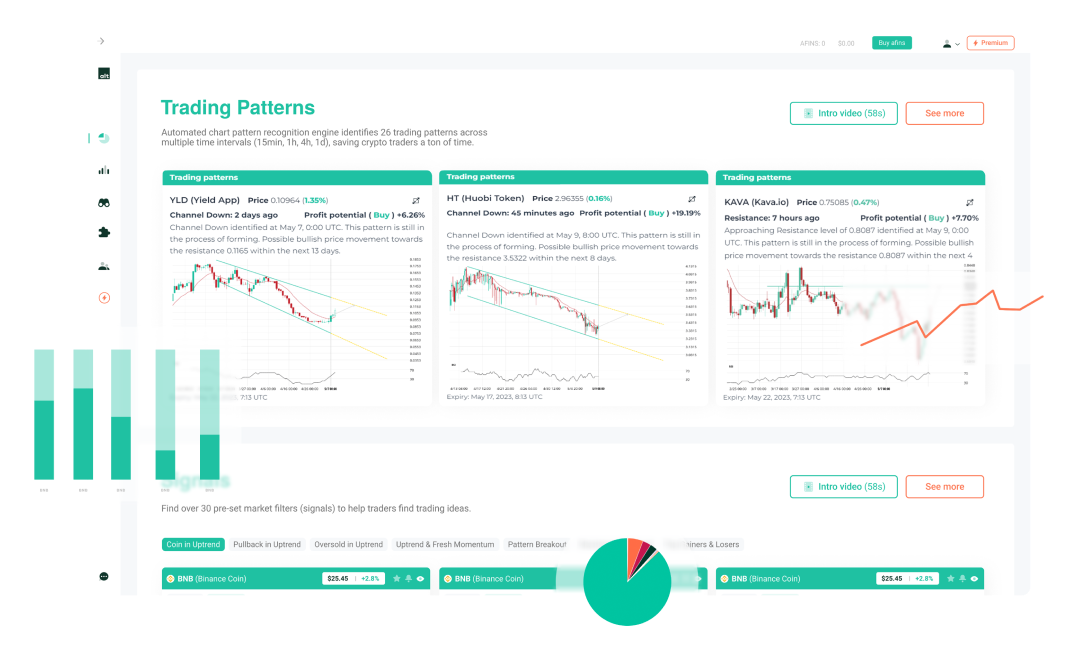
Want to time your DEX trades with data-driven signals? Check out the altFINS Crypto Screener for real-time technical analysis, chart patterns, and trade setups across hundreds of tokens traded on the DEXs above.
Disclaimer: This article is for educational purposes only and does not constitute financial advice. Cryptocurrency trading involves significant risk, including the total loss of capital. Always do your own research before trading on any decentralized exchange. Data sources: DefiLlama, CoinGecko CEX & DEX Trading Activity Report 2026, and individual protocol documentation. Figures reflect the best-available data as of April 2026 and may change quickly.