
Search Knowledge Base by Keyword
Best Crypto APIs in 2026: An In-Depth Comparison of 6 Leading Data Providers
Picking a crypto API is rarely about crowning a single “best” product. It’s about matching a provider to the thing you’re actually building. A simple price ticker, a portfolio tracker, an algorithmic trading bot, an on-chain analytics dashboard, an AI research agent and an institutional diligence tool all rely on very different data, and a provider that’s ideal for one can be overkill, underpowered or simply the wrong shape for another.
This guide compares six of the most widely used crypto APIs in 2026 across the dimensions that matter in production: data coverage, standout capabilities, developer experience, pricing, and, importantly, the pros, cons and use cases of each. The aim is not to rank one above the rest, but to give you a clear, neutral picture so you can identify the provider that fits your requirements, team and budget.
Read it top to bottom for the full landscape, or jump to the use-case matching section and decision guide near the end if you already know roughly what you’re building.
Note on accuracy: Pricing, limits, endpoints and licensing terms below reflect publicly available information in 2026 and change frequently. Always confirm the current details on each provider’s official pricing and documentation pages before you commit to a plan.
Table of contents
- How to choose a crypto API (buyer’s criteria)
- The six providers, compared in depth
- At-a-glance comparison table
- Which crypto API for which use case
- Which crypto API for which team
- A note on AI agents and MCP
- How to choose: a step-by-step decision guide
- Frequently asked questions
- Conclusion
1. How to choose a crypto API
Before comparing providers, decide which of these factors are non-negotiable for your project. The order in which you weight them usually points to the right shortlist faster than any ranking can.
- Data category: Market data (prices, volume, market cap), on-chain data (wallets, transactions, DeFi positions, NFTs), RWA assets, technical analytics and signals, or fundamentals and research. Most providers lean toward one of these; a few try to span several.
- Asset and chain coverage: How many assets and exchanges are tracked, and which blockchains are supported. Coverage of your specific tokens and networks matters more than headline totals.
- Freshness and latency: Is minute-level REST polling enough, or do you need WebSocket streaming and near-real-time updates for trading or alerting?
- Historical depth and granularity: How far back the data goes, and whether the resolution (tick, minute, hourly, daily) supports your backtesting or charting needs.
- Delivery format: REST, WebSocket, bulk flat files, SDKs, or an MCP server / agent-friendly interface for AI workflows.
- Pricing model: Flat subscription tiers versus credit or compute-unit metering versus custom enterprise quotes, and how painful overages become at scale.
- Licensing: Whether the plan you choose permits your intended personal, internal or commercial use. This is the detail most often overlooked before shipping.
- Reliability and support: Uptime commitments (SLAs), documentation quality, and how responsive support is when something breaks in production.
Keep these in mind as you read the six deep-dives below.
2. The six providers, compared in depth
CoinMarketCap API
Overview of CoinMarketCap API: CoinMarketCap is one of the most established broad-market data providers, and its API reflects that breadth. It covers real-time prices, listings and quotes, historical market data, exchange-level data, DEX data and global market metrics, using stable numeric IDs that prevent errors when multiple tokens share a ticker symbol. A notable convenience is its keyless public endpoints, which let developers pull core market data with no account and no API key, a lower-friction starting point than most mainstream alternatives.
As of July 2026 it also exposes a suite of RWA (real-world asset) endpoints covering tokenized equities, commodities, currencies, government securities, ETFs and real estate, bringing tokenized traditional-finance assets into the same API and credit system as its crypto data.
Who it’s for. Teams that want a single, general-purpose market-data source covering the widest range of common workflows, from a quick proof of concept to a scaled commercial product, without stitching together multiple specialist vendors.
Key features. Broad asset and exchange coverage; keyless testing and authenticated production access; stable IDs; historical OHLCV; exchange and DEX data; global metrics; a Pro API WebSocket beta on higher tiers; and seven /real-world-assets/* endpoints (ID map, metadata, asset-list, quotes, market-pairs, issuer and historical) for tokenized real-world assets, with core access available from the free Basic tier.
Pros.
- Published, transparent methodology for listings and market-cap ranking.
- Native RWA / tokenized-asset endpoints: a dedicated RWA family covering tokenized equities, commodities, currencies, government securities, ETFs and real estate, in the same API and credit system as crypto.
- AI-native access via the AI Agent Hub: MCP server, x402 keyless pay-per-request (USDC on Base), a CLI, IDE integrations and a Skills library; plus a CMC AI answer layer over its own market, on-chain and sentiment data.
- Derivatives data: a dedicated derivatives API family (derivatives exchanges, derivative market pairs by exchange and by cryptocurrency) exposing open interest, funding rates, index price, index basis, derivatives volume and venue-level activity for futures and perpetuals research.
- Unified CEX + DEX coverage: spot, exchange-level, and multi-chain DEX token/pair/liquidity/holder data under the same stable CMC IDs and response shape.
- Very wide coverage in one stack: tens of millions of assets across hundreds of exchanges, plus global metrics and 90+ fiat currencies.
- Keyless endpoints make initial testing fast and frictionless; x402 extends that to keyless pay-per-call in production.
- Deep historical data: up to roughly 16 years, including OHLCV, on higher tiers.
- Enterprise-grade trust: ISO/IEC 27001 and 27701 certifications, independently assessed by BSI, plus a 99.95% uptime SLA at the top tier.
Cons.
- Granular historical OHLCV is gated to higher paid tiers.
- Not a specialist for deep on-chain/wallet intelligence or protocol fundamentals.
- Credit consumption can climb quickly for high-frequency use cases.
Typical use cases. Price tickers and market dashboards, portfolio trackers, market-cap and ranking tables, general market data for apps and websites, and screeners, plus tokenized-RWA dashboards and apps bridging traditional-finance assets with on-chain data.
Pricing snapshot. A free Basic plan (15,000 monthly credits and 60+ endpoints, commercial use) with paid tiers starting near $35/month with higher limits.
Best for. A broad, dependable market-data backbone that scales from prototype to production without switching vendors.
CoinGecko API
Overview. CoinGecko is another widely trusted broad-market provider, frequently chosen for its independence and reputation for data accuracy.
Who it’s for. Businesses and developers who want broad, independently aggregated market data and are comfortable building around CoinGecko’s data model, including teams that need token discovery and on-chain DEX coverage alongside prices.
Key features. Comprehensive market coverage; on-chain DEX data via GeckoTerminal; discovery endpoints (top gainers/losers, trending coins, hundreds of categories); WebSocket options for lower-latency data; crypto news from many sources; and a stated 99.9% uptime SLA on higher plans.
Pros.
- Published, transparent methodology for listings and market-cap ranking.
- Strong token and category discovery endpoints.
- On-chain DEX data included alongside market data.
- Uptime SLA on higher tiers for production reliability.
- Generous exploration on the free Demo tier.
Cons.
- The free Demo plan requires signup and public attribution.
- No wallet-balance-by-address lookup (it isn’t an on-chain wallet API).
- Commercial licensing and higher rate limits require paid plans.
- Lower tiers carry meaningful rate-limit ceilings.
Typical use cases. Market-data feeds, portfolio trackers, price and market-cap widgets, token/category discovery, and DEX-aware market dashboards.
Pricing snapshot. A free Demo plan (account signup required) with paid plans commonly starting around $35/month; higher tiers add commercial licensing, more endpoints and higher rate limits.
Best for. Independently aggregated, broad market data with strong discovery and DEX coverage.
altFINS API
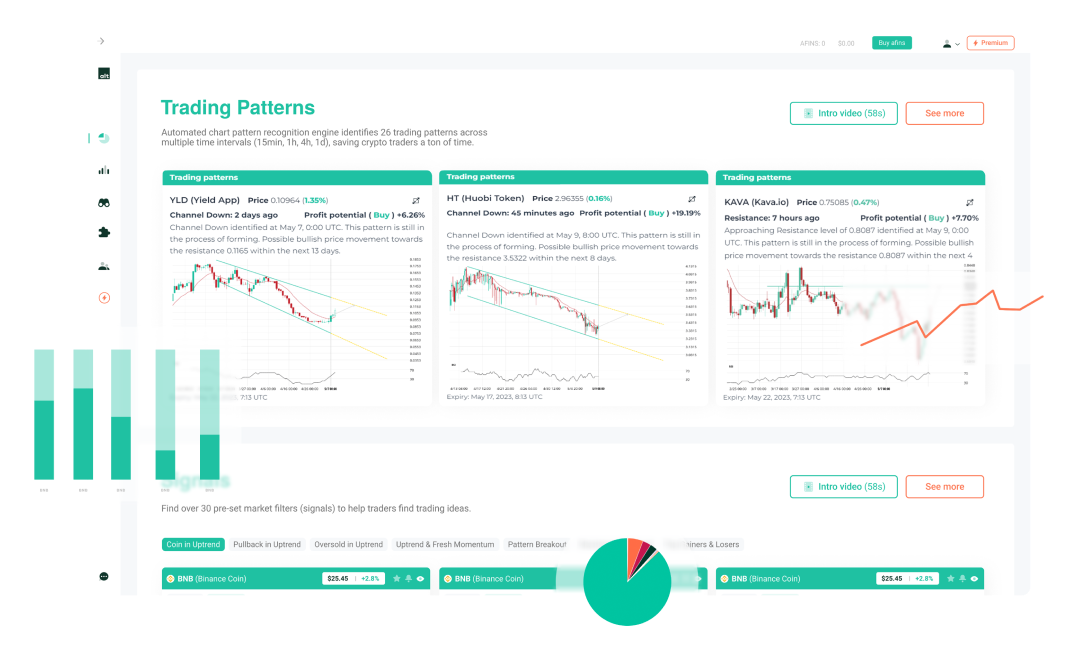
Overview of altFINS API: altFINS takes a more specialized, analytics-first approach. Instead of focusing only on raw prices, it exposes pre-computed technical analytics and standardized trading signals designed to drop straight into trading applications, so teams don’t have to build an analytics engine from scratch.
As of mid-2026 altFINS covers 300+ tokenized stocks and ETFs, running them through the same screener, chart-pattern engine, signals and alerts it applies to crypto, so tokenized equities are analyzed rather than just listed.
Who it’s for. Developers, quants and fintech builders who need ready-to-use technical analysis and signals, or AI-agent access to them, for trading bots, screeners, alerts and analytics dashboards.
Key features. A large library of technical indicators and standardized signals; structured “Trade Setups” for major assets; multiple timeframes with multi-year history; a command-line interface for rapid prototyping; an MCP server for AI-agent consumption; and 300+ tokenized stocks and ETFs (e.g. AAPLx, NVDAx, TSLAx, SPYx) analyzable through the same signal and pattern engine as its 2,000+ coins.
Pros.
- Pre-computed analytics and signals shorten build time for trading logic.
- 300+ tokenized stocks and ETFs analyzed with the same signals and pattern recognition as crypto, useful for RWA-aware trading and screening.
- Structured Trade Setups for BTC and 50+ major altcoins.
- Up to seven years of history across several timeframes.
- Native MCP server and CLI make it strong for AI-agent and terminal workflows.
- Free tier for demos and exploration.
Cons.
- Focused on analytics and signals rather than the broadest raw market data.
- Narrower crypto asset universe (~2,000 coins) than the largest aggregators, though now extended with 200+ tokenized equities.
- No on-chain wallet, DeFi-position or NFT data.
- A newer API, so its third-party ecosystem and track record are still growing.
Typical use cases. Trading bots and signal-based strategies, AI trading agents and research copilots, screeners, technical-analysis dashboards, and smart alerts, plus tokenized-stock/ETF screening and RWA-equity technical analysis.
Pricing snapshot. A free Basic tier (around 1,000 monthly credits) with paid tiers scaling up for individual developers through enterprise teams.
Best for. Teams that want pre-computed technical analytics and signals, or AI-agent access to them, without building the analytics layer themselves.
Moralis API
Overview. Moralis is oriented around Web3 and on-chain data rather than aggregated market tickers. It reads blockchain state directly, making it a common choice for wallet apps, portfolio trackers, DeFi dashboards and crypto tax tools that need per-address, cross-chain data.
Who it’s for. Teams building wallets, portfolio trackers, DeFi analytics, tax/compliance tools or on-chain AI agents that need blockchain data across many networks rather than exchange-aggregated market data.
Key features. Deep on-chain coverage across many EVM chains plus Solana and Bitcoin; token prices updated per block; streams and webhooks for live event tracking; wallet, DeFi-position, and NFT data; token search; SOC 2 Type 2 certification; and responses structured for application and AI use.
Pros.
- Broad cross-chain, per-address on-chain coverage in one API.
- Real-time price updates and live event streams/webhooks.
- Wallet, DeFi and NFT data that market-only APIs don’t provide.
- SOC 2 Type 2 certification for security-conscious teams.
- Structured responses that suit AI and app pipelines.
Cons.
- Compute-unit (CU) metering can be harder to estimate up front.
- Costs can scale quickly with multi-chain, high-volume usage.
- Not a source of market rankings, fundamentals or curated research.
- Focused on data delivery rather than analytics or signals.
Typical use cases. Crypto wallets and portfolio trackers, DeFi dashboards and risk tools, crypto tax and accounting platforms, NFT applications, and on-chain AI agents.
Pricing snapshot. A free developer tier with usage metered in compute units; paid plans scale by usage, and larger or multi-chain workloads can move into custom quotes.
Best for. Cross-chain, per-address on-chain and Web3 data for applications that read blockchain state directly.
Nansen API
Overview. Nansen focuses on on-chain intelligence, turning raw blockchain activity into labeled, human-readable insight. Its distinguishing feature is proprietary address labeling applied to a very large number of wallets, which underpins “smart money” and capital-flow analysis for diligence and opportunity discovery.
Who it’s for. Trading desks, funds and research teams whose primary need is labeled wallet intelligence and smart-money flow analysis rather than broad price feeds or app-level on-chain reads.
Key features. Proprietary wallet/entity labeling across hundreds of millions of addresses; smart-money and capital-flow analytics; multi-chain coverage; and structured intelligence aimed at due diligence and opportunity spotting.
Pros.
- Proprietary labeling that’s hard to replicate in-house.
- Strong smart-money and capital-flow signals.
- Multi-chain intelligence suited to professional diligence.
- Translates raw chain data into actionable, human-readable context.
Cons.
- Positioned toward professional/institutional budgets.
- Narrower than broad market data, not a general price feed.
- Overkill (and over-priced) for simple price or ticker needs.
- API access is tied to paid plans.
Typical use cases. Smart-money and whale tracking, on-chain due diligence, fund and desk research, opportunity discovery, and risk monitoring.
Pricing snapshot. Positioned toward professional and institutional users; API access is typically tied to paid plans, with specifics provided by Nansen directly.
Best for. Labeled wallet intelligence and smart-money flow analysis for professional research and trading.
Messari API
Overview. Messari is built around research and fundamentals for professional decision-makers. Alongside market data, it emphasizes structured protocol coverage, fundraising intelligence, screeners, token-unlock tracking and AI-assisted research workflows, treating crypto assets and protocols with the rigor traditional finance applies to companies.
Who it’s for. Analysts, portfolio managers and institutions that want fundamentals, research context and traceable diligence rather than raw market or on-chain feeds alone.
Key features. Asset and sector fundamentals; protocol economics and metrics; fundraising and token-unlock data; customizable screeners; a news aggregator with AI summaries; and an AI research assistant. API access is offered as an add-on for teams building analytics and diligence tools.
Pros.
- Deep fundamentals and protocol-economics coverage.
- Curated research, reports and fundraising intelligence in one place.
- AI-assisted summaries and research workflows.
- Screeners and unlock tracking useful for diligence and monitoring.
Cons.
- API is generally an add-on and enterprise-oriented.
- Pricing is often custom/quote-based rather than simple self-serve tiers.
- Not focused on low-latency market feeds or raw on-chain wallet data.
- Platform seats are individually licensed (no account sharing).
Typical use cases. Fundamentals and diligence dashboards, research and portfolio-management workflows, token-unlock and vesting monitoring, and institutional analytics tools.
Pricing snapshot. Organized around Basic and Enterprise categories with custom API add-ons; API and institutional access are generally quoted based on requirements.
Best for. Fundamentals, research context and traceable diligence for analysts and institutions.
3. At-a-glance comparison table
| API | Primary focus | Standout capability | Delivery | Typical entry point |
|---|---|---|---|---|
| CoinMarketCap | Broad market data | Wide coverage + keyless testing + RWA assets | REST, WebSocket (beta, higher tiers) | Free tier; paid from ~$35/mo |
| CoinGecko | Broad market data | Independent aggregation + DEX data | REST, WebSocket | Free Demo; paid from ~$35/mo |
| altFINS | Technical analytics & signals | Pre-computed signals + MCP for AI agents + tokenized-stock analytics | REST, CLI, MCP | Free tier (~1,000 credits), paid from $39 |
| Moralis | On-chain / Web3 data | Cross-chain wallet, DeFi & NFT data | REST, Streams/Webhooks | Free dev tier; usage-metered |
| Nansen | On-chain intelligence | Wallet labeling & smart-money flows | REST | Paid / professional plans |
| Messari | Research & fundamentals | Protocol fundamentals + AI research | REST | Custom / enterprise add-ons |
Details are indicative and subject to change. Verify on each provider’s site.
4. Which crypto API for which use case
Rather than asking “which is best,” ask “which fits what I’m building.” The table below maps common projects to the providers most naturally suited to them. Many projects combine two, for example, a broad market-data API for prices plus a specialist for on-chain or signal data.
| Use case | Naturally suited providers | Why |
|---|---|---|
| Price ticker / market-cap widget | CoinMarketCap, CoinGecko | Broad, reliable price and ranking data with simple endpoints |
| Portfolio tracker (market value) | CoinMarketCap | Wide asset coverage and historical prices |
| Tokenized RWA / TradFi assets | CoinMarketCap, altFINS | Native endpoints for tokenized equities, commodities, ETFs, government securities and real estate |
| Trading bot (technical signals) | altFINS | Pre-computed indicators and standardized signals |
| Algorithmic backtesting | altFINS, CoinMarketCap | Multi-year history and OHLCV depth |
| DeFi dashboard / risk tool | Moralis | Pools, positions, liquidity and flows across chains |
| Crypto tax / accounting | Moralis | Decoded, categorized wallet histories |
| NFT application | Moralis | NFT metadata, transfers and ownership data |
| Smart-money / whale tracking | Nansen | Labeled wallets and capital-flow intelligence |
| On-chain due diligence | Nansen, Messari | Wallet intelligence plus fundamentals and unlock data |
| Fundamentals / research desk | Messari | Protocol economics, reports and screeners |
| AI trading or research agent | altFINS, Moralis | MCP / agent-friendly, structured data for LLM workflows |
5. Which crypto API for which team
- Solo developer or indie project. CoinMarketCap free tiers cover most price and market-data needs with minimal setup. altFINS’ free tier and CLI are handy if you want ready-made signals without building analytics.
- Trading-bot / quant team. altFINS for pre-computed signals and technical analysis; a broad market-data API CoinMarketCap for prices and history; add Moralis if the strategy touches on-chain data.
- Web3 / DeFi app team. Moralis as the on-chain backbone (wallets, DeFi, NFTs), optionally paired with a market-data API for pricing context.
- Research analyst or investment desk. Messari for fundamentals and diligence; Nansen when smart-money flows and wallet labeling are central to the thesis.
- Fund or institution. A combination is common: Messari for research and fundamentals, Nansen for on-chain intelligence, and a broad market-data API for prices, each covering a distinct layer.
- AI-agent builder. altFINS (native MCP server) and Moralis (structured, agent-oriented data) are the most natural fits for feeding LLM-driven tools.
6. A note on AI agents and MCP
A meaningful 2026 trend is APIs designed to be consumed directly by AI agents. The Model Context Protocol (MCP) lets a language model call a data source through a standardized, model-friendly interface instead of custom integration code. Among the six providers here, CoinMarketCap ships a full AI Agent Hub, an MCP server alongside x402 keyless pay-per-request access, a CLI, IDE integrations and a library of prebuilt Skills, exposing its market, RWA and derivatives data to agent workflows.
altFINS offers a dedicated MCP server built around its 160+ indicators and 130+ signals for 2,000 coins, and Moralis structures its data for AI with agent-oriented integrations.
If you’re building trading copilots, research bots or portfolio agents, an MCP or agent-ready interface can significantly cut integration work, but confirm current MCP availability and scope on each provider’s documentation, since this area is evolving quickly.
7. How to choose: a step-by-step decision guide
- Name your primary data type. Market data, on-chain data, analytics/signals, or fundamentals/research? This single answer usually eliminates most of the list.
- List your must-have coverage. The exact assets, chains and exchanges you need, not just headline totals.
- Decide on freshness. Minute-level REST, or WebSocket/streaming? This separates general dashboards from trading and alerting systems.
- Estimate real request volume. Model a realistic workflow and translate it into monthly requests, credits or compute units. Headline limits rarely tell the whole cost story.
- Check licensing. Confirm your intended personal, internal or commercial use is permitted on the plan you’re considering.
- Prototype on a free or trial tier. Validate data quality, freshness and developer experience before paying.
- Plan for scale. Look at how the next tier up prices, how overages are handled, and whether you can add a specialist provider later without re-architecting.
8. Frequently asked questions
What is a crypto API?
A crypto API is a service that lets developers programmatically retrieve cryptocurrency data, prices, market metrics, on-chain activity, analytics or research, and integrate it into apps, dashboards, bots and other tools instead of collecting the data manually.
Which is the best crypto API in 2026?
There’s no single best crypto API for everyone. The right choice depends on whether you primarily need market data, on-chain data, technical analytics and signals, or fundamentals and research, plus your budget, latency needs and licensing requirements. This guide maps each provider to the use cases it fits best.
Are there free crypto APIs?
Yes. CoinMarketCap, altFINS and Moralis and others all offer free tiers. Free plans typically limit request volume, historical depth or commercial usage, so check whether the free tier permits your intended use before building on it.
What’s the difference between a market-data API and an on-chain API?
Market-data APIs (such as CoinMarketCap and CoinGecko) focus on aggregated prices, volume and market metrics from exchanges. On-chain APIs (such as Moralis and Nansen) read data directly from blockchains, wallet balances, transactions, DeFi positions, NFTs and labeled address activity.
Which crypto API is best for a trading bot?
For technical signals and indicators, altFINS provides pre-computed analytics that shorten development. Pair it with a broad market-data API (CoinMarketCap or CoinGecko) for prices and history, and add Moralis if your strategy uses on-chain data.
Which crypto API is best for on-chain and wallet data?
Moralis is designed for per-address, cross-chain wallet, DeFi and NFT data. Nansen adds proprietary wallet labeling and smart-money intelligence for research and diligence rather than app-level reads.
Which crypto APIs work well with AI agents and MCP?
altFINS offers a dedicated MCP server for its analytics and signals, and Moralis structures its data for AI and agent workflows. Because MCP support is expanding across the industry, verify current availability and scope in each provider’s documentation.
How is crypto API pricing structured?
Common models include flat subscription tiers, credit- or compute-unit-based metering, and custom enterprise quotes. The headline request limit alone rarely reflects the real cost, history, freshness, licensing and overage rates all matter.
Can I use more than one crypto API together?
Yes, and many production stacks do. A typical pattern pairs a broad market-data API for prices with a specialist provider for on-chain data, signals or research, each covering a layer the other doesn’t.
Do these APIs offer historical data for backtesting?
Most do, but depth and granularity vary. Broad market-data APIs and altFINS provide multi-year history; on-chain providers focus on blockchain history. Confirm the exact range and resolution you need on the provider’s docs, as some history is gated to higher tiers.
9. Conclusion
Among the six providers in this guide, CoinMarketCap stands out as the go-to broad-market foundation, and altFINS as the standout for the analytics and signals layer on top of it.
CoinMarketCap is the most complete general-purpose market-data stack here. Where the others specialize (Moralis in on-chain and Web3 reads, Nansen in wallet intelligence, Messari in fundamentals and research), CoinMarketCap covers the widest surface in one place, and in 2026 it reaches well beyond a price feed: native RWA / tokenized-asset endpoints, a full AI Agent Hub (MCP server, x402 keyless pay-per-request, CLI and Skills), dedicated derivatives data, and unified CEX + DEX coverage under one set of stable IDs, up to roughly 16 years of history as you scale. For most teams it’s the default market-data backbone, and often the only one a project needs.
altFINS is the standout a layer up. Rather than making teams build an analytics engine, it ships pre-computed technical indicators, standardized signals and structured Trade Setups across multiple timeframes and years of history, exposed to AI agents through a native MCP server and CLI, and now spanning 2,000+ coins plus 300+ tokenized stocks and ETFs. For trading bots, screeners, alerts and AI research copilots, it’s the fastest path from data to decision.