
Search Knowledge Base by Keyword
Technical Analysis for Crypto Trading: The Ultimate Learning Guide (2026)
Technical analysis (TA) is the study of price charts, patterns, and indicators to predict future price movements. In crypto — where markets move 24/7 and volatility is high — TA gives traders a rules-based framework to find high-probability setups, manage risk, and replace emotion with data.
This guide covers the complete technical analysis curriculum every crypto trader should master, from reading candlesticks to advanced breakout strategies. Each topic connects directly to the Free altFINS Crypto Trading Course and the altFINS Crypto Screener, so you can move from theory to real trades immediately.
Quick Answer (TL;DR):
- What is TA? Using charts, patterns, and indicators to forecast crypto prices.
- Why it works in crypto: 24/7 markets, high volatility, frequent setups.
- Core skills: candlesticks, trends, moving averages, MACD, RSI, support/resistance, chart patterns, risk management.
- Fastest path: 10 lessons + 7 strategies + live tools via the altFINS Trading Course.
Beginner’s Checklist: Your 7-Step Start
Before diving into advanced concepts, every new crypto trader should check off these seven fundamentals:
| Step | Skill to Master | altFINS Tool to Use |
|---|---|---|
| 1 | Read candlestick charts | Chart viewer + candlestick filters |
| 2 | Pick the right time frame | 5 time intervals built in |
| 3 | Spot trends with SMA and EMA | Automatic trend ratings |
| 4 | Use momentum indicators (MACD, RSI) | Signals Summary + pre-set filters |
| 5 | Test strategies with screeners | Crypto Screener with 120+ indicators |
| 6 | Manage risk (stop losses, 2% rule) | Risk calculators + alerts |
| 7 | Track trades with a journal | Portfolio + watchlists |
Why Learn Technical Analysis in Crypto?
Crypto markets are tailor-made for technical analysis. Here’s why:
- 24/7 trading: no market close, meaning more trade opportunities and continuous chart development.
- High volatility: bigger price swings = bigger profit potential for disciplined technical traders.
- Rules-based systems: TA removes emotion by giving you clear entry, exit, and stop criteria.
- Self-fulfilling prophecy: because thousands of crypto traders use the same indicators and levels, TA patterns often play out.
- Universal framework: once you learn TA, you can apply it to Bitcoin, Ethereum, altcoins, DeFi tokens, and even forex or stocks.
Key insight: Unlike hype-driven trading, TA gives you a repeatable process. The goal isn’t to predict every move — it’s to find setups where probabilities favor you, then size trades so a few winners outpay several small losers.
The Complete TA Curriculum: 13 Topics Every Crypto Trader Should Master
The altFINS Crypto Trading Course is structured across 10 lessons covering the full skillset below. Each links directly to tools on the altFINS platform so you can apply what you learn immediately.
1. Price Charts & Candlestick Patterns
Candlesticks reveal the battle between buyers and sellers during a given time window. Every trader must learn to recognize:
- Bullish / bearish candles
- Dragonfly Doji and other reversal patterns
- Hammers, engulfing candles, shooting stars
- Three White Soldiers and continuation patterns
On altFINS: candlestick charts across every asset, adjustable time frames, and a pre-set filter for each major candlestick pattern.
2. Chart Time Frames & Trading Styles
The time frame you trade determines everything else — from risk per trade to screen time required.
| Trading Style | Time Frame | Trade Duration |
|---|---|---|
| Scalping | 1min – 15min | Minutes |
| Day trading | 15min – 1H | Hours (intraday) |
| Swing trading | 4H – Daily | Days to weeks |
| Position trading | Daily – Weekly | Weeks to months |
3. Trends & Moving Averages (Lesson 2)
“The trend is your friend” — trading in the direction of the dominant trend dramatically improves your win rate.
- SMA vs. EMA: learn which moving average fits your style.
- 200-day SMA: the single most-watched trend line in markets.
- Short, medium, and long-term trend ratings on altFINS tell you instantly where each coin stands.
4. Moving Average Crossover Strategy
A classic trend-following strategy: when a shorter EMA (e.g., 12-day) crosses above a longer EMA (e.g., 50-day), it’s a bullish signal. altFINS includes a dedicated screener filter to find coins printing this crossover in real time.
5. Support & Resistance Zones
Support is where buying pressure halts a decline; resistance is where selling pressure stops a rally. These zones are the foundation of every trade entry and exit. altFINS visually marks these levels and lets you filter for assets approaching or breaking them.
6. Pullback in Uptrend Strategy
Healthy uptrends pull back to key support before continuing higher. Buying these pullbacks — ideally at a Fibonacci retracement level or moving average — is one of the highest-probability strategies in TA. Use the Pullback in Uptrend pre-set filter on altFINS to find them instantly.
7. MACD: The Momentum Workhorse
The MACD indicator combines trend-following and momentum in one tool. Master signal line crossovers, histogram slope shifts, and divergences — and use altFINS alerts to catch them across 3,000+ coins.
8. RSI & Oversold-in-Uptrend Strategy
The Relative Strength Index (RSI) measures overbought (>70) and oversold (<30) conditions. The golden setup: a coin in a confirmed uptrend pulling back to oversold — use the Oversold in Uptrend filter on altFINS.
9. Trading Ranges (Sideways Markets)
When price trades between horizontal support and resistance, range traders buy the bottom and sell the top. This works best in non-trending markets, and altFINS automatically detects range-bound coins and highlights key levels.
10. Key Level Breakouts
Breakouts above resistance or below support often mark the start of a new trend. Learn how to spot winning breakouts — altFINS flags them automatically in the Signals Summary and Screener.
11. Chart Patterns
Classical chart patterns signal continuation or reversal. The essential ones:
- Symmetrical Triangle
- Ascending / Descending Triangles
- Bull & Bear Flags
- Head & Shoulders
- Double Top / Double Bottom
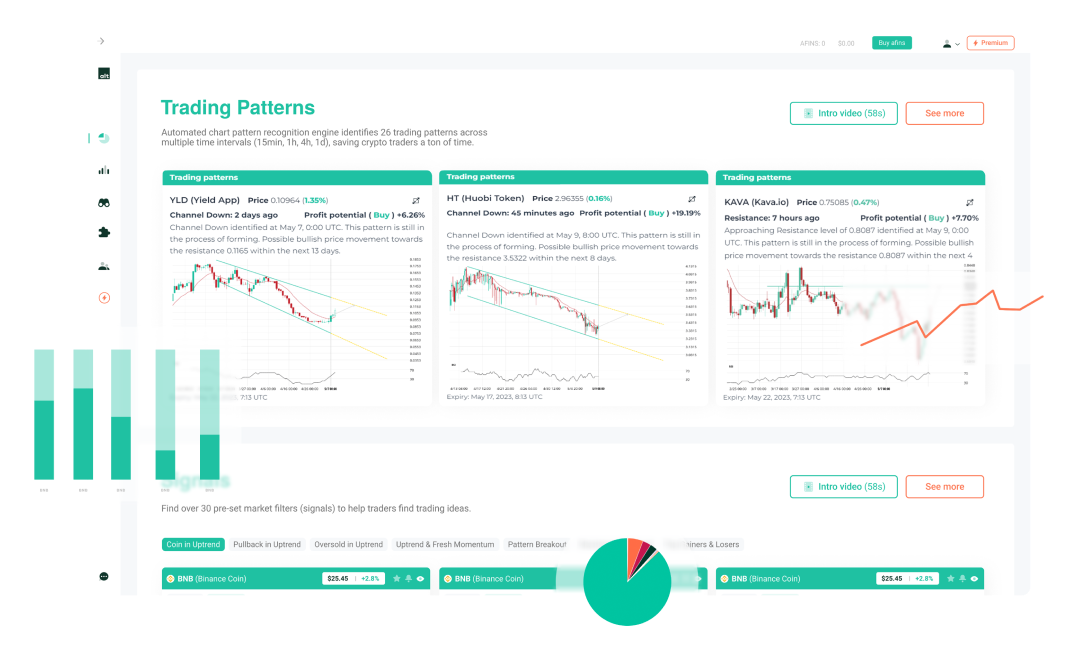
altFINS uses AI to automatically detect and label these chart patterns on annotated charts — a massive time-saver.
12. Risk Management (Lesson 9)
No strategy survives poor risk management. The essentials every trader must apply:
- The 2% rule: never risk more than 2% of your capital on a single trade.
- Stop-loss placement: always defined before entry, based on structure (below support, above resistance).
- Risk/reward ratio: aim for 1:2 or better — potential profit at least double your risk.
- Position sizing: calculate based on stop-loss distance, not gut feeling.
13. Short Selling & Margin Trading (Lesson 10)
In bear markets, shorting lets you profit from falling prices. Lesson 10 covers how to short responsibly, including trend-reversal indicators altFINS uses to flag short setups.
How the altFINS Crypto Screener Turns Theory Into Trades
Learning TA without applying it is pointless. The altFINS Crypto Screener is purpose-built to let you scan 2,000+ coins for your exact strategy in seconds:
| Screener Feature | What It Does |
|---|---|
| 150+ indicators | MACD, RSI, moving averages, ATR, OBV, volume, and more |
| 5 time frames | 15min, 1H, 4H, Daily, Weekly |
| 100 Pre-set filters | “Oversold in Uptrend”, “Dragonfly Doji”, “MACD Bullish Crossover”, etc. |
| Custom filters | Build your exact strategy by stacking conditions |
| Grid chart view | Scan 6, 12, or 24 charts at once — perfect for spotting divergences |
| Signals Summary | Live feed of bullish/bearish setups across all coins |
| AI Chart Patterns | Triangles, flags, wedges — automatically detected and labeled |
| Alerts | Get notified the moment your setup triggers |
Technical Analysis Glossary
| Term | Definition |
|---|---|
| Support | Price level where buying stops a decline |
| Resistance | Price level where selling halts an advance |
| MACD | Momentum indicator comparing two moving averages |
| RSI | Measures speed of price change; detects overbought/oversold |
| Breakout | Price moves beyond support or resistance, signaling a new trend |
| Risk/Reward | Ratio of potential profit to potential loss |
| EMA | Exponential Moving Average — weights recent prices more heavily |
| Divergence | Price and indicator moving in opposite directions — often signals reversal |
What You Get in the altFINS Crypto Trading Course
The altFINS Crypto Trading Course is built on one principle: learn → practice → apply immediately. Here’s everything included:
- 10 practical lessons covering the full TA curriculum
- 7 trading strategies with clear entry, exit, and risk rules
- 100+ quiz questions to lock in what you learn
- 40+ video lessons — visual, step-by-step instruction
- Live webinars with expert analysts
- Real trade examples from actual crypto markets
- Direct integration with the altFINS platform — screen, chart, and trade right away
“After 14 years on Wall Street, I built altFINS to give crypto traders the same edge that pros have. This course and our tools will make you a smarter, more confident trader.”
— Richard Fetyko, CEO & Founder, altFINS
The 90-Day Learning Roadmap
Here’s exactly how to structure your learning:
| Phase | Focus | Outcome |
|---|---|---|
| Weeks 1–2 | Candlesticks, time frames, basic trends | Read any chart confidently |
| Weeks 3–4 | Moving averages, support/resistance | Identify trend structure |
| Weeks 5–6 | MACD, RSI, momentum | Time entries using indicators |
| Weeks 7–8 | Pullback, breakout, range strategies | Apply full trading strategies |
| Weeks 9–10 | Risk management & journaling | Protect capital, track performance |
| Weeks 11–12 | Chart patterns, advanced setups, shorting | Trade long AND short |
Common Beginner Mistakes (Avoid These)
- Indicator overload. Stacking 10+ indicators creates noise. Master 3–4 you actually understand.
- Skipping risk management. Without stops and position sizing, one bad trade can wipe months of gains.
- Trading without a plan. Define entry, stop, and target before opening a position.
- Ignoring the trend. Counter-trend trading is advanced — don’t start there.
- Chasing FOMO candles. Once price has pumped 30%, the edge is gone. Wait for pullbacks.
- Not journaling trades. You can’t improve what you don’t measure.