
Search Knowledge Base by Keyword
What is ATR Indicator and How to Find It on altFINS?
What is ATR (Average True Range)
ATR (Average True Range) is a technical indicator that measures how much an asset typically moves during a given time period. It was developed by J. Welles Wilder Jr. and is widely used by traders to evaluate asset volatility.
Unlike trend-following indicators like moving averages, ATR does not show price direction. It only measures how much prices move. A higher ATR means the asset is more volatile, while a lower ATR means the asset is more stable.
Why Use ATR in Crypto Trading
ATR is useful for a number of reasons:
- It helps traders identify assets with rising or falling volatility
- It allows you to set more effective (trailing) take profit or (trailing) stop-loss levels based on recent price behavior
- It can signal the start of a breakout or trend reversal when volatility spikes
- It helps filter out low-volatility assets when you’re looking for strong movers
How ATR is Calculated
ATR is based on the True Range (TR), which is the greatest of the following:
- Current High minus Current Low
- Absolute value of Current High minus Previous Close
- Absolute value of Current Low minus Previous Close
The ATR is then calculated as the average of these True Range values over a certain number of periods, typically 14.
Example:
If Bitcoin has a high of $51,000, a low of $49,000, and the previous close was $50,000, the TR would be 2,000. If similar values are seen for 14 days, then the 14-day ATR would be about $2,000.
Example Use Case
Suppose the 14-day ATR for Ethereum is $80. If today’s price range (high minus low) is $320, then Ethereum’s current range is 4 times the ATR. That means it’s experiencing much higher volatility than usual, which might indicate a strong move is underway.
Traders could use this information to:
- Enter short-term trades during a breakout
- Set wider stop-loss levels to avoid being stopped out prematurely
- Focus on assets that are actually moving, rather than trading sideways
Where to find ATR on altFINS platform
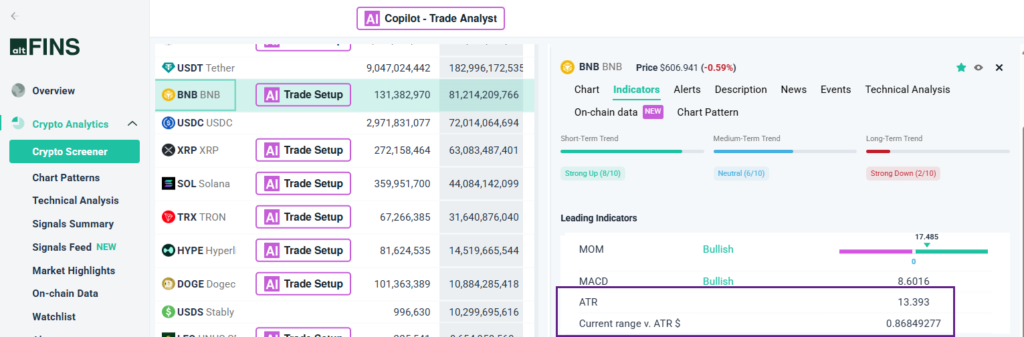
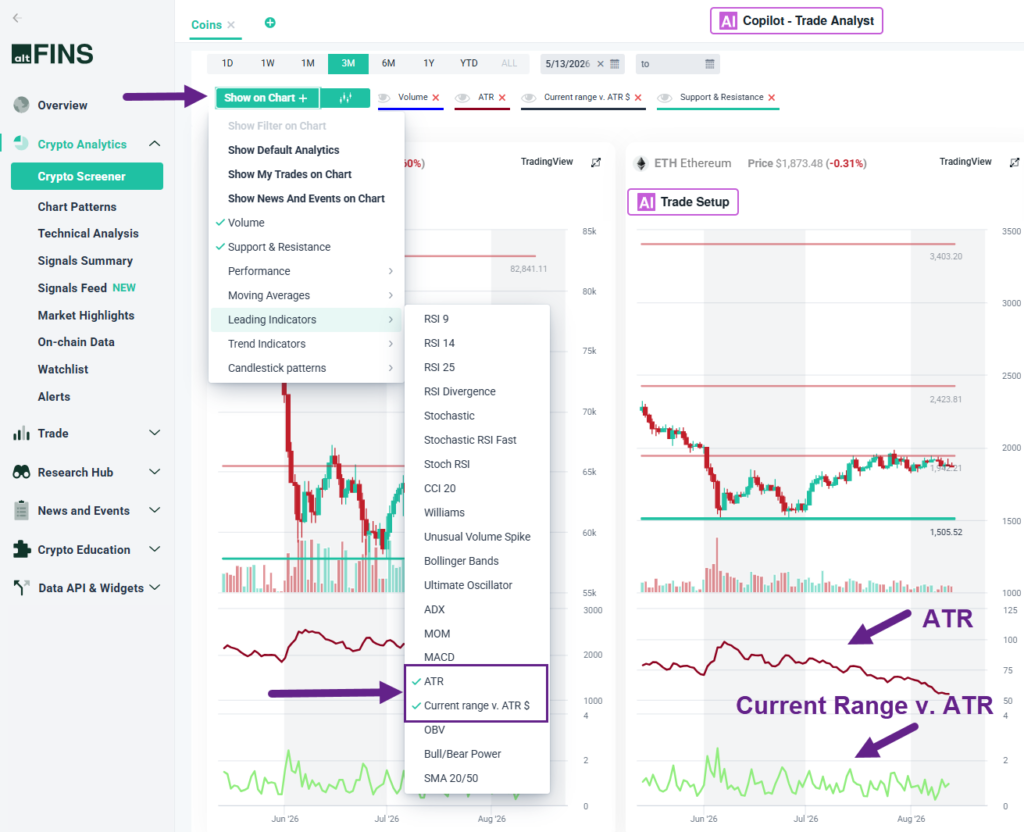
altFINS calculates ATR and Current Range v. ATR ratio for over 2,000 assets across multiple time intervals (15m, 1h, 4h, 12h, 1d).
You can find values for these indicators on the Screener:
You can also add ATR and Current Range v. ATR indicators to the charts:
How to Use ATR for Setting Stop Loss (SL) Levels
If ATR for ETH if $80 and a trader takes a long position, then he may chose to place an SL level at least $80 below his entry price. That’s because $80 price movement is very normal (ATR) for ETH. If the traders places an SL level lower than $80, he’s very likely to get stopped out just during a normal daily price fluctuation.
Using ATR for setting a trailing take profit or trailing Stop Loss (SL)
Using the Average True Range (ATR) is one of the most systematic and mathematically sound ways to set up a trailing take profit (or trailing stop-loss) because it dynamically adapts to an asset’s current volatility.
Here is a breakdown of how users typically set it up, why ATR works well, and a few practical suggestions you can share with them:
How an ATR-Based Trailing Mechanism Works
Instead of using a static percentage (e.g., trailing by exactly 2% or 5%), an ATR trailing setup bases the distance on how much the asset normally fluctuates.
- The Logic: During high volatility, the price swings wildly, so your trailing distance needs to be wider to avoid getting “whipsawed” out prematurely. During low volatility, it tightens up to lock in profits.
- The Formula Direction: For a Long position, the trailing stop sits below the highest price reached since the trade was opened by a multiple of the ATR. As the price climbs, the trailing stop ratchets upward, but it never moves backward.
Suggested Configurations & Multipliers
Depending on the trader’s timeframe and risk appetite, here are standard configurations used in crypto and traditional markets:
- The Standard/Conservative Setup (21-Period, 3x ATR)
- ATR Period: 14 or 21 periods (on daily or 4-hour charts).
- Multiplier:
- Why use it: This is widely considered the industry standard. A 3-multiplier gives the asset enough “breathing room” to handle normal market noise and standard pullbacks without cutting a winning trend short.
- The Short-Term / Aggressive Setup (14-Period, 2x ATR)
- ATR Period: 14 periods.
- Multiplier:
- Why use it: Best for day traders or swing traders dealing with high-momentum altcoins. It locks in profits much faster, but comes with a higher risk of getting prematurely stopped out by a minor correction.
How to Find the ATR Pre-Set market scan on altFINS
The altFINS platform includes a Pre-Set ATR market scan called “ATR: Current Range” that allows you to screen for assets showing above-average volatility.
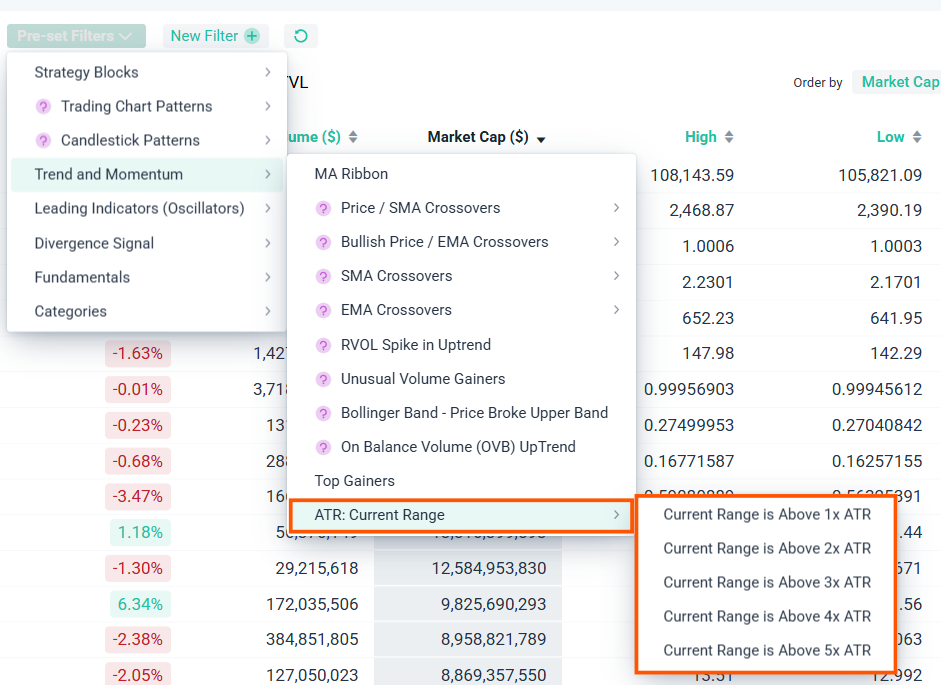
To use it:
- Go to the Screener on altFINS
- Click on the “Pre-set Filters” dropdown
- Select “Trend and Momentum”
- Choose “ATR: Current Range”
Pick a filter option, such as:
- Current Range is Above 1x ATR
- Current Range is Above 2x ATR
- Current Range is Above 3x ATR
- Current Range is Above 4x ATR
- Up to 5x ATR
This filter shows you which assets are experiencing more movement today compared to their historical average. The higher the multiple, the more unusual the volatility.
Practical Tips
- Use the ATR filter in combination with volume filters or trend indicators to confirm signals
- Look for assets with high ATR multiples and volume spikes as potential breakout candidates
- Use ATR to help size your position and set stop-loss levels more effectively
Who Should Use ATR in Trading?
This filter is ideal for:
- Day traders and swing traders looking for high-momentum opportunities
- Volatility-based strategy traders
- Traders who want to set stop-losses dynamically based on market conditions
- Beginners who want a simple way to gauge market activity without complex chart patterns
Mistakes to Avoid When Using ATR:
- Using ATR as a trend indicator (it only measures volatility, not direction)
- Setting static stop-losses regardless of ATR (you might get stopped out too early)
- Ignoring volume and context—high ATR doesn’t always mean a good trade setup
- Comparing ATR values across different coins without context (use percentages or multiples)
Summary
ATR is a valuable indicator for measuring volatility in crypto markets. It doesn’t predict direction but tells you how much movement is happening. The “ATR: Current Range” filter on altFINS helps you quickly find assets that are showing unusual volatility, often a sign of breakouts or important market shifts.
Try it today on the altFINS Screener to discover new trading opportunities based on real-time volatility data.