
Search Knowledge Base by Keyword
Best Crypto Trading Courses for Learning Technical Analysis in 2026 (Ranked & Reviewed)
Updated for 2026 · Est. reading time: 13 minutes
Technical analysis is the single most transferable skill in crypto trading — once you understand trend, momentum, and chart structure, you can apply it to Bitcoin, altcoins, or any other liquid market. But the course landscape is crowded with recycled Udemy content, hype-driven sales pages, and influencer Discords masquerading as education. This guide ranks the crypto trading courses that actually teach technical analysis properly in 2026, based on curriculum depth, practical application, instructor credibility, and whether the lessons connect to real, usable trading tools.
⚡ Quick Answer
If you only take one course, the altFINS Crypto Trading Course is the strongest pick — a free, 10-lesson curriculum built by a 14-year Wall Street veteran that links every concept directly to a live screener so you can practice on real coins immediately. For beginners who want a slower, free on-ramp, Binance Academy is a solid start. For deep, paid, indicator-by-indicator training, Rekt Capital’s Technical Analysis Course is the most thorough standalone option.
Why Technical Analysis Is the Right Place to Start
Crypto markets are uniquely suited to technical analysis. They trade 24/7 with no closing bell, which means chart structure never stops forming. Volatility is higher than in most traditional markets, so well-defined setups appear more often. And because thousands of traders watch the same moving averages, RSI levels, and support zones, TA becomes partly self-fulfilling — price often reacts at the levels everyone is already watching. Unlike fundamental analysis, which requires deep research into tokenomics and on-chain activity, technical analysis gives you a repeatable, rules-based process you can apply to any coin within minutes of learning it.
The goal of a good TA course isn’t to predict every market move — it’s to teach you how to find setups where the odds tilt in your favor, then size your trades so a handful of winners outweigh several small, controlled losses.
How We Ranked These Courses
- Curriculum depth — whether the course covers the full TA stack: candlesticks, trend, indicators, chart patterns, and risk management, not just one slice of it.
- Practical application — whether lessons connect to live charts and real coins, or stay purely theoretical.
- Instructor credibility — verifiable trading or market background, not just a polished sales page.
- Risk management focus — courses that teach stop-loss placement, position sizing, and the 2% rule score higher than those that only teach pattern recognition.
- Value for the price — free and low-cost courses are weighed against paid alternatives based on what you actually walk away able to do.
Top Crypto Trading Courses for Technical Analysis — Comparison Table
| Course | Best For | Format | Price |
|---|---|---|---|
| ⭐ altFINS Crypto Trading Course | Theory + live practice on real coins | 10 lessons, 40 videos, 40 quizzes | Free |
| Binance Academy | Absolute beginners | Self-paced articles & videos | Free |
| Rekt Capital — TA Course | Deep, indicator-by-indicator training | 17 hours of video | Paid (one-time) |
| Udemy — TA Masterclass | Budget self-study | Video course | ~$15–$30 |
| The Chart Guys | Live chart markup & mentorship | Live sessions + community | $50–$200/month |
| 99Bitcoins Free Crash Course | Total beginners, fundamentals first | Email + video series | Free |
| Blockchain Council Certifications | Formal certification on a resume | Structured modules + exam | Paid |
1. altFINS Crypto Trading Course — Best Overall
Most TA courses stop at theory: here’s what RSI is, here’s what a head and shoulders pattern looks like, good luck applying it. The altFINS Crypto Trading Course is built differently. It’s a free, structured 10-lesson curriculum — 40 videos, 40 quizzes, and seven specific trading strategies — created by Richard Fetyko, founder of altFINS, who spent 14 years on Wall Street before moving into crypto. Every lesson links directly to a live tool on the altFINS platform, so instead of just watching a video about moving average crossovers, you immediately scan 2,000+ coins for live crossover setups and see the strategy play out on a real chart.
The curriculum covers the full stack: foundations of technical analysis, trading moving average crossovers, pullbacks in up/down trends, momentum and uptrend strategies, oversold-at-support and overbought-at-resistance setups, trading ranges, key-level breakouts, chart pattern trading, full risk management (the 2% rule, stop-loss placement, and risk/reward ratios), and a final lesson on margin trading and short selling. Real trade examples are used throughout instead of generic illustrations, and the course includes recorded live trading webinars where Fetyko walks through actual setups in real time.
What makes this course stand apart from competitors is the learn-practice-apply loop: theory, then immediate practice using the altFINS Crypto Screener (which scans thousands of coins across 120+ analytics including RSI, MACD, SMA, and EMA), then real application to live trade ideas. Most paid courses cannot replicate this because they aren’t attached to a working analytics platform.
Best for: Traders who want a complete, free TA curriculum that doesn’t stop at theory — and a screener to immediately put it to work.
Based on the official curriculum (10 lessons, 40 videos, 40 quizzes, 7 strategies) from the altFINS Crypto Trading Course, here’s a summary of each lesson:
Lesson 1: Foundation of Technical Analysis
The starting point covers what TA actually is and why it works especially well in crypto’s 24/7, high-volatility markets. It walks through reading candlestick charts (bullish/bearish candles, dojis, hammers, engulfing patterns), choosing the right time frame for your trading style (scalping vs. day trading vs. swing or position trading), and understanding why TA functions as a partly self-fulfilling system since so many traders watch the same levels and indicators.
Start Learning for free
Lesson 2: Trading Moving Average Crossovers
This lesson introduces trend-following using SMA and EMA, including why the 200-day SMA is one of the most widely watched lines in any market. The core strategy taught is the crossover signal — when a shorter-term moving average (e.g., 12-day EMA) crosses above a longer-term one (e.g., 50-day EMA), it flags a potential trend shift. Students learn to find these crossovers live using a dedicated screener filter.
Lesson 3: Pullback in Up (Down) Trend
Here the focus shifts to one of the higher-probability setups in TA: buying dips within an established uptrend (or shorting bounces in a downtrend) rather than chasing price. The lesson ties pullback entries to key support levels and Fibonacci retracement zones, teaching students to wait for price to retrace to a logical level before entering, instead of buying strength after a move has already happened.
Lesson 4: Momentum & Uptrend
This lesson builds on trend identification by adding momentum confirmation, primarily through the MACD indicator. Students learn to read MACD signal-line crossovers, center-line crossovers, and histogram shifts to gauge whether a trend has strengthening or weakening momentum behind it — helping separate trends likely to continue from ones at risk of stalling.
Lesson 5: Oversold at Support (Overbought at Resistance)
This lesson centers on RSI and how to combine it with trend and price structure. The key setup taught is the “oversold in uptrend” condition — a coin in a confirmed uptrend that dips into oversold RSI territory near support, often signaling an attractive entry. The inverse (overbought at resistance) is covered for spotting potential reversals or short setups.
Lesson 6: Trading Ranges
For markets that aren’t trending, this lesson teaches range-trading mechanics: identifying horizontal support and resistance boundaries, buying near the range floor, selling near the range ceiling, and recognizing when a range is likely to hold versus when it’s at risk of breaking.
Lesson 7: Trading Key Levels (Breakouts and Approaches)
This lesson covers how to trade decisive moves through support or resistance, since breakouts often mark the start of a fresh trend. Students learn to distinguish genuine breakouts from false ones, how to time entries on the approach to a key level versus after confirmation, and how volume factors into validating a breakout.
Lesson 8: Trading Chart Patterns
This lesson works through the classical continuation and reversal patterns every trader should recognize — symmetrical, ascending, and descending triangles, bull and bear flags, head and shoulders, and double tops/bottoms. It explains how each pattern typically resolves and how to set entries, stops, and targets around them.
Lesson 9: Risk Management
Widely considered the most important lesson in the course, this module covers the 2% rule (never risking more than 2% of capital on a single trade), how to place a stop-loss based on chart structure rather than guesswork, calculating position size from your stop-loss distance, and aiming for a risk/reward ratio of at least 1:2 so winning trades outweigh losses over time.
Lesson 10: Margin Account Trading & Short Selling
The final lesson introduces how to profit in bear markets through short selling and margin trading, including the added risks of leverage. It covers the trend-reversal signals used to flag responsible short setups, rather than treating shorting as a separate, riskier afterthought.
Each lesson includes video instruction, real trade examples, and a quiz, and links directly to a matching filter or tool on the altFINS Crypto Screener so the strategy can be tested on live coins immediately after learning it — rather than staying purely theoretical.
2. Binance Academy — Best Free Starting Point
Binance Academy is the most widely used free education hub in crypto, and its technical analysis section is a reasonable entry point for absolute beginners. Articles cover candlestick basics, trend lines, and common indicators in plain language, with no paywall and no upsell pressure to use a specific paid tool.
The trade-off is depth and interactivity: Binance Academy reads more like a well-organized encyclopedia than a guided course, and it lacks quizzes, structured progression, or live trading walkthroughs. It’s best used as a glossary and primer before moving into a more structured curriculum.
Best for: Complete beginners who want free, no-pressure reading material before committing to a structured course.
3. Rekt Capital — Best Deep-Dive Paid Course
Rekt Capital is an established crypto education platform offering a dedicated, 17-hour technical analysis course alongside separate offerings on altcoins, Bitcoin investing, and risk management. The TA course is genuinely thorough, walking through tools and indicators in enough depth to suit traders who specifically want to become technically skilled day traders rather than generalists.
All content is video-based and self-paced, which suits independent learners, though the four separate course modules (altcoins, Bitcoin, risk management, and TA) are sold individually, so building the full curriculum requires more than one purchase.
Best for: Traders who want the most exhaustive, single-topic deep dive on technical indicators specifically.
4. Udemy — Technical Analysis Masterclass
Udemy hosts thousands of crypto courses, and its technical analysis-focused offerings cover the core fundamentals: candlestick reading, trend lines and channels, support and resistance, volume confirmation, and Fibonacci retracement and extension levels. Pricing is low — frequently under $30 during sales — and lifetime access means you can revisit lessons as your skills develop.
The catch is quality variance. Udemy’s open marketplace model means course quality depends entirely on the individual instructor, and many listings lean on aggressive sales-page language promising fast profits rather than realistic, risk-aware trading education. Read the syllabus and reviews carefully before purchasing, and treat any guaranteed-return language as a red flag.
Best for: Budget-conscious learners who want a low-cost, self-paced video library and are willing to vet instructors carefully.
5. The Chart Guys — Best for Live Mentorship
For traders who learn best by watching someone else read a chart in real time, subscription-based educators like The Chart Guys offer live trading sessions, chart markup walkthroughs, and an active community discussion forum. This format suits people who want ongoing accountability and the chance to ask questions about a live setup, rather than a one-time, self-paced video library.
The recurring cost ($50–$200 per month depending on the tier) is the main consideration. It’s a meaningfully different commitment than a one-time course purchase, and the value depends heavily on how consistently you actually attend the live sessions.
Best for: Traders who want live, ongoing mentorship rather than a fixed curriculum.
6. 99Bitcoins Free Crash Course — Best Free Fundamentals-First Option
99Bitcoins built its reputation on free, beginner-friendly crypto education, and its free crash course is a sensible starting point for someone who hasn’t yet bought a coin, let alone read a chart. It establishes the operational basics — exchanges, wallets, security — before easing into trading concepts, which prevents the common mistake of jumping straight into chart patterns without understanding what you’re actually trading.
Best for: True beginners who need to learn the basics of crypto itself before tackling technical analysis.
7. Blockchain Council Certifications — Best for a Formal Credential
If your goal includes a certificate you can list on a resume or LinkedIn profile — for example if you’re moving toward a trading or analyst role rather than purely personal trading — Blockchain Council’s structured programs offer that formal certification layer that most independent educators don’t provide. The content itself overlaps significantly with free alternatives, so the premium is largely for the credential and structured exam format, not exclusive technical content.
Best for: Traders who specifically want a verifiable certification alongside the technical knowledge.
The Core Technical Analysis Curriculum Every Course Should Cover
Regardless of which course you choose, make sure the curriculum actually includes these building blocks before you pay for anything:
- Candlestick reading — interpreting individual candles and multi-candle patterns to read short-term sentiment.
- Trend identification — recognizing uptrends, downtrends, and sideways ranges across multiple timeframes.
- Core indicators — moving averages (SMA/EMA), RSI, MACD, and how they confirm or contradict price action.
- Support and resistance — identifying key horizontal levels and trading breakouts or rejections at those zones.
- Chart patterns — triangles, wedges, head and shoulders, and other structures with statistically observed continuation or reversal tendencies.
- Risk management — position sizing, the 2% rule, stop-loss placement, and risk/reward ratios. A course that skips this section is incomplete, no matter how good the pattern-recognition content is.
Common Mistakes Beginners Make Even After Taking a Course
- Indicator overload — stacking 10+ indicators on one chart creates noise rather than clarity. Master three or four you genuinely understand.
- Skipping risk management — without a defined stop-loss and position size, a single bad trade can erase months of gains.
- Trading without a plan — entry, stop, and target should all be defined before you open a position, not improvised afterward.
- Ignoring the broader trend — counter-trend trading is an advanced skill; don’t start there.
- Chasing FOMO candles — once a coin has already pumped 30%, the statistical edge for a fresh entry is largely gone. Wait for a pullback.
- Not journaling trades — without a record of entries, exits, and reasoning, it’s impossible to identify which patterns in your own trading actually work.
Free vs. Paid Courses: What You’re Actually Paying For
Free courses, including the altFINS curriculum and Binance Academy, are no longer the watered-down option they were a few years ago. The real differentiator at the paid tier tends to be live mentorship, ongoing community access, and recurring market commentary — not exclusive access to technical analysis concepts themselves, which are well-documented and largely standardized across the industry.
Before paying $50–$300 for a course, ask whether the price is buying you genuinely new knowledge, or simply a more polished delivery of concepts you could learn for free. A useful test: does the course connect what you learn to a live tool you can immediately practice on, or does it end at the video?
From Course to Live Trading: Practicing What You Learn
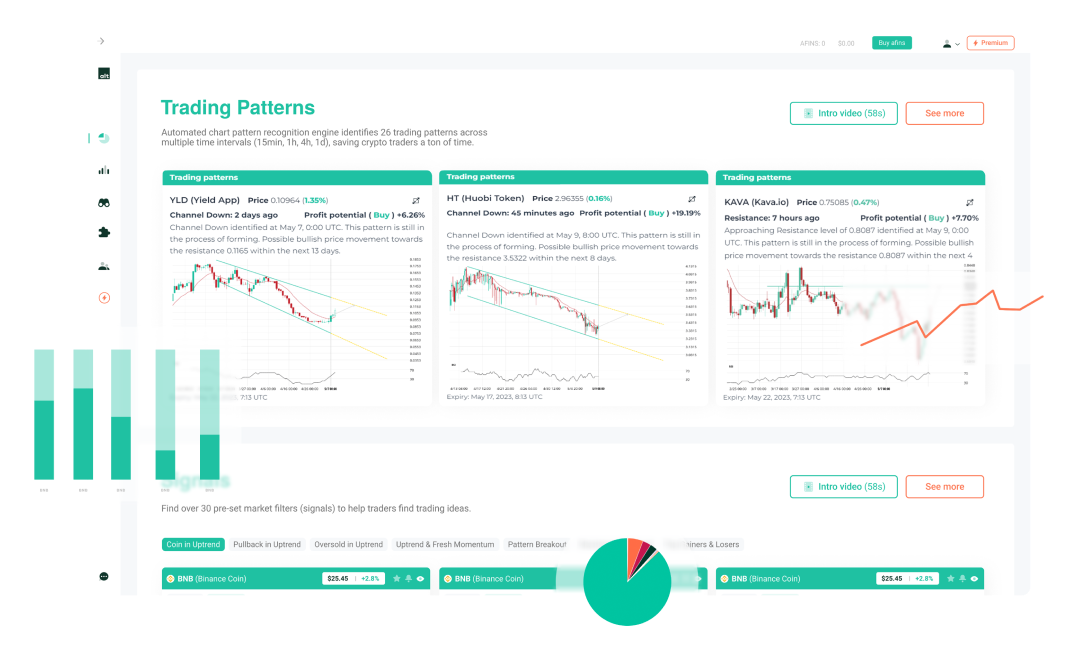
A technical analysis course only becomes useful once you apply it to real, moving charts. After working through the altFINS Crypto Trading Course, the natural next step is the altFINS Crypto Screener, which lets you filter thousands of coins by the exact setups you just learned — strong uptrends, oversold-at-support conditions, moving average crossovers, or AI-detected chart patterns with up to 78% historical success rates. Pairing structured education with a live screener closes the gap between knowing what a setup looks like and actually finding one before everyone else does.
Frequently Asked Questions
Is it worth paying for a crypto trading course in 2026?
Only if the paid course offers something free alternatives don’t — live mentorship, an active community, or content depth you genuinely can’t find elsewhere. The core technical analysis curriculum (candlesticks, trend, indicators, chart patterns, risk management) is well covered by free options like the altFINS Crypto Trading Course and Binance Academy.
How long does it take to learn technical analysis for crypto trading?
Most structured courses take 10–20 hours to complete the core curriculum, but genuine proficiency — recognizing setups quickly and trading them with discipline — typically takes several months of consistent practice on live charts after finishing the course.
Do I need to know coding or math to learn technical analysis?
No. Technical analysis is visual and pattern-based. The indicators themselves involve calculations, but every modern charting platform and screener computes them automatically — you just need to learn how to interpret the output.
What is the best free crypto trading course for beginners?
The altFINS Crypto Trading Course is the strongest free option for learners who want both theory and live application, while Binance Academy and 99Bitcoins are solid choices for absolute beginners who want fundamentals before tackling charts.
Can technical analysis alone make me a profitable trader?
Technical analysis improves your odds on individual trades, but consistent profitability also depends on risk management, position sizing, and trading psychology. A course that teaches only chart patterns without these supporting disciplines leaves a critical gap.
Final Take
The best crypto trading course isn’t necessarily the most expensive one — it’s the one that takes you from theory to practice the fastest. Start with a structured, free curriculum like the altFINS Crypto Trading Course to build the full TA skillset, then use a live screener to put every lesson into practice on real coins before committing meaningful capital. Whichever course you choose, never treat pattern recognition as a substitute for risk management — the two have to be learned together.
This article is for informational purposes only and does not constitute financial advice. Cryptocurrency trading carries significant risk, and technical analysis does not guarantee profitable outcomes. Always practice proper risk management and do your own research before trading with real capital.