Search Knowledge Base by Keyword
Stock Screener for Penny Stocks: How to Find Low-Priced Stocks Safely in 2026
A stock screener for penny stocks filters thousands of shares down to the few that trade under $5 and still meet your rules for liquidity, volume and trend. The right filters matter more than the tool: price under $5, average volume above 500,000 shares, a real exchange listing and a clear technical setup remove most of the junk before you ever open a chart.
This guide is for active traders and newer investors who want to trade low-priced stocks without walking into a pump and dump. It also helps crypto traders who already scan small caps in crypto and want the same discipline in equities.
You will get a ready-made penny stock screen you can copy, a comparison of the screener types available in October 2026, the red flags regulators warn about, and a simple trade plan with entry, stop and exit rules.
Quick answer: To screen for penny stocks, set price under $5, average daily volume above 500,000 shares, relative volume above 1.5 and exchange listing to NYSE, Nasdaq or NYSE American. Then add one technical trigger, such as a breakout above resistance or price above the 50-day moving average. Avoid OTC shares with no recent SEC filings, because thin trading makes them easy to manipulate.
Screen setups, not hype: altFINS already scans 2,000+ coins and 200+ tokenized stocks for breakouts, volume spikes and chart patterns, and full stock coverage is coming to the screener soon. Try the altFINS screener free.
💡 What counts as a penny stock?
Takeaway: in US rules a penny stock trades under $5 a share, but where it trades matters as much as the price.
Under SEC Rule 3a51-1, a penny stock is generally an equity security priced under $5 per share. The rule has exclusions, and shares listed on a national exchange that meets SEC standards are usually not treated as penny stocks for regulatory purposes. In everyday trading talk, though, “penny stock” means any low-priced share, whether it lists on Nasdaq or trades over the counter (OTC).
Most penny stocks are also microcaps. Investor.gov describes microcap stocks as companies with a market value under roughly $250 million to $300 million. Small size, little public information and low liquidity are what make this corner of the market both volatile and risky.
| Type | Where it trades | Disclosure | Typical liquidity |
|---|---|---|---|
| Exchange-listed low-priced stock | Nasdaq, NYSE, NYSE American | Full SEC reporting, listing standards | Medium to high |
| OTC reporting company | OTC markets (higher tiers) | Files with the SEC or a qualified regulator | Low to medium |
| OTC non-reporting company | OTC markets (lowest tiers) | Limited or none | Very low, wide spreads |
Do it in altFINS: the screener lets you filter by price, market cap, dollar volume and relative volume, the same building blocks you need for any low-priced asset screen. See the guide to altFINS preset screener filters.
The penny stock screen you can copy today
Takeaway: price is the first filter, but liquidity and volume do the real safety work.
- Price: between $1 and $5. Shares under $1 risk exchange delisting notices and have even wider spreads.
- Exchange: Nasdaq, NYSE or NYSE American only, if you want SEC reporting and listing standards.
- Average volume (30 day): above 500,000 shares, so you can get in and out without moving the price.
- Relative volume (RVOL): above 1.5, which means today’s volume is at least 50% above normal. Learn how it works in our relative volume (RVOL) guide.
- Trend: price above the 50-day simple moving average (SMA), so you trade with the trend, not against it.
- Trigger: a fresh breakout above resistance or a new 20-day high.
- Float (optional): under 50 million shares for faster movers, with the trade-off of higher volatility.
Run the screen after the close for swing trades, or in the first hour of the session for day trades. Expect a short list. A good screen returns 5 to 20 names, not 300.
Build the habit on a market that never closes. The same price, volume and breakout filters work in the altFINS screener on 2,000+ crypto assets and 200+ tokenized stocks, with alerts when new names qualify. Save your first low-price breakout scan.
Types of penny stock screeners compared
Takeaway: free screeners handle the basics; paid or real-time tools matter only if you day trade.
| Screener type | Good for | Data speed | Watch out for |
|---|---|---|---|
| Free web screeners (Finviz, Yahoo Finance, TradingView free plan) | End-of-day swing screens, price and volume filters | Usually delayed | Limited intraday filters, few saved alerts |
| Broker screeners (Fidelity, Schwab, Webull, Moomoo) | Screening inside the account you trade from | Real-time for account holders | Filters vary by broker; OTC coverage differs |
| Real-time scanners (Trade Ideas, Benzinga Pro, paid TradingView plans) | Day trading momentum and gap scans | Real-time | Monthly cost; easy to overtrade |
| OTC-focused screeners (OTC Markets) | Checking OTC tier, disclosure status and filings | Varies | Not built for technical setups |
| altFINS screener | Technical setups, chart patterns and alerts on crypto and tokenized stocks | Updated through the day | Full stock coverage is coming soon |
Want the full list of free tools? Read our comparison of the best free stock screeners in 2026.
Red flags: how to avoid penny stock traps
Takeaway: if you cannot verify the company, do not trade the chart.
Low prices attract manipulation. The SEC’s microcap fraud spotlight explains that thin public information and low liquidity make it easier for fraudsters to move a stock’s price or volume. The classic scheme is the pump and dump: promoters hype a stock, buyers pile in, and insiders sell into the rally.
| Do | Don’t |
|---|---|
| Check that the company files reports with the SEC on EDGAR | Buy a stock because of an unsolicited text, email or social post |
| Confirm the spread is a few cents, not 10% of the price | Trade OTC shares with no filings and no clear business |
| Look for volume that builds over several days | Chase a one-day spike of 100% or more with no news |
| Read recent filings for dilution, such as new share offerings | Ignore reverse splits and repeated capital raises |
| Risk 0.5% to 1% of your account per trade | Size up because the share price looks “cheap” |
A low share price does not mean a stock is cheap. A $2 stock with 500 million shares is valued at $1 billion. Always look at market cap and dilution, not the price tag.
How to trade penny stocks from a screener
Takeaway: use the screener to find candidates, then let the chart decide entry and exit.
1. Read the chart first
Open the daily chart of every name on your list. Mark the nearest support and resistance levels and check whether price is in an uptrend, a range or a downtrend. Skip anything you cannot read in 30 seconds.
2. Wait for a clean trigger
The best penny stock setups are simple: a breakout above a multi-week range on high relative volume, or a pullback to rising support that holds. Chart patterns such as flags, triangles and double bottoms help you define the level. Our guide to trading patterns covers the main ones.
3. Set the stop before you buy
Place the stop below the breakout level or the last swing low. Because penny stocks move 10% or more in a day, size the position so a stop-out costs no more than 1% of your account.
4. Take profits into strength
Sell part of the position at the next resistance or at a 2:1 reward-to-risk target, and trail the rest under the 10-day or 20-day moving average. Low-priced stocks reverse fast, so do not let a winner turn into a loss.
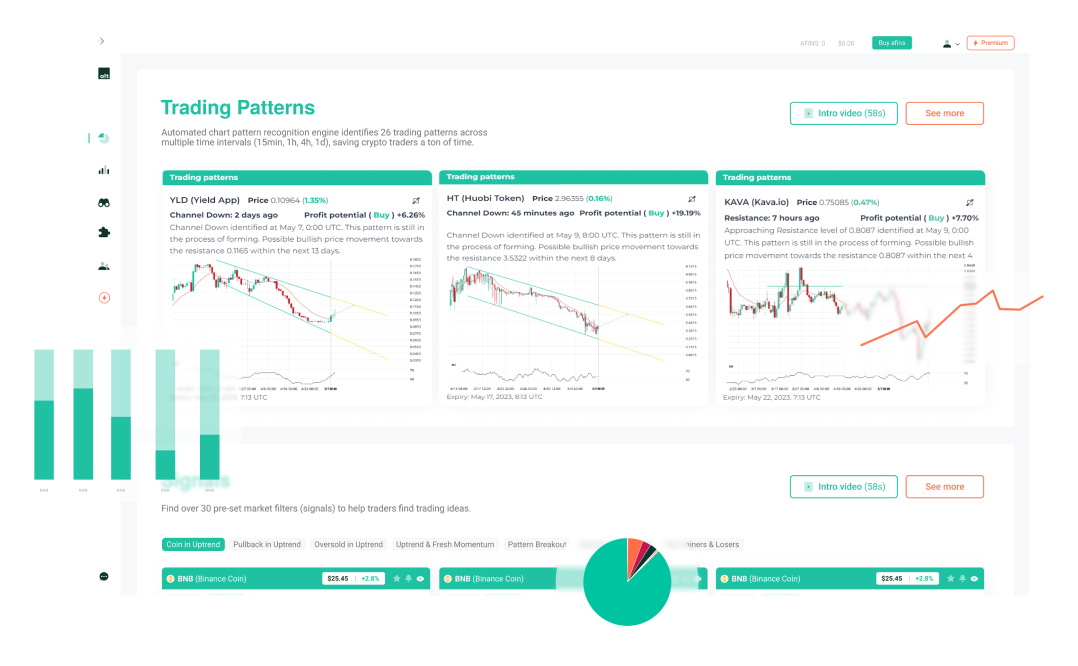
Do it in altFINS: altFINS chart pattern recognition marks triangles, flags, channels and wedges automatically, with breakout levels and targets, so you can practise this exact workflow before stocks go live.
How altFINS helps
Takeaway: altFINS automates the technical part of the screen, so you spend your time on verification and risk.
- Screener with 150+ presets: price, market cap, relative volume, new highs, support and resistance breakouts and moving average filters.
- Automated chart patterns: 26 pattern types detected across timeframes, with breakout direction and targets.
- Signals Summary: a live feed of fresh bullish and bearish signals so you see new setups first.
- Tokenized stocks today: 200+ tokenized equities and ETFs are already in the screener. See the tokenized stocks tutorial.
- Stocks coming soon: full stock coverage is on the way to the altFINS screener.
Frequently asked questions
What is the best stock screener for penny stocks?
For end-of-day swing trading, a free web screener with price, volume and exchange filters is enough. Day traders need a real-time scanner or a broker screener with live data. Whatever you use, the filters matter more than the brand: price under $5, average volume above 500,000 shares, high relative volume and a clear chart trigger.
What filters should I use to find penny stocks?
Start with price between $1 and $5, listing on Nasdaq, NYSE or NYSE American, and average daily volume above 500,000 shares. Add relative volume above 1.5 to find stocks in play, price above the 50-day moving average for trend, and a breakout or new 20-day high as the trigger. Optional: a float under 50 million shares.
Are penny stocks a good investment?
Penny stocks can make large moves, but most are small, volatile companies with weak finances and frequent share dilution. Regulators warn that they are a common target for pump and dump schemes. Treat them as short-term trades with strict stops and small position sizes, not as long-term investments, and only use money you can afford to lose.
Can you find penny stocks on Finviz or TradingView for free?
Yes. Both offer free screeners with a price filter, so you can set price under $5 and add volume and exchange filters. Free versions usually show delayed data and offer fewer alerts and intraday filters than paid plans. That is fine for swing traders who screen after the close, but day traders typically need real-time data.
Why do penny stocks move so much?
Low share prices, small floats and thin order books mean a modest amount of buying or selling can move the price sharply. News, social media attention and short squeezes amplify the effect. The same forces work in reverse, so penny stocks can drop 30% or more in a single session when buyers disappear.
Verdict
A stock screener for penny stocks is only as good as its filters. Combine a price ceiling with strict liquidity, exchange and volume rules, then use the chart for the entry and the stop. Verify every company before you trade it, keep risk per trade small, and walk away from anything that arrives through a hot tip.
Get your screening workflow ready before stocks launch. Practise volume, breakout and chart pattern scans on 2,000+ coins and 200+ tokenized stocks in altFINS today. Start scanning for free or compare altFINS plans.
Disclaimer: This article is for educational purposes only and is not financial or investment advice. Penny stocks, tokenized stocks and cryptocurrencies are highly volatile and risky, and you can lose some or all of your capital. Tool names are listed for information only; altFINS does not receive payment for mentioning them. Do your own research and consider speaking with a licensed financial professional before making investment decisions.