
Search Knowledge Base by Keyword
The Gravestone Doji and Perfect Gravestone Doji Candlestick Patterns
The Gravestone Doji is a bearish reversal candlestick pattern that looks like an inverted “T.” It signals that buyers pushed prices up during the session, but sellers successfully drove them back down to the opening price by the close. This guide covers how to spot it, how to confirm it, and how to scan for it across thousands of coins with altFINS.
TL;DR: Gravestone Doji Pattern Guide. The Gravestone Doji is a bearish reversal candlestick pattern that looks like an inverted “T.” It signals that buyers pushed prices up, but sellers successfully drove them back down to the opening price by the end of the session.
Key characteristics:
- Visual: long upper shadow (wick), little to no lower shadow, and identical open, close, and low prices.
- Context: most effective at the peak of an uptrend or near resistance levels.
- The “Perfect” Gravestone Doji: a specific high-probability setup consisting of two green candles (uptrend), the Doji, and a following red candle (confirmation).
How to trade it:
- Wait for confirmation: do not trade the Doji alone. Wait for the next candle to close below the Doji’s low.
- Volume: high volume during the Doji formation strengthens the bearish signal.
- Confluence: use indicators like RSI (check for overbought conditions) or moving averages to confirm resistance.
- Invalidation: if the next candle closes above the Doji’s high, the bearish signal is void.
Tools for identification:
Use altFINS’s Crypto Screener or Signals Summary with pre-set filters to scan thousands of altcoins for this pattern across multiple timeframes.
What is the Gravestone Doji pattern?
The Gravestone Doji is a significant candlestick pattern in technical analysis, often signaling potential bearish market reversals. This distinctive pattern is characterized by its unique visual trait: a long upper shadow with little to no lower shadow.
This guide provides an in-depth exploration of the Gravestone and Perfect Gravestone Doji patterns, offering traders advanced strategies and techniques for applying these patterns across various trading environments.
Detailed characteristics of the Gravestone Doji pattern
Understanding the Gravestone Doji
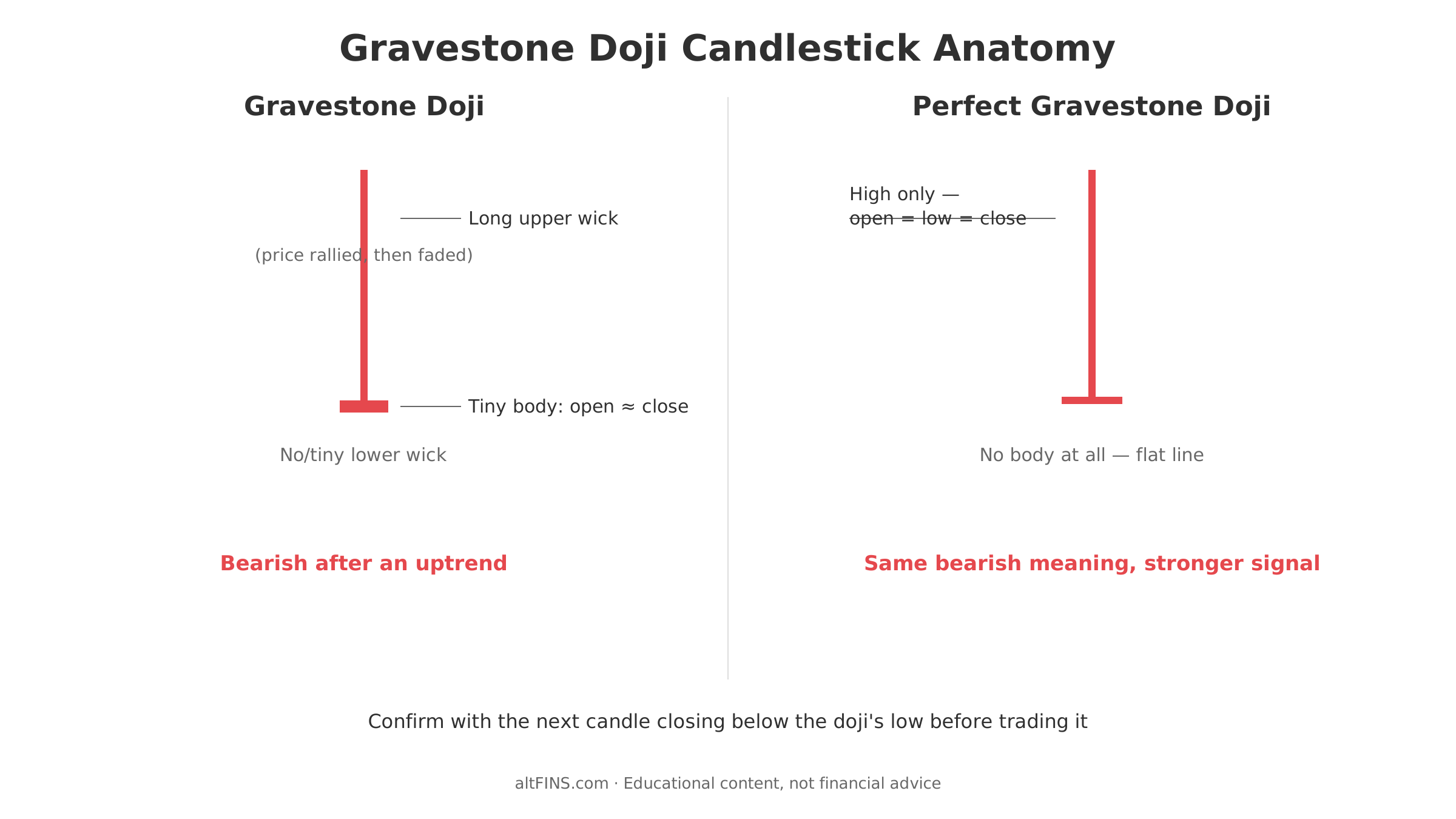
A Gravestone Doji forms when the open, low, and close prices are the same or very close, creating an inverted T-shaped candlestick. This pattern typically emerges at the top of uptrends and represents a struggle between bulls and bears, indicating that buyers initially pushed the price higher, but sellers eventually overwhelmed them, bringing the price back down to its opening level. This often signals a potential reversal to the downside.
The Gravestone Doji can signal a bearish trend reversal. The effectiveness of the Gravestone Doji increases when it appears in the right market context.
Ideally, the Gravestone Doji is preceded by two up (green) candles and followed by a down (red) candle. This is called the Perfect Gravestone Doji pattern.
The long upper wick indicates that after buyers drove the price up, sellers pushed it back down to the opening level. A confirmation with a red down candle in the following session strengthens the signal.
Higher-than-average volume accompanying the Gravestone Doji can further confirm that buyers were exhausted and sellers took control.
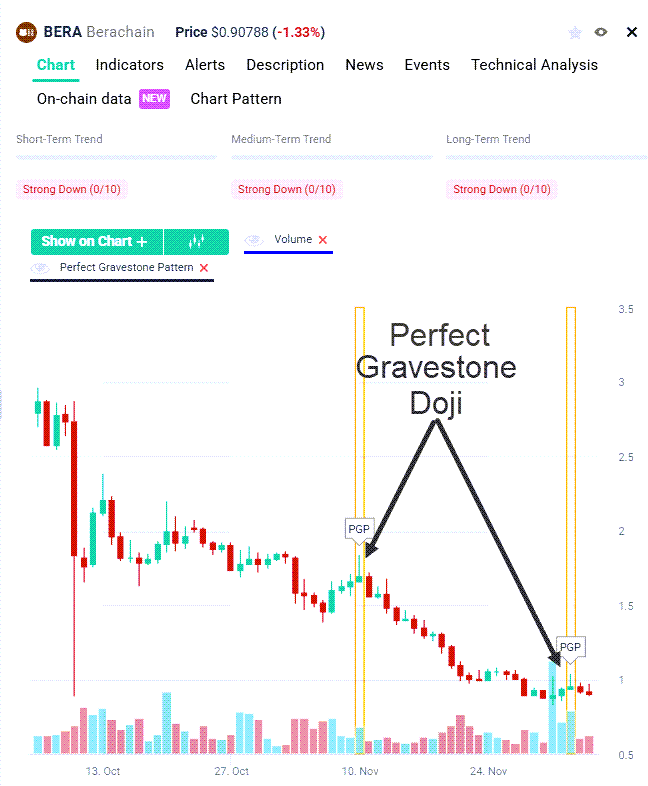
Examples of Gravestone Doji and Perfect Gravestone Doji candlestick patterns
Successful Gravestone Doji occurrences often show initial resistance after the pattern forms, followed by a series of downward movements. It is essential to consider possible retracements before the price trends lower consistently.
In the case of Perfect Gravestone Doji patterns, look for two bullish candles leading into the Doji, followed by bearish candles confirming the reversal.
It also helps to align the signal with the overall price trend. In the example below (BERA), price is already in a strong downtrend across the short, medium, and long term. Trading with the trend, buying in an uptrend and selling in a downtrend, increases traders’ success rates, so it’s a good general rule to follow.
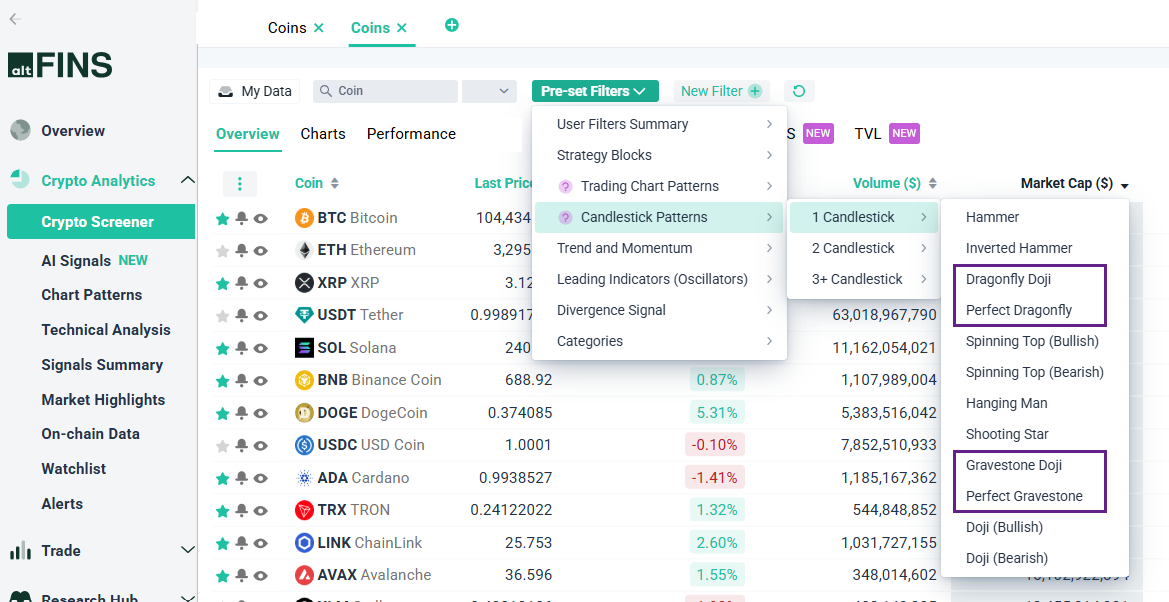
🔍 How to identify Gravestone Doji and Perfect Gravestone Doji patterns on altFINS
altFINS provides a powerful cryptocurrency screening tool that analyzes over 3,000 altcoins using 120 different indicators across multiple timeframes. The platform offers pre-set filters designed to quickly identify popular patterns, such as the Gravestone Doji candlestick pattern.
Using the Crypto Screener
Pre-set filters: select “Candlestick Patterns – 1 Candlestick – Gravestone Doji” on the Crypto Screener to generate results.
Custom filters: create a new filter by selecting “Candlestick Patterns – 1 Candlestick – Gravestone Doji” and choose the desired time interval.
Using Signals Summary
Once you identify a coin with the Gravestone Doji pattern using the Crypto Screener or Signals Summary, proceed to the Chart tab for a more detailed analysis of the findings.
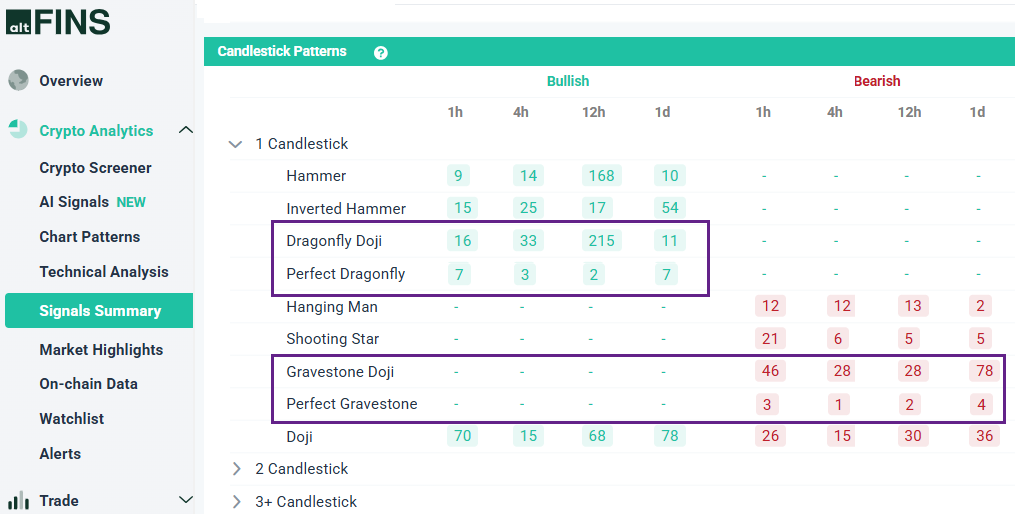
Once the results of the pre-set filter appear in the Crypto Screener, it is essential to analyze Gravestone Doji patterns within the appropriate context.
Analyze the preceding trend
- Uptrend: a Gravestone Doji at the top of an uptrend suggests a potential reversal, indicating that buyers tried to push prices higher but failed.
- Downtrend: if the pattern appears during a downtrend, it might indicate a continuation or short-term consolidation before further decline.
Volume analysis
- High volume: strengthens the bearish signal, showing strong selling pressure.
- Low volume: weakens the reliability of the pattern, indicating indecisiveness rather than strong bearish sentiment.
Confirmation with the next candles
- A bearish confirmation requires follow-up candles closing below the Doji’s low, indicating seller dominance.
- A bullish confirmation (invalidating the pattern) happens if the next candle closes above the Doji’s high.
Variations and similar patterns
Recognizing these variations helps traders make informed decisions and refine their strategies.
| Pattern | Shape | Signal |
|---|---|---|
| Gravestone Doji | Long upper shadow, little to no lower shadow | Bearish, at the top of an uptrend |
| Dragonfly Doji | Long lower shadow, little to no upper shadow | Bullish, at the bottom of a downtrend (the mirror image of the Gravestone Doji) |
| Long-legged Doji | Long upper and lower shadows, tiny body | Indecision, direction unclear until confirmed by the next candle |
Advanced trading strategies
Combining with resistance levels
When a Gravestone Doji forms at a key resistance level, it strengthens the likelihood of a bearish reversal. The confluence of technical indicators provides stronger confirmation than the pattern appearing alone.
Using with trend lines
If a Gravestone Doji appears near critical upward trend lines, it may suggest a potential downward breakout. Traders often look for further bearish confirmation with a close below the trend line.
Tips and tricks for effective use
- Wait for confirmation by observing a red candlestick in the next session to validate the bearish reversal signal and minimize false alarms. Use the Perfect Gravestone Doji setups on the altFINS platform.
- Create candlestick pattern alerts on altFINS so you can act immediately when your preferred setups trigger. Learn how in this guide on setting up alerts.
- Evaluate historical occurrences of the pattern to offer valuable insights into potential outcomes and enhance decision-making.
- Monitor overall market sentiment, since the pattern’s significance may diminish in a strong bullish environment.
- Incorporate technical indicators such as the Relative Strength Index (RSI), where an overbought reading can reinforce the bearish outlook, and moving averages, since a Gravestone Doji appearing near major moving averages can signal resistance and strengthen the likelihood of a reversal.
Frequently asked questions
What does a Gravestone Doji mean?
A Gravestone Doji means buyers pushed price higher during the session but lost control by the close, which fell back to the open. Appearing after an uptrend, it’s an early warning that a bearish reversal may follow, though it needs confirmation from the next candle before traders act on it.
What is a Perfect Gravestone Doji?
A Perfect Gravestone Doji is the highest-probability version of the setup: two green (bullish) candles building the uptrend, the Gravestone Doji itself, and a red (bearish) candle confirming the reversal. It’s rarer than a standalone Gravestone Doji but carries a stronger signal.
Is the Gravestone Doji bullish or bearish?
The Gravestone Doji is bearish when it appears after an uptrend, signaling that buying pressure failed to hold. If it appears during a downtrend, it’s more likely to represent continuation or short-term consolidation rather than a strong directional signal.
How do you confirm a Gravestone Doji before trading it?
Wait for the candle immediately after the Gravestone Doji to close below the Doji’s low, ideally on above-average volume. If the next candle instead closes above the Doji’s high, the bearish signal is invalidated.
What is the difference between a Gravestone Doji and a Dragonfly Doji?
A Gravestone Doji has a long upper shadow and forms after an uptrend, signaling a bearish reversal. A Dragonfly Doji is its mirror image: a long lower shadow that forms after a downtrend, signaling a bullish reversal.
Continue learning on altFINS
- Mastering Candlestick Patterns for Successful Crypto Trading
- Essential Candlestick Patterns for Crypto Traders
- The Dragonfly Doji Candlestick Pattern
- The Inverted Hammer Candlestick Pattern
- The Hammer Candlestick Pattern
- Bullish Engulfing Candlestick Pattern
- The Spinning Top Candlestick Pattern
- The Hanging Man Candlestick Pattern
For a broader primer on candlestick charting itself, see Investopedia’s overview of the most powerful candlestick patterns.
Ready to stop scanning charts by hand? Try the altFINS Crypto Screener and let the AI flag Gravestone Doji and Perfect Gravestone Doji setups across the market for you.
This article is for educational purposes only and is not financial advice. Cryptocurrency trading carries a high level of risk, and past pattern performance does not guarantee future results. Always do your own research and consider your risk tolerance before trading.