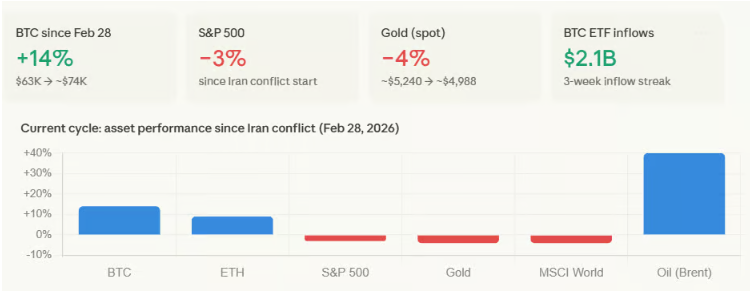
That's a genuinely unusual configuration. Historically, oil shocks and gold have moved together as safe havens; this time BTC is decoupling from gold while oil surges, which is the inverse of what you'd expect.
Prepared with Claude Pro + altFINS MCP (see how)
Historical precedent — the pattern is structural, not coincidental
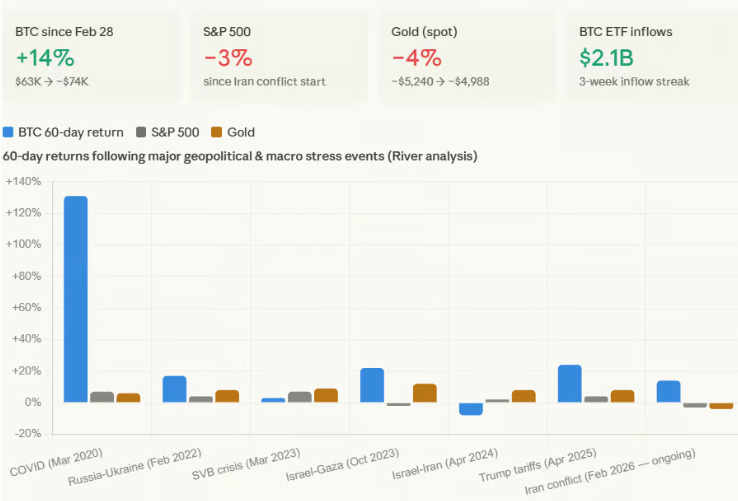
An analysis tracking 60-day returns across seven major geopolitical events shows Bitcoin delivering positive returns in every single instance, averaging approximately 18%, versus roughly 3% for the S&P 500 and 4% for gold. Gold recorded negative 60-day returns twice; the S&P did too; Bitcoin's worst print was a +3% during the carry-trade unwind — still positive.
The one exception to BTC's "safe haven" behavior: the carry trade unwind event, which was a liquidity shock rather than a geopolitical one — which may explain why Bitcoin behaved more like a risk asset than a safe haven in that instance. This is an important nuance: BTC's outperformance is specific to geopolitical and monetary system stress events, not pure liquidity crunches.
Why BTC is outperforming this time specifically
Three structural factors are converging:
Crypto's 24/7 structure is increasingly an edge for the asset class. When the Iran conflict escalated over the weekend, crypto-native markets were the only venue open for global risk trading — a structural advantage that traditional markets cannot replicate.
Bernstein attributed the resilience to a shift in ownership toward institutional investors via spot ETFs and Strategy. Long-term holders and institutional capital are strengthening Bitcoin's capital base even as retail investors sell.
Macro strategist Mark Connors argues that a prolonged conflict could boost Bitcoin as war-related deficit spending expands liquidity and weakens the dollar over time — and that even a stagflationary environment could support BTC, as policymakers would likely prioritize financial stability and government financing over fighting inflation alone.
BTC (Bitcoin) - Technical Analysis
BTC Technical Analysis: Price is trading in a Rising Wedge pattern, within a large Channel Down pattern. There are signs of trend reversal. Price held up surprisingly well during this geo-political turbulence.
It's gotten rejected at $75K resistance and is pulling back to $70K. Let's see if that level holds up, which would switch it from resistance to support. If it breaks above $75K, it could revisit $80K next. That's a horizontal resistance as well as Channel trendline.
The key risk that overrides all of this
The single most important transmission mechanism from the war to Bitcoin's price is oil. If Brent crude sustains above $80 per barrel, the re-inflation narrative hardens. Rate cut expectations get pushed out, and elevated oil prices make even June cuts unlikely.
The June 2025 analog is instructive: after the June 2025 U.S. strike on Iran, Bitcoin temporarily fell below $100,000 before rallying to $123,000 within weeks.
So the pattern of "initial dip, then sustained rally" is consistent — but requires the conflict not to permanently entrench stagflation.
Academic evidence — the safe-haven debate
A recent study found that Bitcoin and the Swiss Franc function as safe havens against geopolitical risk during market crashes, while Gold and Treasury bonds do not — with the protective aspects of Bitcoin mainly showing through large stock market moves rather than moderate variations. This is consistent with what we're seeing now: BTC outperforms decisively in extreme geopolitical shock, less so in milder uncertainty.
However, over longer horizons the safe-haven effect weakens. Investors should treat crypto as a complementary hedge rather than a replacement for gold or stable currencies, with short-term positioning benefiting from Bitcoin's resilience immediately after shocks.
Bottom line for near-term positioning
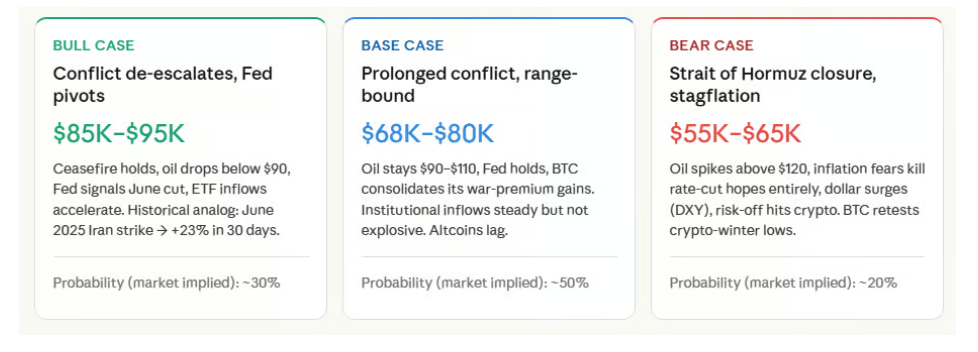
The base case ($68K–$80K range) reflects a prolonged conflict at current intensity: BTC holds its war premium but doesn't break out.
The bull case hinges on de-escalation + Fed pivot.
The existential bear case is a Strait of Hormuz closure keeping oil above $120 for 30+ days, which would force a stagflation repricing across all risk assets.
Given BTC is still 47% off its ATH, the most important lens is whether this conflict marks the end of the crypto winter's bottoming process — and historically, the answer after geopolitical shocks has been yes, over a 60-day window analysis.
Building an trading algo, app, AI Agent, or dashboard?
Take advantage of altFINS’ API + MCP server to accelerate your development, even with simple vibe coding with Claude integration. You don’t have to be a programmer anymore to create trading apps and algos.
altFINS’ API is the only API that includes 150+ indicators and 130+ signal types already pre-calculated so you don’t waste time or credits when developing, backtesting, etc.
Learn more here.